All species › Passerines › Ground babblers › Scaly-Breasted Illadopsis
Scaly-Breasted Illadopsis | Illadopsis albipectus
Schubborstlijstertimalia | Tordina Pechiescamada
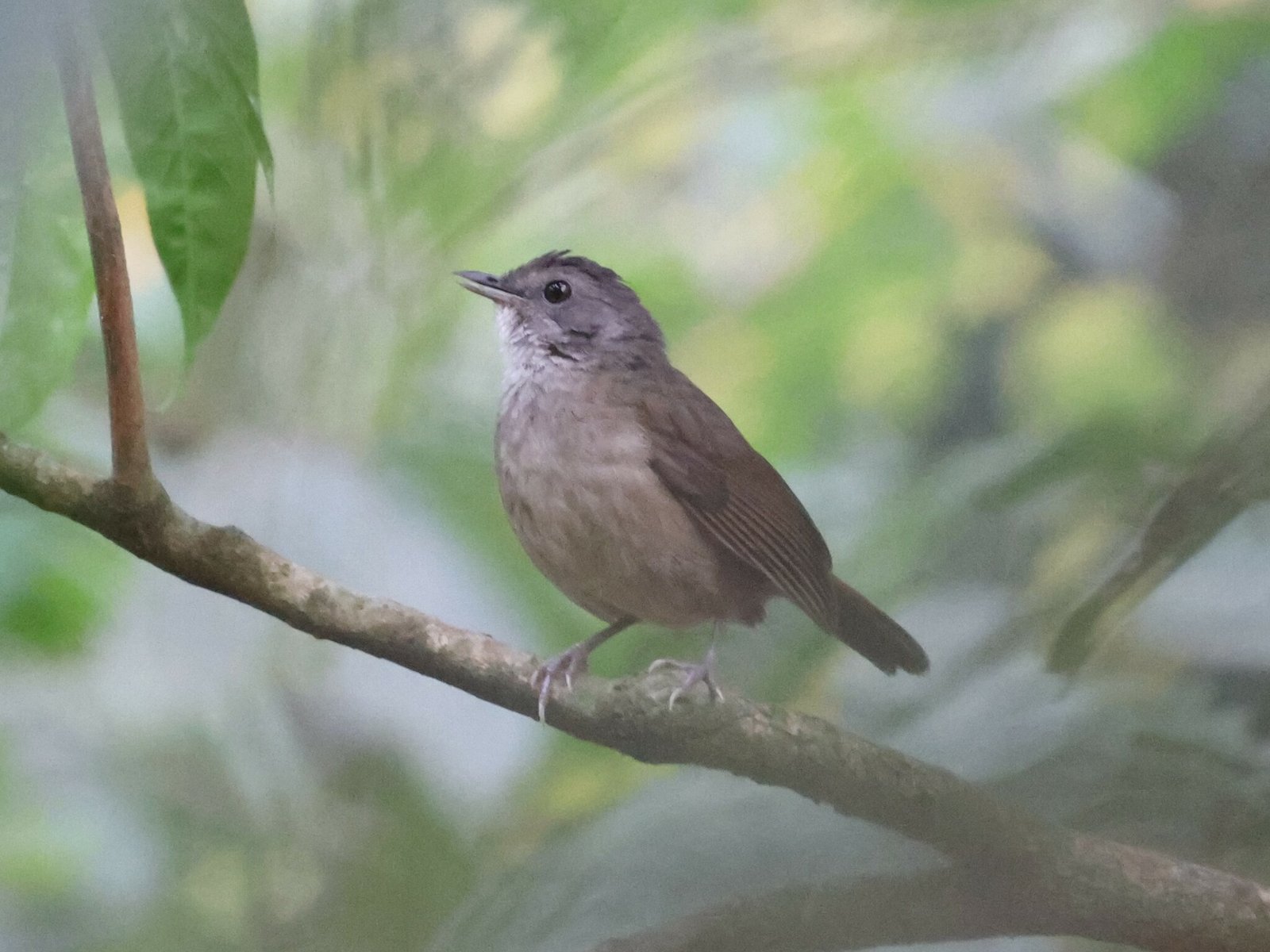
The Scaly-Breasted Illadopsis is a stocky, drably marked babbler of rainforest undergrowth. Within the region it is known only from the forests of north-western Angola, where it is reported much less often than Brown Illadopsis; the short, rising whistled series is its best feature.
Voice
For an illadopsis the song is remarkably constant: one or two short, hard introductory ticks followed by three or four clear whistles rising in steps, tek-tek fuu-fee-fee-fii. When alarmed it gives a dry, rasping scold and hard chek calls; pairs keep in contact with soft, squeaky notes.
Recording: isaac kilusu — CC BY-NC-SA 4.0 · converted to mono · xeno-canto
Identification
14–15 cm. A fairly robust, short-tailed babbler with a stout bill. The upperparts are olive-brown, the crown and sides of the head greyer. The throat and belly centre are clean white. The breast is pale grey to grey-brown, with fine dark feather edges forming a scaly pattern that can only be seen in a good view. The flanks are olive-brown. The bill is dark above and pale below, the legs pale pink. The sexes are alike; juveniles are warmer brown, with less distinct breast markings.
Confusion species
Brown Illadopsis Illadopsis fulvescens in the same forests has a pale grey rather than white throat, a uniform cinnamon-brown breast without scaling and warmer brown upperparts; its song consists of separate, monotone whistles rather than a short rising series. Pale-Olive Greenbul Phyllastrephus fulviventris is slimmer, longer-tailed and more olive, with tawny underparts, and forages higher.
Habitat
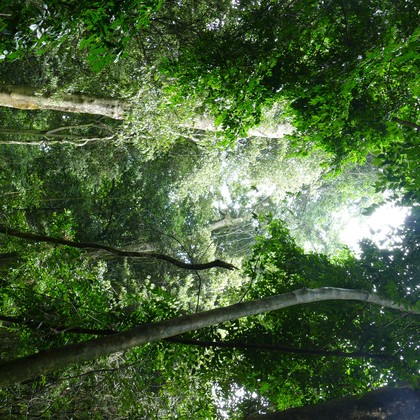
Dense undergrowth of moist lowland rainforest, gallery forest and transitional forest, especially where tangles and lianas reach the ground; also older secondary forest and shade coffee. It lives in pairs or family groups just above or on the forest floor, searching dead leaves and twigs for insects and other small invertebrates.
Where the bird is most at home, classified by the vegetation units of southern Africa.

Range and movements
Within the region only in north-western Angola: the forests of Uíge and Cuanza Norte (including around Quiculungo and Quibaxe) and south along the escarpment to Cuanza Sul (Kumbira). Not known from Zambia. Beyond the region from the Central African Republic and South Sudan south through eastern DR Congo to Uganda, western Kenya and north-western Tanzania.
How and when to look
All year. Listen at dawn in the Angolan escarpment forests for the short, rising whistled series; it is far more regular than the song of Brown Illadopsis. Wait at a spot with a view of the forest floor and check the white throat and grey, scaly breast when the bird comes briefly onto a low branch.
Conservation status
Not threatened; fairly common in its East African core range. In Angola scarce and confined to the remaining forest fragments of the escarpment and the north-west, where logging and burning of forest edges reduce its habitat.
Scientific name
Illadopsis albipectus | (Reichenow, 1888)
Reichenow described the species in 1888 as Turdinus albipectus; because it was later moved to another genus, the author and year stand in brackets. The genus Illadopsis was introduced in 1860 by Heine. Illadopsis combines the Greek illas, genitive illados, 'thrush', with opsis, 'appearance' — for the thrush-like look of these forest birds. albipectus is Latin for 'white-breasted', from albus, 'white', and pectus, 'breast'. The specimen the first description was based on came from Boyoma (Stanley) Falls near Kisangani, DR Congo.