All species › Passerines › Ground babblers › Brown Illadopsis
Brown Illadopsis | Illadopsis fulvescens
Bruine lijstertimalia | Tordina Parda
The Brown Illadopsis is a small, extremely unobtrusive inhabitant of lowland rainforest undergrowth. Within the region it occurs only in the forests of north-western Angola; it is nearly always heard first, as a series of clear, monotone whistles from the dark tangle.

Voice
The song consists of clear, pure whistles, each separate and with short pauses, often on one pitch: fuuuu … fuuuu … fiiii. It varies a good deal from bird to bird. The mate sometimes joins in with a dry, hoarse scolding, chrrr-chrrr; when alarmed it gives a sharp, reproachful chek.
Recording: Budongo Conservation Field Station — CC BY-NC-SA 4.0 · converted to mono · xeno-canto
Identification
14–15 cm. A compact, short-tailed babbler with a fairly long, straight bill. The upperparts are warm dark brown, the crown hardly darker, the sides of the head slightly greyer. The throat is paler, pale greyish-brown to dirty white, merging without a sharp border into the uniform tawny to cinnamon-brown breast and flanks; the centre of the belly is slightly paler. There is no scaling on the breast. The bill is dark with a paler lower mandible, the legs strikingly pale pink. The sexes are alike; juveniles are more rufous in tone.
Confusion species
Scaly-Breasted Illadopsis Illadopsis albipectus lives in the same forests and is almost the same size, but has a white throat and belly centre, a pale grey breast with fine dark scaling and more olive upperparts; in the field the song is the best distinction. Pale-Olive Greenbul Phyllastrephus fulviventris is slimmer and longer-tailed, more olive and forages higher in the tangle. Brown-Chested Alethe Chamaetylas poliocephala is larger and longer-tailed, with a grey head, a white supercilium and a white throat.
Habitat
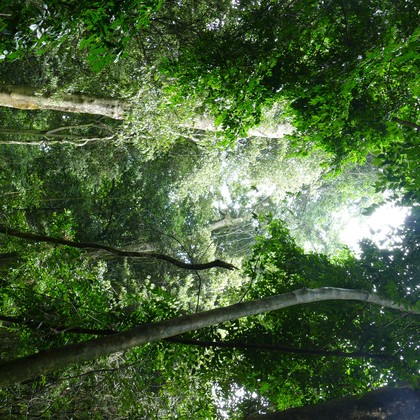
Dense undergrowth of moist lowland rainforest and gallery forest, also older secondary forest, shade-coffee plantations and the forested slopes of the Angolan escarpment. It lives in pairs or small family groups on and just above the forest floor, searching the leaf litter and among lianas for insects, spiders and other small invertebrates.
Where the bird is most at home, classified by the vegetation units of southern Africa.

Range and movements
Within the region only in north-western Angola: the forests of Cabinda, Uíge, Cuanza Norte and Malanje, south along the escarpment to Cuanza Sul (including Kumbira), and in the north-east in the gallery forests around Dundo in Lunda Norte. Not known from Zambia. Beyond the region widespread in the West and Central African rainforest belt, from Senegal east to DR Congo, Uganda, western Kenya and north-western Tanzania.
- Resident
- dark = core range, pale = thinly spread
How and when to look
All year. Best in the early morning, when the birds sing most, in the escarpment forests at Kumbira or the forests around Uíge. Stand quietly by a dense patch of undergrowth where the whistles come from and wait: the bird often works its way closer while foraging and may sit briefly on a low branch. Check the pink legs and the unmarked breast.
Conservation status
Not threatened; fairly common in suitable forest, but in Angola strongly dependent on the remaining escarpment and rainforest fragments. Logging, the replacement of shade coffee by open farmland and burning of forest edges shrink its habitat locally.
Scientific name
Illadopsis fulvescens | (Cassin, 1859)
Cassin described the species in 1859 as Turdirostris fulvescens; because it was later moved to another genus, the author and year stand in brackets. The genus Illadopsis was introduced in 1860 by Heine. Illadopsis combines the Greek illas, genitive illados, 'thrush', with opsis, 'appearance' — for the thrush-like look of these forest birds. fulvescens is Latin for 'tawny, becoming tawny', from fulvus — for the warm brown plumage. The specimen the first description was based on came from Cama River, Gabon.