All species › Turacos › Turacos › Schalow's Turaco
Schalow's Turaco | Tauraco schalowi
Schalows toerako | Turaco de Schalow
Schalow's Turaco is a green turaco with the longest, most pointed crest of its group: an erect green plume tipped white. It is the turaco of the riverine forest along the Zambezi at Victoria Falls.

Voice
A deep, hoarse, barking kow-kow-kow-kow, swelling and fading again, similar to the call of Knysna Turaco. Pairs and neighbours answer one another.
Recording: Tristan Spurway — CC BY-NC-SA 4.0 · converted to mono · xeno-canto
Identification
About 40 to 42 cm, nearly half of it tail. Head, neck and breast are grass-green; the very long, pointed crest is green with a broad white edge at the tips and often flops slightly backwards. A white line runs above and below the eye, with a small black spot in front; eye-ring and bill are red. Back, wings and tail are glossy blue-violet. The primaries are crimson and flash in flight. Sexes alike. It runs nimbly along branches and glides from tree to tree.
Confusion species
Livingstone's Turaco (Tauraco livingstonii) of eastern Zimbabwe, Mozambique and southern Malawi is almost identical, but has a slightly shorter crest and a greener, less violet tail; the two replace each other geographically. Knysna Turaco (Tauraco corythaix) has a shorter, rounder crest. Purple-Crested Turaco (Gallirex porphyreolophus) has a violet crest without white.
Habitat
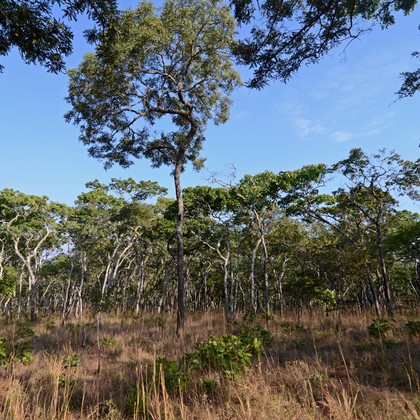
Riverine and gallery forest, dense thickets and moist miombo, wooded ravines and slope forest. It eats mainly fruit, also leaves, buds and flowers.
Where the bird is most at home, classified by the vegetation units of southern Africa.

Range and movements
Within the region in Angola, most of Zambia, northern Malawi, north-western Zimbabwe around Victoria Falls and the Zambezi, the Zambezi Region of Namibia and marginally the far north-east of Botswana near Kasane. Beyond the region in south-eastern DR Congo, south-western Tanzania and south-western Kenya. The boundary with Livingstone's Turaco in Malawi and Mozambique is not sharp.
- Resident
- Summer visitor (c. Oct–Mar)
- Winter visitor (c. Apr–Sep)
- Passage (Mar–Apr, Oct–Nov)
- dark = core range, pale = thinly spread
How and when to look
The rainforest at Victoria Falls, on both the Zimbabwean and Zambian sides, is the classic site; also the riverine forest along the Zambezi at Katima Mulilo. Listen for the barking chorus and look for the running green shape with its striking pointed crest.
Conservation status
Not threatened and fairly common in suitable habitat. It depends on riverine and dense forest and is declining locally through clearing and fire.
Scientific name
Tauraco schalowi | (Reichenow, 1891)
Reichenow described the species in 1891 as Corythaix schalowi; because it was later moved to another genus, the author and year stand in brackets. The genus Tauraco was introduced in 1779 by Kluk. Tauraco is a Latinised form of 'touraco', a name that imitates the bird's call and was already in use among European travellers in West Africa in the eighteenth century. schalowi honours the German banker and ornithologist Herman Schalow (1852–1925). The specimen the first description was based on came from Novo Redondo (Sumbe), Angola.