All species › Turacos › Turacos › Ross's Turaco
Ross's Turaco | Tauraco rossae
Lady Ross' toerako | Turaco de Ross
Ross's Turaco is a glossy violet-black turaco with a shaggy crimson crest and a bright yellow bill that extends as a shield onto the forehead. In flight the wings show a large crimson patch.

Voice
A loud, hoarse, cackling kaw-kaw-kaw-kaw, accelerating and passing into a rolling growl; groups often call in chorus. Also a deep, growling grrrow.
Recording: Jonathan Onongo — CC BY-NC-SA 4.0 · converted to mono · xeno-canto
Identification
About 50 to 54 cm, with a long tail. The whole plumage is deep violet-blue to almost black with a strong gloss. Bill and frontal shield are bright yellow, as is the bare skin around the eye. On the crown sits a dense, shaggy crest of crimson feathers. The primaries are crimson with a dark border and form a striking red window in flight. Sexes alike; juveniles are duller with a darker bill. It lives in pairs or noisy family groups.
Confusion species
No other dark turaco with a yellow frontal shield occurs in the region. Great Blue Turaco (Corythaeola cristata) also has a yellow bill, but is much larger, turquoise-blue with a black crest and no red in the wing. The green turacos are green with a green crest.
Habitat
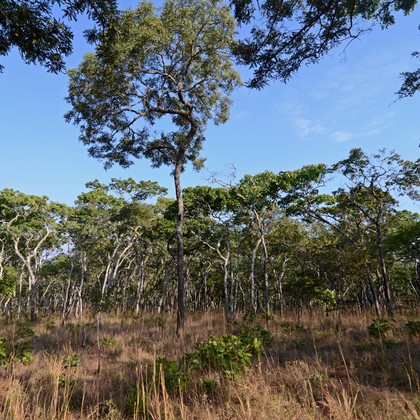
Riverine and gallery forest along rivers, dense thickets in miombo, forest edges and swamp forest, also gardens and villages with fruit trees. It eats mainly fruit, also leaves and flowers.
Where the bird is most at home, classified by the vegetation units of southern Africa.

Range and movements
Within the region in northern, central and eastern Angola and in northern and north-western Zambia, south to about Lake Bangweulu and the upper Zambezi. Beyond the region from Cameroon and the Central African Republic through DR Congo to Uganda, western Kenya, Rwanda, Burundi and western Tanzania.
- Resident
- dark = core range, pale = thinly spread
How and when to look
In Zambia readily found in the gallery forest of Kasanka and around Mwinilunga, and in Angola along the rivers of the north and east. The cackling chorus gives the group away; then look for the red wing window as the birds glide from tree to tree.
Conservation status
Not threatened and fairly common over most of its range. Locally hunted for its feathers, which are used in traditional dress, and affected by the clearing of riverine forest.
Scientific name
Tauraco rossae | (Gould, 1852)
Gould described the species in 1852 as Musophaga Rossae; because it was later moved to another genus, the author and year stand in brackets. The genus Tauraco was introduced in 1779 by Kluk. Tauraco is a Latinised form of 'touraco', a name that imitates the bird's call and was already in use among European travellers in West Africa in the eighteenth century. rossae honours Lady Eliza Ross, wife of Sir Patrick Ross, Governor of St Helena (1846–1850); she kept African birds there and supplied John Gould with feathers and a drawing of this turaco. The specimen the first description was based on came from Angola.