All species › Passerines › Reed warblers › Sedge Warbler
Sedge Warbler | Acrocephalus schoenobaenus
Rietzanger | Carricerín Común
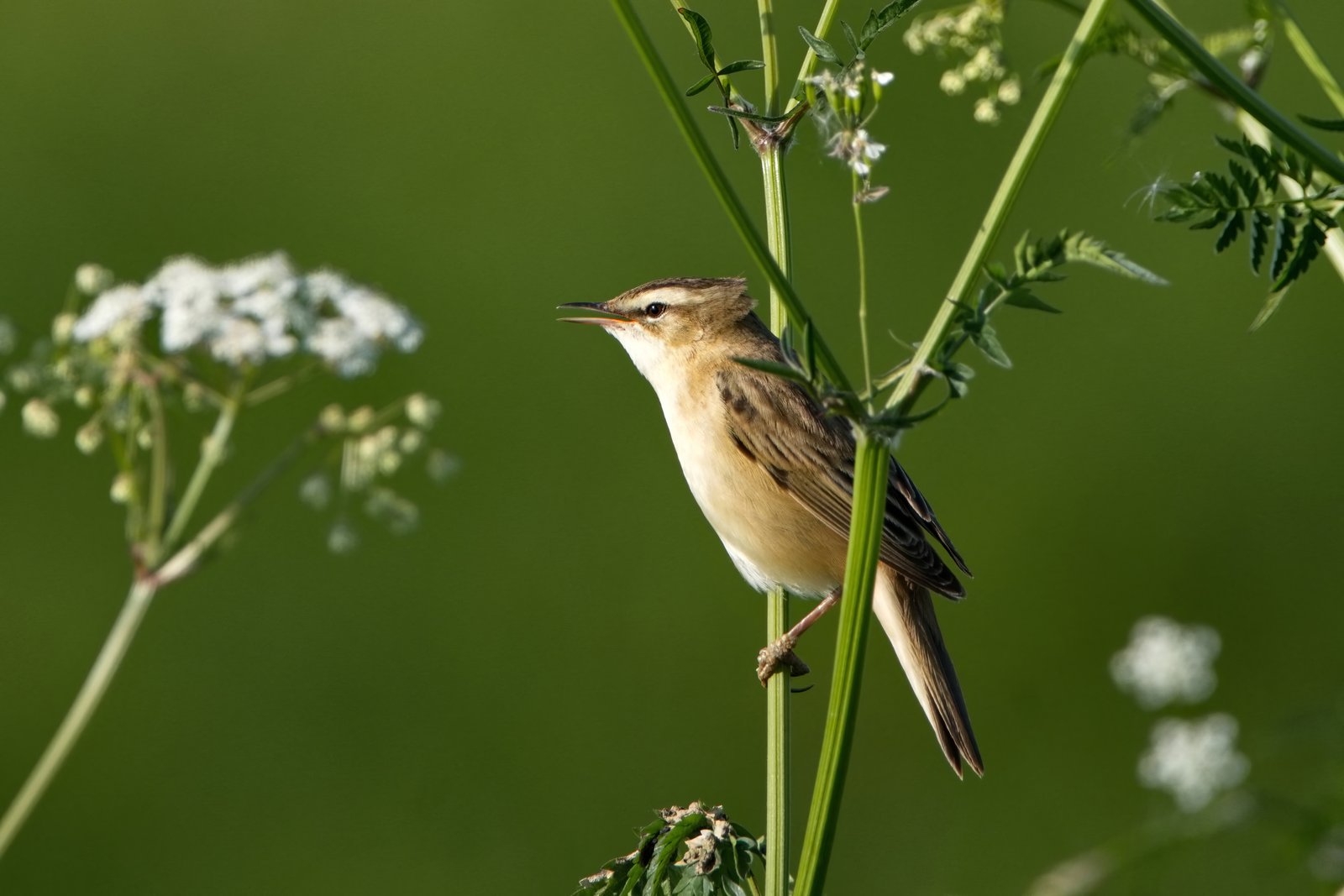
The Sedge Warbler is a Palearctic migrant with a streaked back and a striking, broad creamy supercilium, which winters from November to April in marshes and rank growth in the north and east of the region. Especially in February and March it sings its fast, varied song from the reeds before departure.
Voice
The song is fast, loud and very varied: a medley of grating and scratchy notes, clear whistles, trills and mimicry, with sudden accelerations, often punctuated by a short song flight upwards. The call is a dry tsek, with a rattling chrrr when alarmed.
Recording: Fernand Deroussen — CC BY-NC 4.0 · shortened to the first 60 s, mono · xeno-canto
Identification
12–13 cm, with a flat head and a pointed, rather short bill. The crown is dark brown and finely streaked, bordered by a broad, long, creamy-white supercilium above a dark eye-stripe. The mantle is warm grey-brown with dark streaks, the rump unstreaked rufous-brown, which is obvious mainly as the bird flies off. The underparts are dirty white with warm buff flanks and breast. The tail is rounded and dark brown; the legs are grey-brown. The sexes are alike; first-year birds have a paler central crown stripe and sometimes a finely spotted breast. It often keeps low in the vegetation and flies short and low to the next cover.
Confusion species
Common Reed Warbler Acrocephalus scirpaceus and Marsh Warbler Acrocephalus palustris have an unstreaked back and only a faint supercilium. Little Rush Warbler Bradypterus baboecala is dark warm brown, with an unstreaked back, a finely spotted throat and a broad, rounded tail, and sings an accelerating series of ticks with wing-clapping. Levaillant's Cisticola Cisticola tinniens has a rufous crown and black streaks on a paler back, but no supercilium, and a longer, often cocked tail. Moustached Grass Warbler Melocichla mentalis is larger, with a white throat and a dark malar stripe, and lives in rank grassland.
Habitat
Reedbeds, rushes and sedge beds, rank marginal vegetation along rivers, dams and vleis, and also tall grass and rank growth some distance from water. It forages low in the vegetation, often on aphids and midges, and fattens visibly before departure.
Where the bird is most at home, classified by the vegetation units of southern Africa.

Range and movements
Within the region mainly in the north and east: Angola, Zambia, Malawi, Mozambique, Zimbabwe, northern Botswana (Okavango and Chobe), north-eastern Namibia, and in South Africa mainly in Limpopo, Mpumalanga, Gauteng, North West, KwaZulu-Natal and the Free State; scarce in the Eastern Cape and Eswatini, rare further south-west. It breeds in Europe and western and central Asia and winters in Africa south of the Sahara.
- Resident
- Summer visitor (c. Oct–Mar)
- Passage (Mar–Apr, Oct–Nov)
- dark = core range, pale = thinly spread
How and when to look
From November to April, best in February–March, when birds sing before moving north. Search reedbeds and rank growth along dams and rivers, for example on the Nyl River floodplain at Nylsvley, at Marievale in Gauteng or in the Okavango Panhandle, and look for the broad creamy supercilium when the bird briefly appears on a reed stem.
Conservation status
Not threatened, with a large breeding population in Europe and Asia. Numbers fluctuate strongly with rainfall in the African wintering and staging areas; the loss of wetlands to drainage plays a local role in the wintering range.
Scientific name
Acrocephalus schoenobaenus | (Linnaeus, 1758)
Linnaeus described the species in 1758 as Motacilla Schoenobaenus; because it was later moved to another genus, the author and year stand in brackets. The genus Acrocephalus was introduced in 1811 by Naumann & Naumann. Acrocephalus is Greek, from akros 'topmost, pointed' and kephalē 'head'; the Naumanns, who introduced the genus, called these birds Spitzkopf 'pointed head', so they read akros as 'pointed'. schoenobaenus is Greek, from skhoinos, 'reed', and bainō, 'to tread'; it translates the old Swedish name Sävstigare. The specimen the first description was based on came from southern Sweden.