All species › Passerines › Chats and flycatchers › Northern Wheatear
Northern Wheatear | Oenanthe oenanthe
Tapuit | Collalba Gris
The Northern Wheatear is a Palearctic migrant that winters in Africa north of the equator and reaches southern Africa only exceptionally. A sandy-brown wheatear with a white rump and a black T in the tail on bare ground therefore always deserves a second look. Many claims in the region turn out on closer inspection to be young Capped Wheatears.
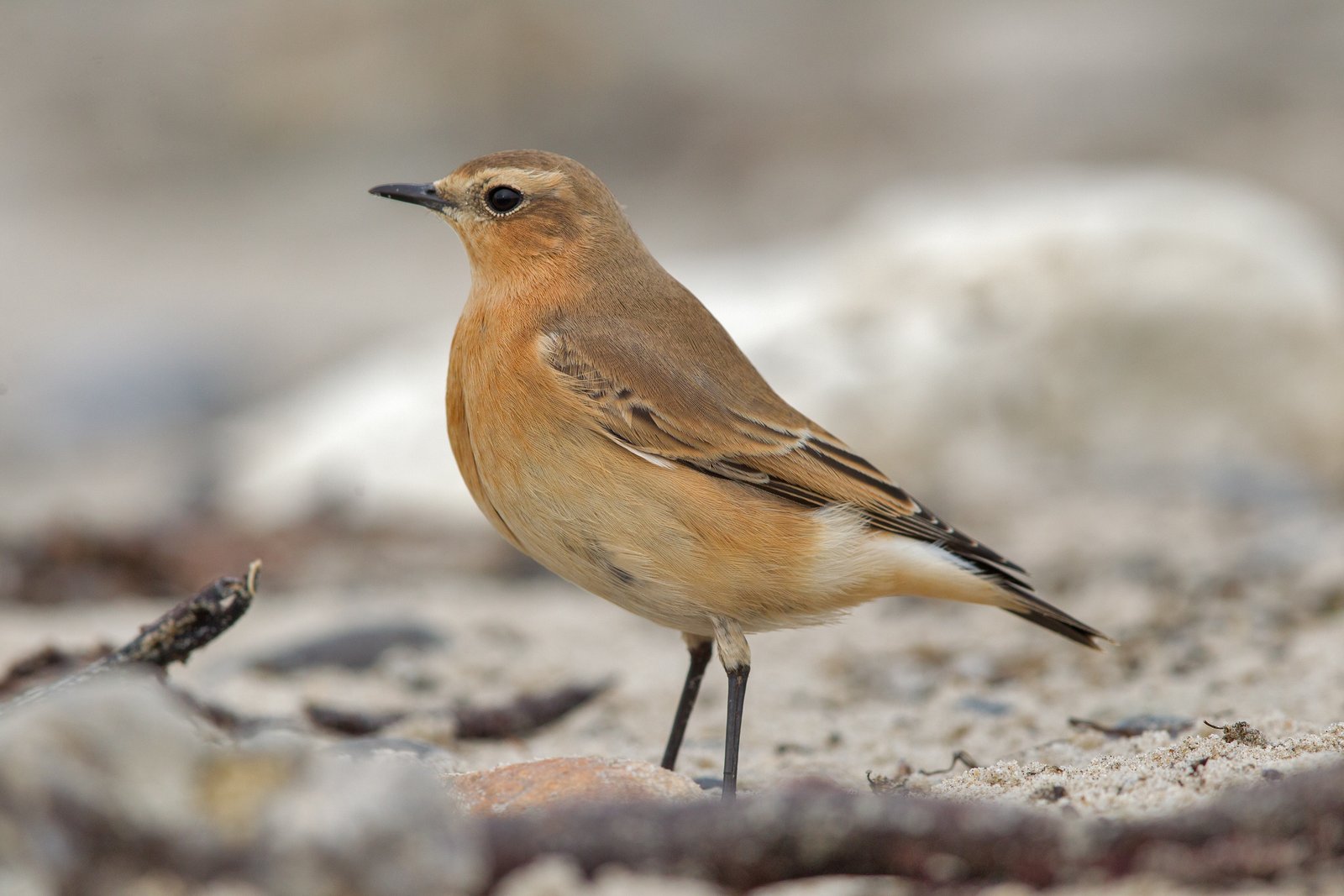
Click a thumbnail to switch the photo above.
Voice
Mostly silent in the wintering area. Calls a hard chack, often combined with a whistled weet: weet-chack-chack. Song is rarely heard in Africa: a short, scratchy, warbling phrase.
Recording: Stanislas Wroza — CC BY-NC-SA 4.0 · converted to mono · xeno-canto
Identification
A slim wheatear of 14 to 16 cm. In non-breeding plumage, as seen in Africa, the upperparts are sandy greyish-brown and the underparts warm pale buff, with a pale supercilium and dark wings with pale fringes. The rump and tail base are pure white; the black terminal band and black central feathers together form an inverted T. Males show traces of breeding plumage as early as February and March: a blue-grey back, a black eye mask and black wings. It stands upright, bobs its tail and runs over the ground in short dashes.
Confusion species
Capped Wheatear (Oenanthe pileata) is larger and longer-legged; adults have a black cap and a broad black breast band, and juveniles are finely spotted pale buff on the upperparts and show a faint dark breast band. The tail pattern is almost the same in both, so head colour, spotted upperparts and structure are decisive. Buff-Streaked Chat (Campicoloides bifasciatus) has a streaked back and no white rump. Whinchat (Saxicola rubetra) is smaller and streaked, with a white supercilium and white tail-side bases, and perches on stems rather than on the ground.
Habitat
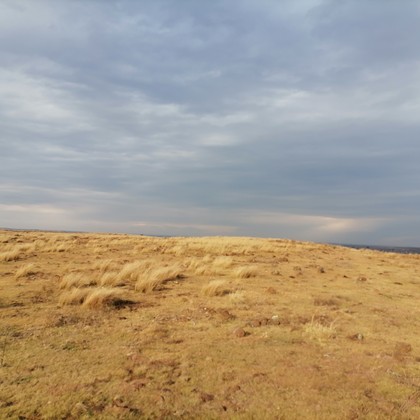
Open, dry ground with short or burnt vegetation: short grassland, bare fields, fallow land, airfields and the edges of pans. Forages on the ground for beetles, ants and other insects, which it catches after a short dash.
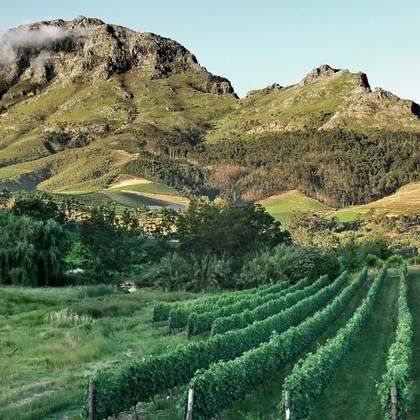
Where the bird is most at home, classified by the vegetation units of southern Africa.
Range and movements
Within the region a rare visitor, mainly in the north: a few records a year in Zambia and Malawi and occasional ones in northern Botswana, Zimbabwe and Namibia; in South Africa and Mozambique a vagrant with few accepted records. Breeds across Europe, Asia, extreme north-western North America and Greenland, and winters almost entirely in the savanna belt of Africa south of the Sahara, south to Tanzania.
How and when to look
Check every pale wheatear on bare or burnt ground in the north of the region, especially from October to March. Look at the head: a Northern Wheatear lacks the black cap and breast band of the adult Capped Wheatear and the spotted upperparts of the juvenile. Photographs of upper- and underparts and of the tail are needed for a record to be accepted by a rarities committee.
Conservation status
Not threatened. Numbers are falling in parts of Europe through the loss of short-grazed grassland and agricultural intensification. For southern Africa the species, as an exceptional visitor, has no conservation significance.
Scientific name
Oenanthe oenanthe | (Linnaeus, 1758)
Linnaeus described the species in 1758 as Motacilla oenanthe; because it was later moved to another genus, the author and year stand in brackets. The genus Oenanthe was introduced in 1816 by Vieillot. Oenanthe was used by Aristotle for a bird that can no longer be identified; the word comes from the Greek oinos, oinoē 'wine, vine' and anthos 'flower, bloom'. The specific name repeats the genus name. The specimen the first description was based on came from Sweden.