All species › Passerines › Bulbuls › Shelley's Greenbul
Shelley's Greenbul | Arizelocichla masukuensis
Shelleys buulbuul | Bulbul de las Misuku
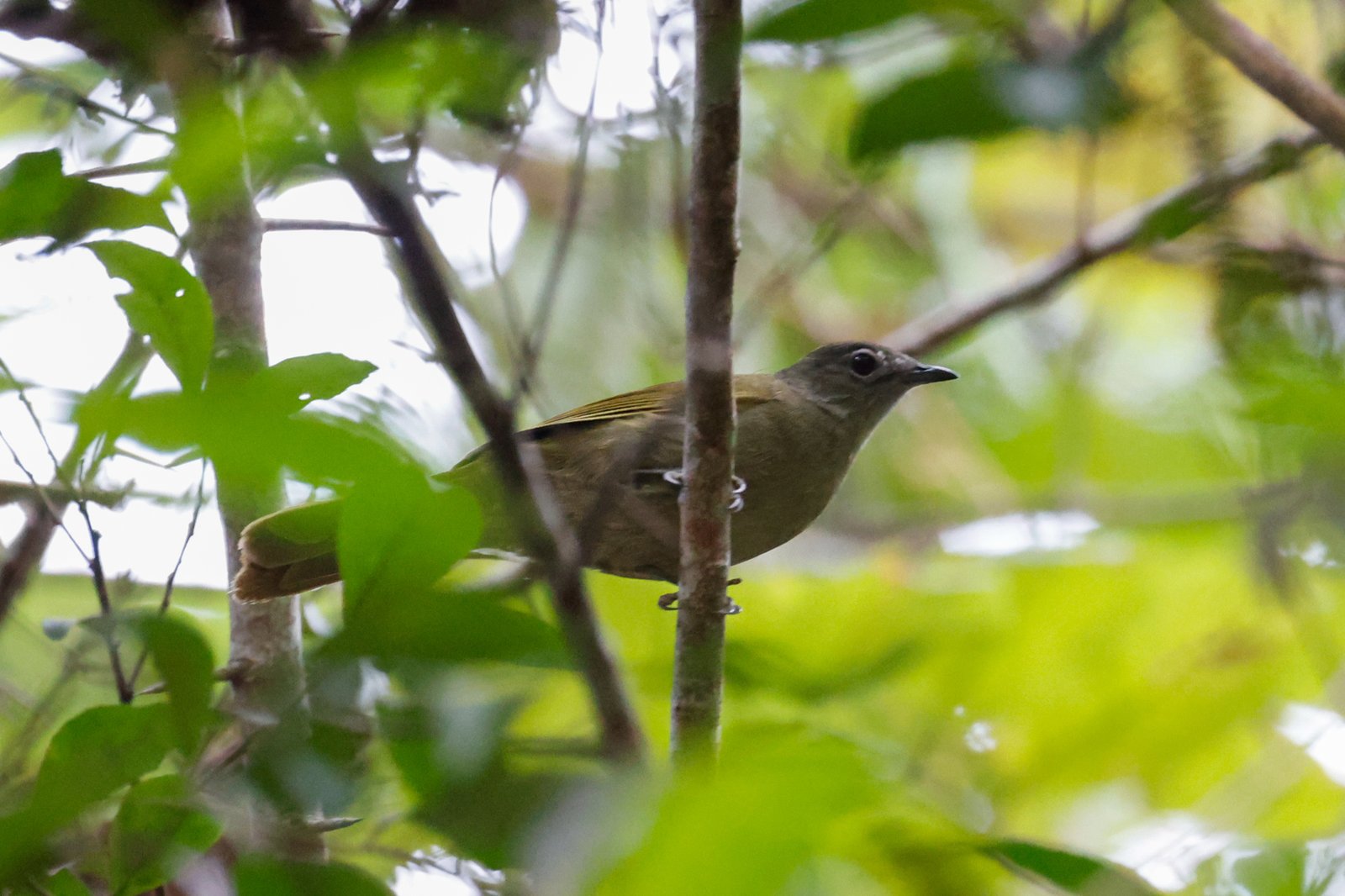
Shelley's Greenbul is a small, inconspicuous greenbul of montane forest, named after the Misuku Hills in northern Malawi, where it was first collected. Within the region it is confined to that far northern corner, and it draws attention more by its calls in the mid-stratum of the forest than by its plumage.
Voice
A rather quiet species. The call is a high, thin tsew and a nasal nyeh; the song is a short, unmusical series of squeaky and scratchy notes, chip-chrrr-tseep, often repeated from a hidden spot in the foliage.
Recording: Louis A. Hansen — CC BY-NC-SA 4.0 · converted to mono · xeno-canto
Identification
16–17 cm. A slim, plain olive-green greenbul with a grey head: crown, lores and ear-coverts are grey and contrast mildly with the olive-green back. Around the eye a narrow, broken white eye-ring. The throat is pale grey, the breast greyish olive, the belly and undertail-coverts yellowish olive. Wings and tail are olive-green without markings. The bill is fairly short and dark, the legs are grey-brown. The sexes are alike; juveniles are duller, with an olive head. In the field size, the grey head with its fine eye-ring and its behaviour in the mid-stratum are the best features.
Confusion species
Black-Browed Mountain Greenbul Arizelocichla fusciceps shares the same forest but is larger and noisier, with a dark crown and dark brow and yellower underparts; it often comes in small groups to fruiting trees at the forest edge. Little Greenbul Eurillas virens is uniformly dark olive without a grey head, stays lower in the undergrowth and has a fast, bubbling song. Yellow-Streaked Greenbul Phyllastrephus flavostriatus has a long thin bill and fine yellow streaks on the breast and constantly flicks one wing. Cabanis's Greenbul Phyllastrephus cabanisi is browner, with a white throat, and forages low in groups with much harsh chattering.
Habitat
Moist montane forest, mainly in the mid-stratum and the lower canopy, also at forest edges and in mature secondary forest, mostly between 1500 and 2300 m. It searches for insects by hopping along branches and leaves and also takes small fruits. It readily joins mixed foraging flocks.
Where the bird is most at home, classified by the vegetation units of southern Africa.

Range and movements
Within the region only in the far north of Malawi, mainly in the forests of the Misuku Hills, the type locality. Beyond the region in the mountains of Tanzania (the Eastern Arc and the south-west), in the Albertine Rift of eastern DR Congo, Rwanda, Burundi and Uganda, and in western Kenya.
- Resident
- Passage (Mar–Apr, Oct–Nov)
- dark = core range, pale = thinly spread
How and when to look
All year. The Misuku Hills are the place to see it in the region: stand still at the level of the mid-stratum and watch for small grey-headed greenbuls in mixed flocks with white-eyes and warblers. Learn the thin call and the irregular scratchy notes; without sound the bird easily slips past unseen among the commoner Black-Browed Mountain Greenbuls.
Conservation status
Not threatened; locally fairly common in suitable forest. In the region the population is small and depends on the few remaining forest patches of the Misuku Hills, which are under pressure from logging and the spread of cultivation.
Scientific name
Arizelocichla masukuensis | (Shelley, 1897)
Shelley described the species in 1897 as Andropadus masukuensis; because it was later moved to another genus, the author and year stand in brackets. The genus Arizelocichla was introduced in 1905 by Oberholser. Arizelocichla comes from the Greek arizēlos, 'conspicuous, distinct', and kikhlē, 'thrush'. masukuensis refers to the Misuku (Masuku) Hills in northern Malawi, where the first specimen was collected. The specimen the first description was based on came from Misuku Hills, Malawi.