All species › Passerines › Bulbuls › Sombre Greenbul
Sombre Greenbul | Andropadus importunus
Vale buulbuul | Bulbul de Zanzíbar
The Sombre Greenbul is a plain olive-green bulbul with a striking white iris, which in dense thicket and coastal forest of the east of the region is heard far more often than seen. Its loud whistled call, traditionally rendered as Willie!, is one of the best-known sounds of the east coast of southern Africa.

Voice
The best-known call is a loud, clear, whistled wee-lee or weep, often followed by a fast, bubbling series of notes ending in a falling, plaintive skeeerr; also short bubbling phrases and nasal chattering. It calls all day, even in the heat of midday.
Recording: Walter Wallner — CC BY-NC-SA 4.0 · shortened to the first 60 s, mono · xeno-canto
Identification
17–19 cm, slim, with a fairly long tail and a fine, dark bill. Southern birds (the nominate form) are dull olive-green above and greyish olive below, with a slightly paler throat and a faint yellowish wash on the belly. Birds of north-eastern South Africa, Zimbabwe, Mozambique and Malawi are distinctly yellower below. The best feature is the white to cream iris, which gives the face a staring expression. The legs are dark grey. The sexes are alike; juveniles have a dark iris and are duller, and are therefore harder to identify.
Confusion species
Yellow-Bellied Greenbul Chlorocichla flaviventris is larger and heavier, with bright yellow underparts, a white eyelid crescent above a dark eye, and lives in noisy groups. Terrestrial Brownbul Phyllastrephus terrestris is brown with a white throat and a dark eye, and forages in groups on or just above the ground. Little Greenbul Eurillas virens is smaller, has a dark eye and keeps hidden in forest undergrowth in Zimbabwe and Mozambique. Stripe-Cheeked Greenbul Arizelocichla milanjensis has grey, finely streaked cheeks and lives in montane forest. Dark-eyed juveniles are best identified by call and behaviour.
Habitat
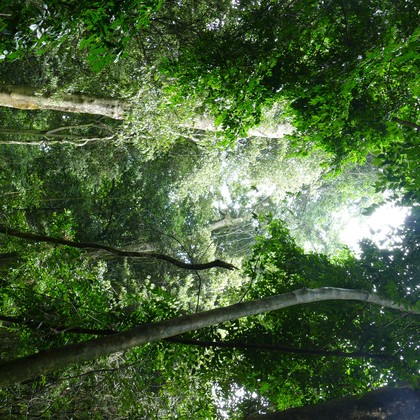
Dense thicket, coastal and dune forest, riverine forest, lowland forest edges, valley thicket and scrub; also parks and well-wooded gardens in coastal towns. It lives singly or in pairs in the middle stratum of the thicket and eats fruit, berries and insects.
Where the bird is most at home, classified by the vegetation units of southern Africa.


Range and movements
Within the region in southern and eastern South Africa, from the south coast of the Western Cape east through the Eastern Cape and KwaZulu-Natal to the lowveld of Mpumalanga and Limpopo; further in Eswatini, eastern and south-eastern Zimbabwe, almost all of Mozambique and southern Malawi. Beyond the region along the coast of East Africa north through Tanzania, Zanzibar and Kenya to southern Somalia.
- Resident
- Summer visitor (c. Oct–Mar)
- Winter visitor (c. Apr–Sep)
- Passage (Mar–Apr, Oct–Nov)
- dark = core range, pale = thinly spread
How and when to look
Year-round; heard almost anywhere in coastal and riverine forest in the east. The whistled wee-lee is the best lead; wait near the calling bird until it perches briefly in the open and check the white eye. Good places include the coastal forests of KwaZulu-Natal, the east of Kruger National Park and the area around Maputo.
Conservation status
Not threatened; common and widespread. It adapts well to gardens and disturbed thicket, and locally benefits from alien fruiting shrubs.
Scientific name
Andropadus importunus | (Vieillot, 1818)
Vieillot described the species in 1818 as Turdus importunus; because it was later moved to another genus, the author and year stand in brackets. The genus Andropadus was introduced in 1832 by Swainson. Andropadus comes from the Greek anēr, andros, 'man', and opados, 'attendant, follower'. The Sombre Greenbul was considered a nuisance, since it followed hunters and alerted other birds and game with its constant chattering. importunus is Latin for 'troublesome, insolent'; Levaillant (1802) called the bird 'L'Importun' because it followed hunters and warned other birds with its loud, irritating and persistent calls. The specimen the first description was based on came from Outeniqua forest, Western Cape, South Africa.