All species › Passerines › Leaf warblers › Laura's Woodland Warbler
Laura's Woodland Warbler | Phylloscopus laurae
Boultons boszanger | Mosquitero de Laura
Laura's Woodland Warbler is a small, brightly coloured leaf warbler of miombo and gallery forest in Zambia and Angola. It is a typical member of mixed flocks in the miombo canopy and, for visitors to north-western Zambia, one of the sought-after species of the area.

Voice
The song is a rapid, high series of clear notes that speeds up and drops, tsee-tsee-tsee-tsu-tsu-tsurrr, often with a short trill at the end; similar in character to Yellow-Throated Woodland Warbler but freer and more varied. The call is a soft tswee or a dry tik, often from a mixed flock.
Recording: Dries Van de Loock — CC BY-NC-SA 4.0 · converted to mono · xeno-canto
Identification
10–11 cm, compact, with short, rounded wings and a short tail. The upperparts are bright yellow-green, the crown slightly greyer olive-green, with no rufous. A long yellow supercilium and a dark eye-stripe mark the head. Throat and breast are bright yellow, the belly whitish to pale yellow and the undertail coverts yellow. Wings and tail are edged green. The bill is fine and dark with a pale lower mandible, and the legs are pale brown. Birds of northern and north-eastern Zambia (subspecies eustacei) are yellower below than those of the north-west and Angola. The sexes are alike. Restless, it flutters and hangs from outer twigs and flicks its wings.
Confusion species
Yellow-Throated Woodland Warbler Phylloscopus ruficapilla has a rufous crown and cheeks and lives in montane forest; in Zambia only on the Nyika Plateau and in the Mafinga Mountains. Willow Warbler Phylloscopus trochilus, numerous in the same miombo from November to April, is paler and less contrasting, with a longer tail, longer wings with an obvious primary projection, a pale rather than yellow supercilium and a disyllabic call. Green-Capped Eremomela Eremomela scotops lives in small groups in the same miombo but has a grey cheek, a yellow belly, a pale iris and a short tail. Yellow-Bellied Hyliota Hyliota flavigaster and Southern Hyliota Hyliota australis have dark upperparts with a white wing stripe.
Habitat
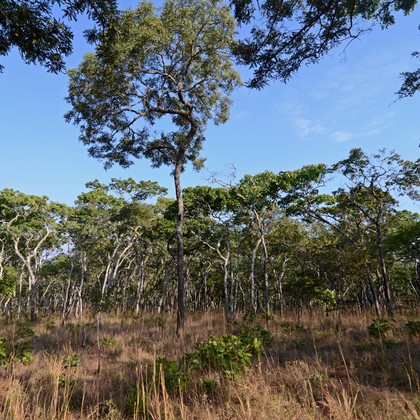
Tall, mature miombo with a closed canopy, and the edges and open parts of gallery forest and moist thicket (mushitu) along streams; in Angola also forest edges and scrub around montane forest on the central highlands. It forages in the canopy, often in mixed flocks with eremomelas, hyliotas, flycatchers and tits.
Where the bird is most at home, classified by the vegetation units of southern Africa.

Range and movements
Within the region in Zambia, from the north-west (Mwinilunga and the area of the Zambezi source) through the Copperbelt to the north and Muchinga Province (including Mutinondo and Shiwa Ng'andu), and in Angola on the central highlands (Mount Moco and the Namba Mountains) and in the north-east (the Lunda provinces). Beyond the region in southern Congo-Kinshasa (Katanga and Kasai) and very locally in the far south-west of Tanzania.
- Resident
- dark = core range, pale = thinly spread
How and when to look
Year-round. Look for it in the morning in tall miombo and near gallery forest in north-western Zambia, for example around Mwinilunga and the Zambezi source, or at Mutinondo Wilderness. It is found most easily by following mixed flocks; from May to October, when Willow Warbler is absent, a small, bright yellow leaf warbler with rounded wings in miombo is almost certainly this species.
Conservation status
Not threatened and fairly common in suitable miombo, but with a limited range. The main threat is the ongoing clearance of miombo for charcoal and cultivation and the loss of gallery forest along streams, especially on the Copperbelt.
Scientific name
Phylloscopus laurae | (Boulton, 1931)
Boulton described the species in 1931 as Seicercus laurae; because it was later moved to another genus, the author and year stand in brackets. The genus Phylloscopus was introduced in 1826 by Boie. Phylloscopus is Greek, from phullon 'leaf' and skopos 'seeker', from skopeō 'to watch': the bird that searches the foliage. laurae honours the American ethnomusicologist Laura Boulton (1899–1980), wife of the ornithologist Rudyerd Boulton who described the species. The specimen the first description was based on came from Mount Moco, Angola.