All species › Kingfishers, bee-eaters and rollers › Kingfishers › Shining-Blue Kingfisher
Shining-Blue Kingfisher | Alcedo quadribrachys
Glansijsvogel | Martín Pescador Brillante
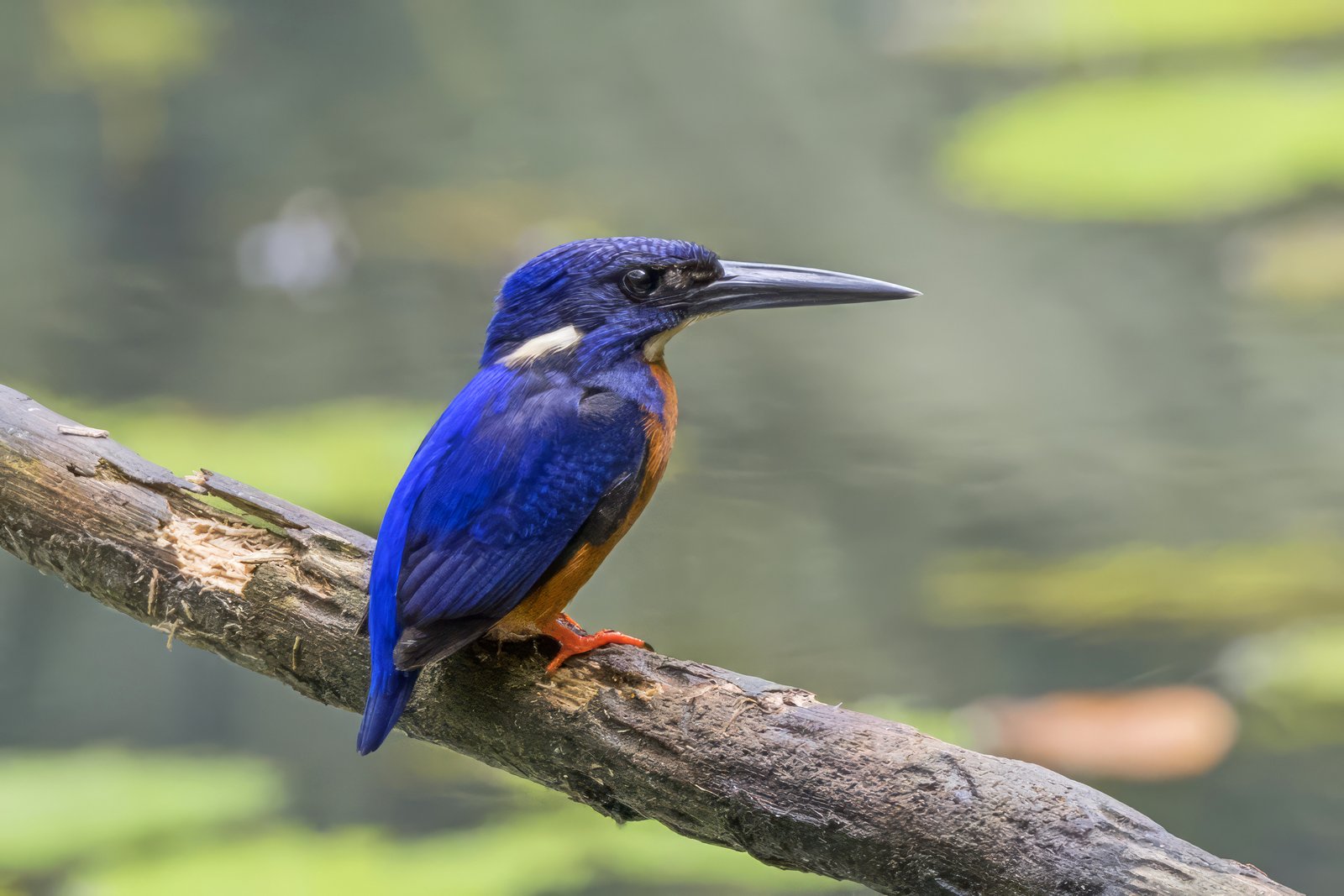
The Shining-Blue Kingfisher is a dark, glossy blue kingfisher with a black bill and deep chestnut underparts, a species of forest rivers in Central and West Africa. In the region it reaches only the northern edges, where it lives along streams shaded by gallery forest.
Voice
A high, thin and penetrating tseet or pseep, mostly in flight low over the water; sometimes rapidly repeated as tsi-tsi-tsi.
Recording: Dries Van de Loock — CC BY-NC-SA 4.0 · converted to mono · xeno-canto
Identification
About 17 cm. The upperparts are deep purplish blue with a brilliant, glossy sky-blue stripe down the back and rump. The crown is finely spotted paler blue, the cheeks dark blue. The throat and a patch on the side of the neck are white to pale orange-buff, the rest of the underparts deep rusty chestnut. The bill is black, the legs red. The sexes are nearly alike; juveniles are duller, with a dark wash on the breast.
Confusion species
Half-Collared Kingfisher (Alcedo semitorquata) is paler blue, with paler cinnamon underparts and a blue patch on each side of the breast; the two locally occur together in Angola and Zambia. Malachite Kingfisher (Corythornis cristatus) is much smaller, with a red bill and a barred crest. White-Bellied Kingfisher (Corythornis leucogaster) is small, with a red bill and a white belly.
Habitat
Wooded banks of rivers and streams, both fast and slow, also lakes, swamp forest and lagoons with overhanging vegetation, often in shade. It sits low over the water and dives for small fish, frogs and aquatic insects. It nests in a tunnel in a steep bank.
Where the bird is most at home, classified by the vegetation units of southern Africa.


Range and movements
In the region only in the north: in Angola in the north and north-east (including Cabinda, Uíge, Malanje and the Lundas) and in north-western and northern Zambia, mainly in the gallery forests of Mwinilunga and the Luapula drainage. Beyond the region from Senegal through West and Central Africa to South Sudan, Uganda and western Kenya and Tanzania.
- Resident
- dark = core range, pale = thinly spread
How and when to look
Best seen in the gallery forests of north-western Zambia, for example along the streams around Mwinilunga, by waiting quietly at a vantage point above a stream. The bird usually gives itself away first by its high call; in good light the back gleams strikingly.
Conservation status
Not threatened and fairly common over most of its range. In the region it is confined to a narrow strip; loss of gallery forest to logging, agriculture and mining is the main threat here.
Scientific name
Alcedo quadribrachys | Bonaparte, 1850
Bonaparte described the species in 1850 and placed it straight away in the genus where it still stands. The genus Alcedo was introduced in 1758 by Linnaeus. Alcedo is the Latin word for 'kingfisher'. quadribrachys comes from the Latin quadri-, 'four', and brachium, 'arm' — meaning its four toes. The specimen the first description was based on came from Guinea coast, West Africa (not specified further).