All species › Passerines › Cisticolas › Short-Winged Cisticola
Short-Winged Cisticola | Cisticola brachypterus
Kortvleugelgraszanger | Cistícola Alicorto
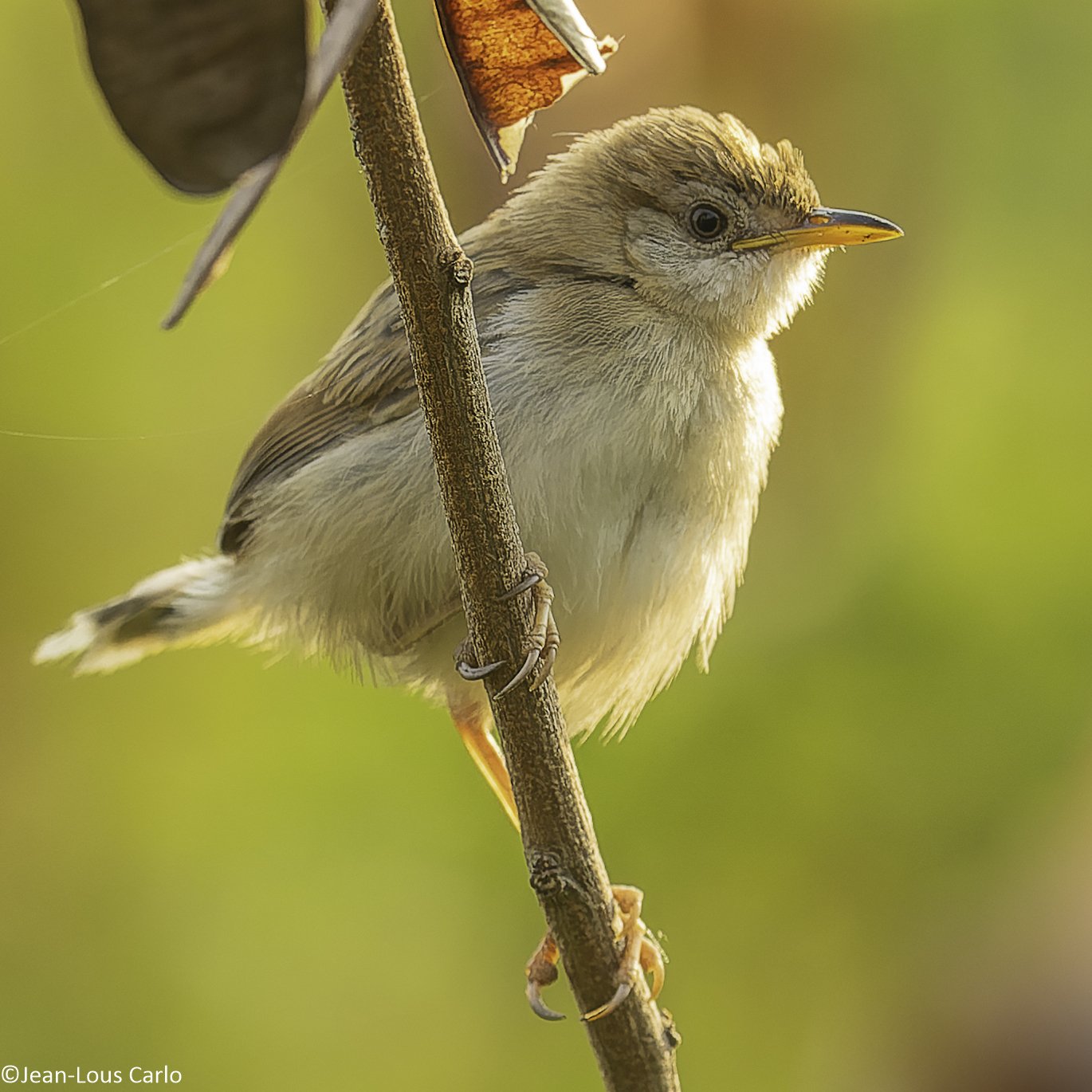
Short-Winged Cisticola is one of the smallest and least obtrusive cisticolas in the region: a plain brown little bird with a short tail that draws attention mainly with its thin song from the top of a tree. It lives in grassy woodland in the north and east of the region.
Voice
A thin, high song of a few descending notes, see-see-see-see or chwee-chwee, often repeated at length from a treetop or in a short song flight. The alarm is a soft, dry tsik.
Recording: Magnus Wadstein — CC BY-NC-SA 4.0 · converted to mono · xeno-canto
Identification
About 10 cm, small, round and short-tailed. The crown is brown, at most slightly warmer than the back and never bright rufous; the mantle and back are greyish-brown with faint dark streaks, almost plain in breeding plumage. The wing is short and rounded, with brown edgings. The tail is short, greyish-brown with a dark subterminal band and pale tips. The underparts are dull white to pale buff. In non-breeding plumage crown and back are more clearly streaked and the tail slightly longer. The sexes are alike. It sings from the top of a tree or a dead branch, often high up, and sometimes in a short song flight.
Confusion species
Neddicky Cisticola fulvicapilla has a bright, plain rufous cap and sings a monotonous piping from a lower branch. Long-Tailed Cisticola Cisticola angusticauda has a rufous cap and a long, thin tail. Trilling Cisticola Cisticola woosnami is much larger, has a rufous crown and sings a long, accelerating trill. Chattering Cisticola Cisticola anonymus of the far north of Angola is larger and sings a loud chatter. A small, plain brown, short-tailed bird singing a thin song high in a tree is almost certainly a Short-Winged Cisticola.
Habitat
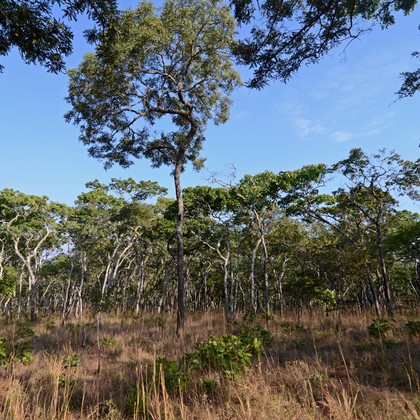
Grassy woodland, miombo and open savanna with scattered tall trees, wooded dambo edges, old fields with regrowth and the edges of forest and riverine forest. It forages low in the grass for small insects but sings high in the trees. The nest is a ball of grass low in a grass tuft.
Where the bird is most at home, classified by the vegetation units of southern Africa.

Range and movements
Within the region in the north and east: across much of Angola, Zambia and Malawi, in central and northern Mozambique and in eastern Zimbabwe, mainly in the lower-lying parts along the Mozambique border. Absent from South Africa, Botswana and Namibia (bar a possible vagrant). Beyond the region widespread in the savannas of West and Central Africa to Ethiopia, East Africa and Tanzania.
- Resident
- Summer visitor (c. Oct–Mar)
- Winter visitor (c. Apr–Sep)
- Passage (Mar–Apr, Oct–Nov)
- dark = core range, pale = thinly spread
How and when to look
Year-round, but conspicuous mainly in the rains when the males sing. Search grassy woodland with scattered tall trees and listen for a thin song from the treetop; then look for a small, plain brown bird with a stubby tail on the highest branch. In eastern Zimbabwe and central Mozambique it is one of the species that is often overlooked.
Conservation status
Not threatened and fairly common within its range. It tolerates some disturbance and also occurs in old fields and open, logged woodland.
Scientific name
Cisticola brachypterus | (Sharpe, 1870)
Sharpe described the species in 1870 as Drymoeca brachyptera; because it was later moved to another genus, the author and year stand in brackets. The genus Cisticola was introduced in 1829 by Kaup. Cisticola combines the Ancient Greek kisthos 'rock-rose' with the Latin colere 'to dwell'. brachypterus comes from the Greek brakhus, 'short', and pteron, 'wing' — for the short, rounded wings. The specimen the first description was based on came from Volta River, Ghana.