All species › Passerines › Cisticolas › Long-Tailed Cisticola
Long-Tailed Cisticola | Cisticola angusticauda
Taboragraszanger | Cistícola Colifino
Long-Tailed Cisticola is a small, slender cisticola with a rufous cap and a strikingly long, thin tail, which within the region occurs only in northern and eastern Zambia. It is in effect a long-tailed counterpart of the Neddicky, and the two are often confused in the field.

Voice
A high, piping song, a series of thin, rapidly repeated notes, tsee-tsee-tsee-tsee or see-see-see, similar to that of the Neddicky but higher and thinner. The alarm is a dry tsik or a fast tik-tik-tik.
Recording: Dries Van de Loock — CC BY-NC-SA 4.0 · converted to mono · xeno-canto
Identification
About 11–12 cm, much of it tail. The crown is warm rufous, the mantle and back greyish-brown and almost unstreaked or only very faintly streaked. The tail is long, narrow and graduated, greyish-brown with a dark subterminal band and pale tips, and is often held cocked or swung from side to side. The wing edgings are brown. The underparts are white to pale greyish-buff, warmer on the flanks. The sexes are alike and plumage hardly varies with season. It sings from a grass stem, small bush or low branch.
Confusion species
Neddicky Cisticola fulvicapilla has the same rufous cap and plain back, but a clearly shorter, broader tail; its song is a monotonous, lower piping. Where both occur, the tail-to-body proportion is the best feature. Short-Winged Cisticola Cisticola brachypterus has a brown, not rufous crown and a short tail. Rock-Loving Cisticola Cisticola aberrans is larger, lives on rocky slopes and has a plaintive song. Tawny-Flanked Prinia Prinia subflava also has a long tail, but a clear white supercilium, no rufous cap and rufous-buff flanks.
Habitat
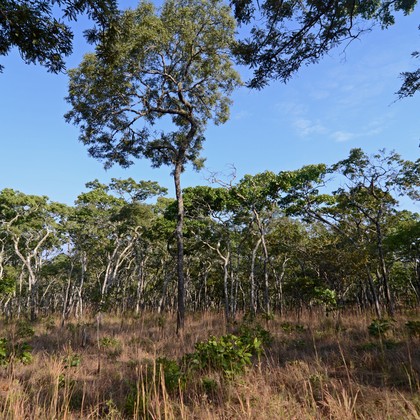
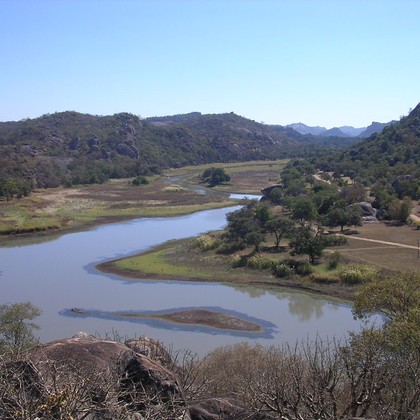
Dry grassy woodland and open miombo with a low grass layer, bushy grassland, old fields and the edges of dambos. It forages low in grass and small bushes for small insects. The nest is a ball of grass low in a grass tuft.
Where the bird is most at home, classified by the vegetation units of southern Africa.
Range and movements
Within the region almost entirely in Zambia, mainly on the northern plateau and in the east, south to the centre of the country. There are a few reports from the far north of Malawi and north-western Mozambique, but the species is poorly documented there. Beyond the region in south-eastern DR Congo, Tanzania (where the town of Tabora gave the Dutch name), Rwanda, south-western Kenya and south-eastern Uganda.
- Summer visitor (c. Oct–Mar)
- dark = core range, pale = thinly spread
How and when to look
Year-round; best in the rains, when the males sing. Search grassy miombo and bushy grassland on Zambia's northern plateau, for example around Kasama, Mbala and Mpika. Listen for a high, thin piping reminiscent of the Neddicky, then check the tail: long and thin means Long-Tailed Cisticola.
Conservation status
Not threatened and fairly common within its range. Within the region it is confined to Zambia, where it seems little affected by grassland burning and the conversion of woodland to small-scale farming.
Scientific name
Cisticola angusticauda | Reichenow, 1891
Reichenow described the species in 1891 and placed it straight away in the genus where it still stands. The genus Cisticola was introduced in 1829 by Kaup. Cisticola combines the Ancient Greek kisthos 'rock-rose' with the Latin colere 'to dwell'. angusticauda comes from the Latin angustus, 'narrow', and cauda, 'tail' — for the long, narrow tail. The specimen the first description was based on came from Igonda near Tabora, Tanzania.