All species › Passerines › Cisticolas › Neddicky
Neddicky | Cisticola fulvicapilla
Bruinkopgraszanger | Cistícola Coronirrufo
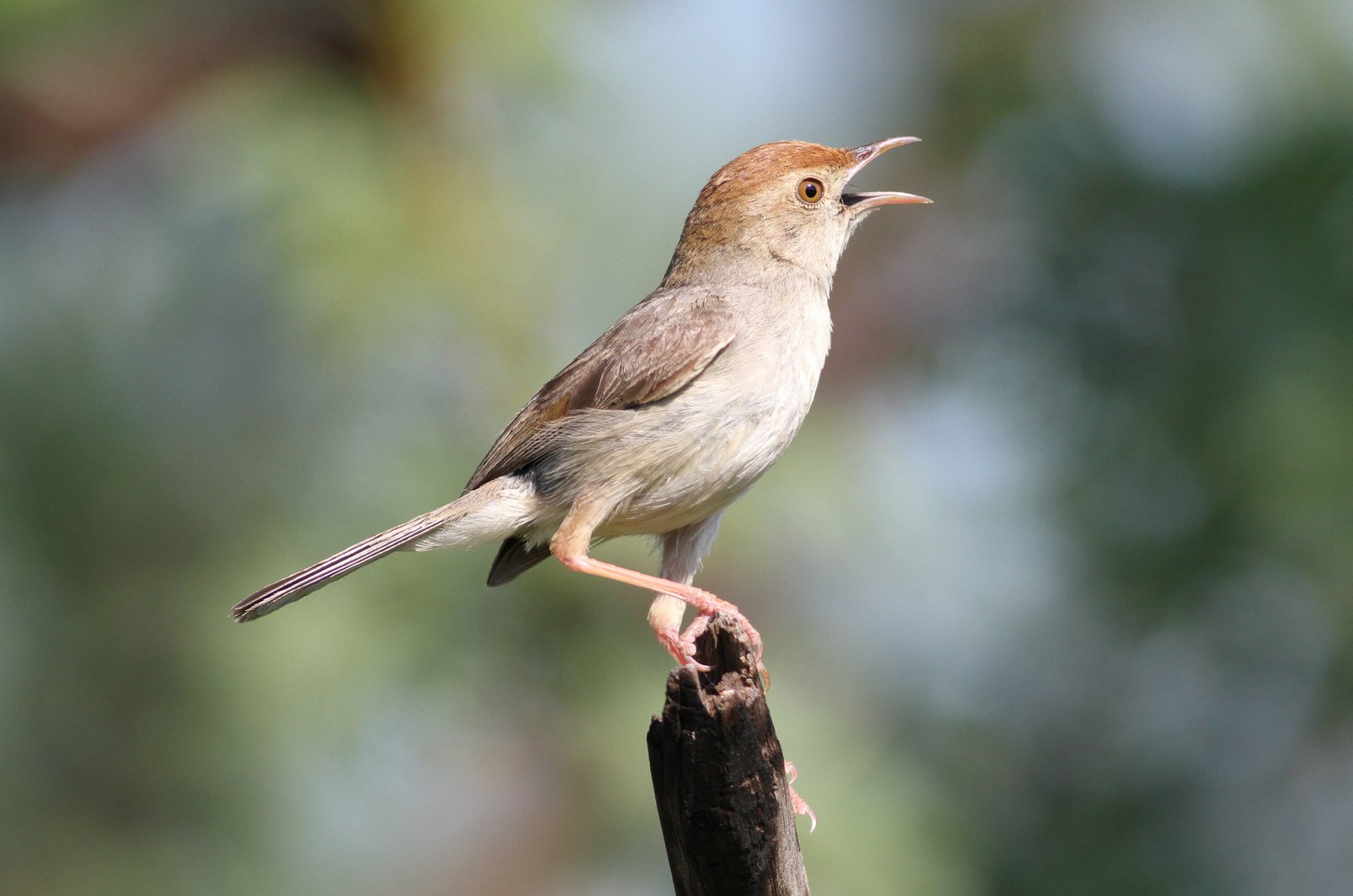
The Neddicky is a small, unstreaked cisticola of woodland and grassy slopes, with a plain rufous cap and a monotonous piping song repeated endlessly from a tree branch. It is one of the few cisticolas that readily perches in trees, and across much of the region the commonest cisticola away from open grassland.
Voice
A monotonous, fast repeated series of high piping notes, chee-chee-chee-chee or weep-weep-weep, for minutes on end from the same branch; in the south also a drier series, chirri-chirri-chirri. The alarm is a fast, dry tik-tik-tik, often with the tail flicking.
Recording: Maarten Sluijter — CC BY-NC-SA 4.0 · converted to mono · xeno-canto
Identification
About 10–11 cm, compact, with a rather short tail that is often flicked up. The crown is plain warm rufous and sharply defined; the mantle and back are plain greyish-brown without streaks, which separates it from almost all other cisticolas in its habitat. The wing edgings are brown, the tail greyish-brown with a dark subterminal band and pale tips. The underparts are blue-grey in the south and west (races fulvicapilla and silberbauer) and warm buff in the north and east (race dumicola). The sexes are alike and there is hardly any difference between breeding and non-breeding plumage. It sings from a branch in a tree or bush, not in the air.
Confusion species
Long-Tailed Cisticola Cisticola angusticauda of northern Zambia is very similar but has a clearly longer, thin tail and a slightly different, higher song. Short-Winged Cisticola Cisticola brachypterus is just as small but has a brown, not rufous crown and sings a thin, descending song from a treetop. Rock-Loving Cisticola Cisticola aberrans also has a rufous crown and unstreaked back but is larger and long-tailed and lives on rocky slopes, with a plaintive, wailing song. Grey-Backed Cisticola Cisticola subruficapilla has a streaked grey back. The combination of a plain rufous cap, a completely unstreaked back and a monotonously repeated song from a tree branch is diagnostic.
Habitat
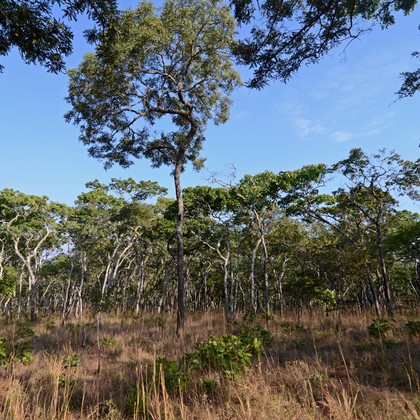
Open woodland and savanna with grassy undergrowth, miombo, grassy slopes with bushes, forest edges, fynbos and scrub in the Cape, plantations and large gardens. It keeps to bushes and low trees and forages low for insects, often on the ground. The nest is a ball of grass with a side entrance, low in a grass tuft or bush.
Where the bird is most at home, classified by the vegetation units of southern Africa.


Range and movements
Widespread in the eastern and southern half of the region: in South Africa from the Western Cape along the south coast to the Eastern Cape and from there across KwaZulu-Natal, the Free State, Gauteng, Mpumalanga, North West and Limpopo; also in Lesotho, Eswatini, Zimbabwe, Mozambique, Malawi, Zambia, eastern and northern Botswana, the Zambezi Region of Namibia and central and eastern Angola. Absent from the dry Karoo, the Kalahari and most of Namibia. Beyond the region only in southern DR Congo and south-western Tanzania.
- Resident
- Summer visitor (c. Oct–Mar)
- Winter visitor (c. Apr–Sep)
- Passage (Mar–Apr, Oct–Nov)
- dark = core range, pale = thinly spread
How and when to look
Year-round; best found by its song, which can be heard in winter too. Walk through grassy woodland or along a bushy slope and listen for the monotonous piping; the bird often sits on an exposed branch halfway up a tree. Check the plain back: a cisticola with a rufous cap and no back streaks in woodland is almost always a Neddicky. In the Cape (grey-bellied race) also in fynbos and on grassy mountain slopes.
Conservation status
Not threatened and common over most of its range. It adapts well to gardens, plantation edges and lightly disturbed woodland. Local declines follow deforestation and the conversion of grassy woodland to cropland.
Scientific name
Cisticola fulvicapilla | (Vieillot, 1817)
Vieillot described the species in 1817 as Sylvia fulvicapilla; because it was later moved to another genus, the author and year stand in brackets. The genus Cisticola was introduced in 1829 by Kaup. Cisticola combines the Ancient Greek kisthos 'rock-rose' with the Latin colere 'to dwell'. fulvicapilla comes from the Latin fulvus, 'tawny', and capillus, 'hair of the head' — for the warm brown crown. The specimen the first description was based on came from Graaff-Reinet, Eastern Cape, South Africa.