All species › Passerines › Cisticolas › Croaking Cisticola
Croaking Cisticola | Cisticola natalensis
Natalgraszanger | Cistícola de Natal
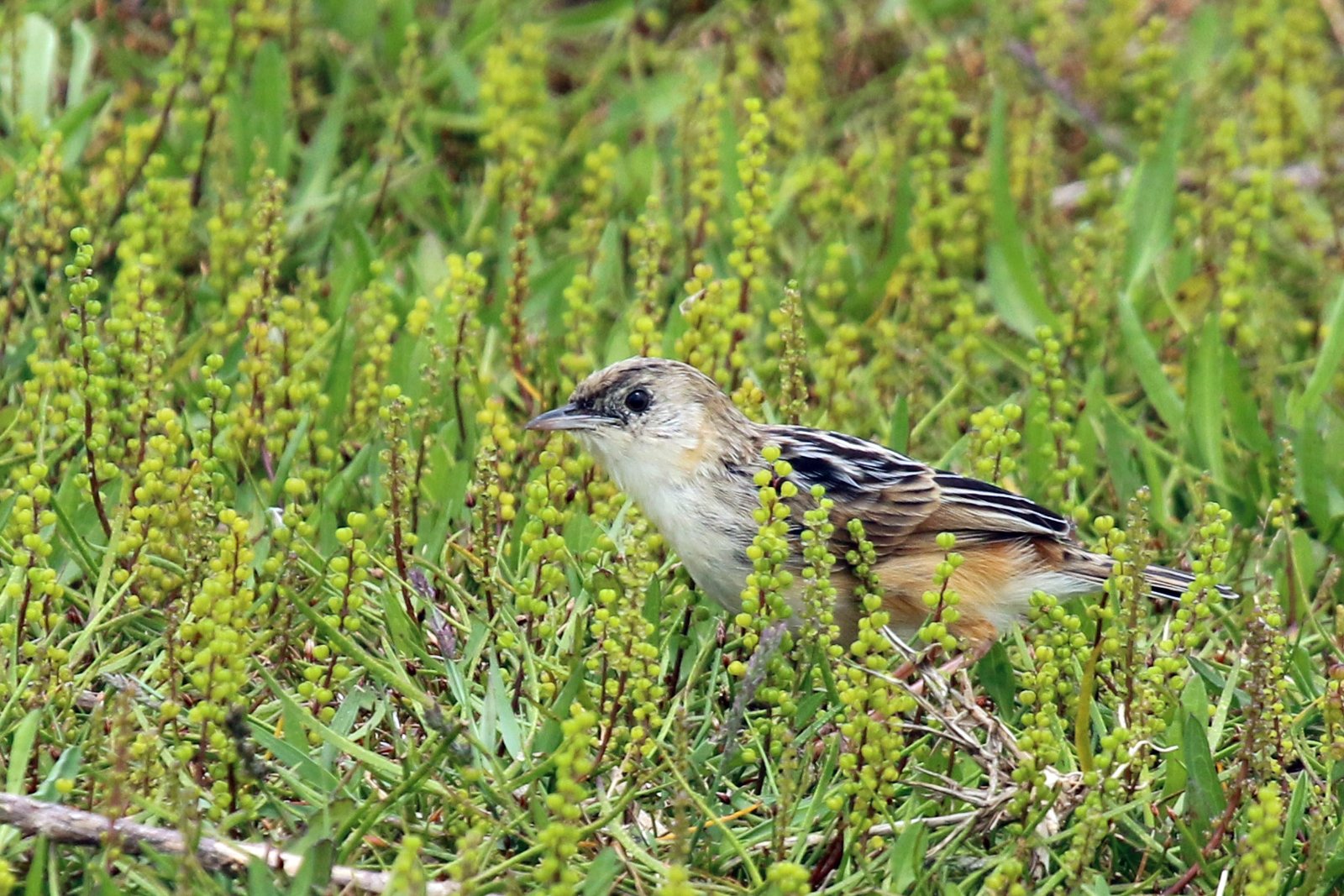
Croaking Cisticola is the largest and most heavily built cisticola in the east of the region, with a thick, slightly decurved bill and a striking size difference between the sexes. Its name refers to the deep, frog-like call by which it gives itself away in tall grassland.
Voice
The song is a deep, croaking chee-frrr or krrrrk, often alternating with a high tee-tee, from a perch or in song flight. The alarm is a dry, hard chak-chak. The frog-like quality of the call is unique among the region's cisticolas.
Recording: Magnus Wadstein — CC BY-NC-SA 4.0 · converted to mono · xeno-canto
Identification
The male measures about 15–16 cm, the female only 13 cm. Sturdy, with a big head and a heavy, slightly curved bill that is black in the breeding male. The upperparts are greyish-brown to buffy brown, evenly streaked black on crown, mantle and back, with no rufous crown or rufous nape; the wing edgings are warm brown. The tail is rather short and broad, dark with pale tips. The underparts are plain pale buff, warmer on the flanks. In non-breeding (winter) plumage the bird is warmer brown and more heavily streaked, with a longer tail and a paler bill. The male sings from a grass stem or bush and performs a song flight with audible wing-flapping and the tail hanging down.
Confusion species
Stout Cisticola Cisticola robustus, only in Angola and northern Zambia, has a rufous nape. Rattling Cisticola Cisticola chiniana is smaller and slimmer, has a rufous crown, a longer tail and a rattling song; it lives in drier bushveld. Wailing Cisticola Cisticola lais has a rufous crown and a plaintive song and lives on mountain slopes. Female Croaking Cisticolas can suggest other cisticolas because of their smaller size: check the heavy bill, the evenly streaked upperparts without a rufous crown and the company of a male. A large, streaked cisticola that croaks is almost certainly this species.
Habitat
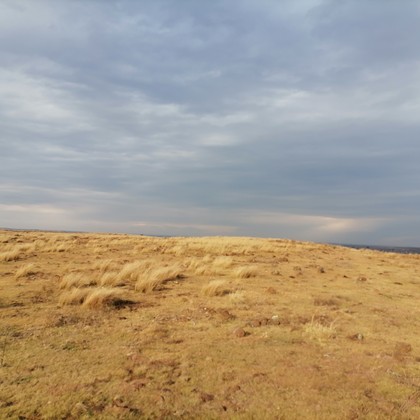
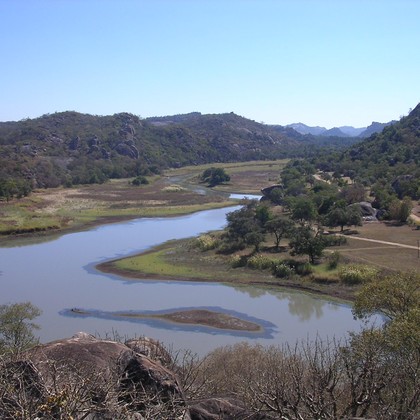
Tall, rank grassland with scattered bushes and trees, open woodland with a dense grass layer, grassy slopes and the edges of vleis and farmland; often where grass grows back tall after a fire. It avoids both short grassland and closed woodland. It forages on the ground and low in the grass for insects. The nest is a ball of grass low in a grass tuft, often bound to living stems.
Where the bird is most at home, classified by the vegetation units of southern Africa.
Range and movements
Within the region in the east and north: in South Africa in the eastern Eastern Cape, KwaZulu-Natal, Mpumalanga, Limpopo and north-eastern Gauteng and North West, and in Eswatini, virtually all of Zimbabwe (except the dry west), Mozambique, Malawi, Zambia and Angola, and scarce in northern Botswana and the Zambezi Region of Namibia. Absent from the dry west and the Lesotho highlands. Beyond the region across much of sub-Saharan Africa, from West Africa to Ethiopia and East Africa.
- Resident
- Summer visitor (c. Oct–Mar)
- Winter visitor (c. Apr–Sep)
- Passage (Mar–Apr, Oct–Nov)
- dark = core range, pale = thinly spread
How and when to look
Present year-round but much easier to find in summer (November–March) when the males sing and perform song flights; in winter they are silent and skulking. Search tall grass with scattered bushes, for example in the grasslands of Zululand, the Mpumalanga lowveld or Zimbabwe's Eastern Highlands. Listen for the croaking, then check the heavy bill and the absence of rufous on head or nape.
Conservation status
Not threatened and fairly common in suitable habitat. Declines locally with the conversion of grassland to farmland and plantations, and with over-frequent burning or overgrazing that removes the tall grass.
Scientific name
Cisticola natalensis | (Smith, 1843)
Smith described the species in 1843 as Drymoica natalensis; because it was later moved to another genus, the author and year stand in brackets. The genus Cisticola was introduced in 1829 by Kaup. Cisticola combines the Ancient Greek kisthos 'rock-rose' with the Latin colere 'to dwell'. natalensis means 'of Natal', the old name of present-day KwaZulu-Natal, where the first specimen came from. The specimen the first description was based on came from Durban, South Africa.