All species › Passerines › Bulbuls › Simple Greenbul
Simple Greenbul | Chlorocichla simplex
Hartlaubs buulbuul | Bulbul Sencillo
Simple Greenbul is a large, brownish greenbul of forest edge and overgrown clearings in West and Central Africa. In the region it reaches only northern Angola. Its most striking feature is the pure white throat, which the bird puffs out when singing, together with its loud, rollicking song.

Voice
Loud. The song is a rolling, somewhat halting series of throaty notes, chook-chook-chirrup-chook, often given by pairs in duet. Also a single dry chuk and a hoarse chatter when excited.
Recording: Étienne Leroy — CC BY-NC-SA 4.0 · converted to mono · xeno-canto
Identification
20–22 cm. A bulky, rather uniformly coloured greenbul. The upperparts are warm olive-brown, the crown slightly darker. The throat is pure white and sharply demarcated; it is puffed out like a white bib when calling. The rest of the underparts are greyish brown to olive-brown, paler and yellowish towards the belly. A narrow white eye-ring, often broken. The bill is dark with a paler lower mandible, the legs grey. The sexes are alike; juveniles are duller, with a less bright throat.
Confusion species
Falkenstein's Greenbul Chlorocichla falkensteini is smaller and greener, with a yellow throat and collar. Yellow-Bellied Greenbul Chlorocichla flaviventris has a pale yellow throat and bright yellow underparts. Pale-Throated Greenbul Atimastillas flavigula has a creamy yellow rather than a white throat and lives mainly in eastern Angola. Swamp Palm Bulbul Thescelocichla leucopleura also has a white throat, but broad white tail tips, and lives in palm swamps.
Habitat
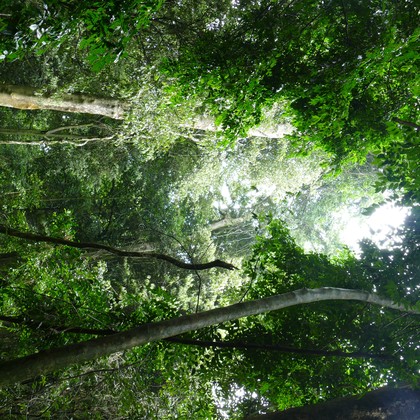
Forest edge, dense thicket, abandoned cultivation with regrowth, secondary forest and gallery forest in savanna country, also gardens and plantations near villages; mainly in the lowlands. It lives in pairs or small groups in the lower and middle strata and eats fruit and insects.
Where the bird is most at home, classified by the vegetation units of southern Africa.

Range and movements
In the region only in northern Angola: mainly in Uíge, Cuanza Norte and Malanje, more sparsely in Bengo, Cabinda, northern Cuanza Sul and the Lunda provinces. Beyond the region from Guinea-Bissau east to South Sudan, Uganda and DR Congo.
- Resident
- dark = core range, pale = thinly spread
How and when to look
All year. Look for it in overgrown forest edges and regrowth around villages in Uíge and Cuanza Norte; the rollicking song and puffed-out white throat make it instantly recognisable. A recording helps: pairs respond quickly and then show themselves in the open bushes.
Conservation status
Not threatened; common over most of its range and well adapted to secondary vegetation. In Angola scarcer and confined to the north.
Scientific name
Chlorocichla simplex | (Hartlaub, 1855)
Hartlaub described the species in 1855 as Trichophorus simplex; because it was later moved to another genus, the author and year stand in brackets. The genus Chlorocichla was introduced in 1882 by Sharpe. Chlorocichla comes from the Greek khlōros, 'green, greenish-yellow', and kikhlē, 'thrush' — for the olive-green and yellow plumage. simplex is Latin for 'simple, plain' — for the unremarkable, uniform olive-brown plumage. The specimen the first description was based on came from Butre River, Ghana.