All species › Passerines › Bulbuls › Slender-Billed Greenbul
Slender-Billed Greenbul | Stelgidillas gracilirostris
Dunsnavelbuulbuul | Bulbul Picofino
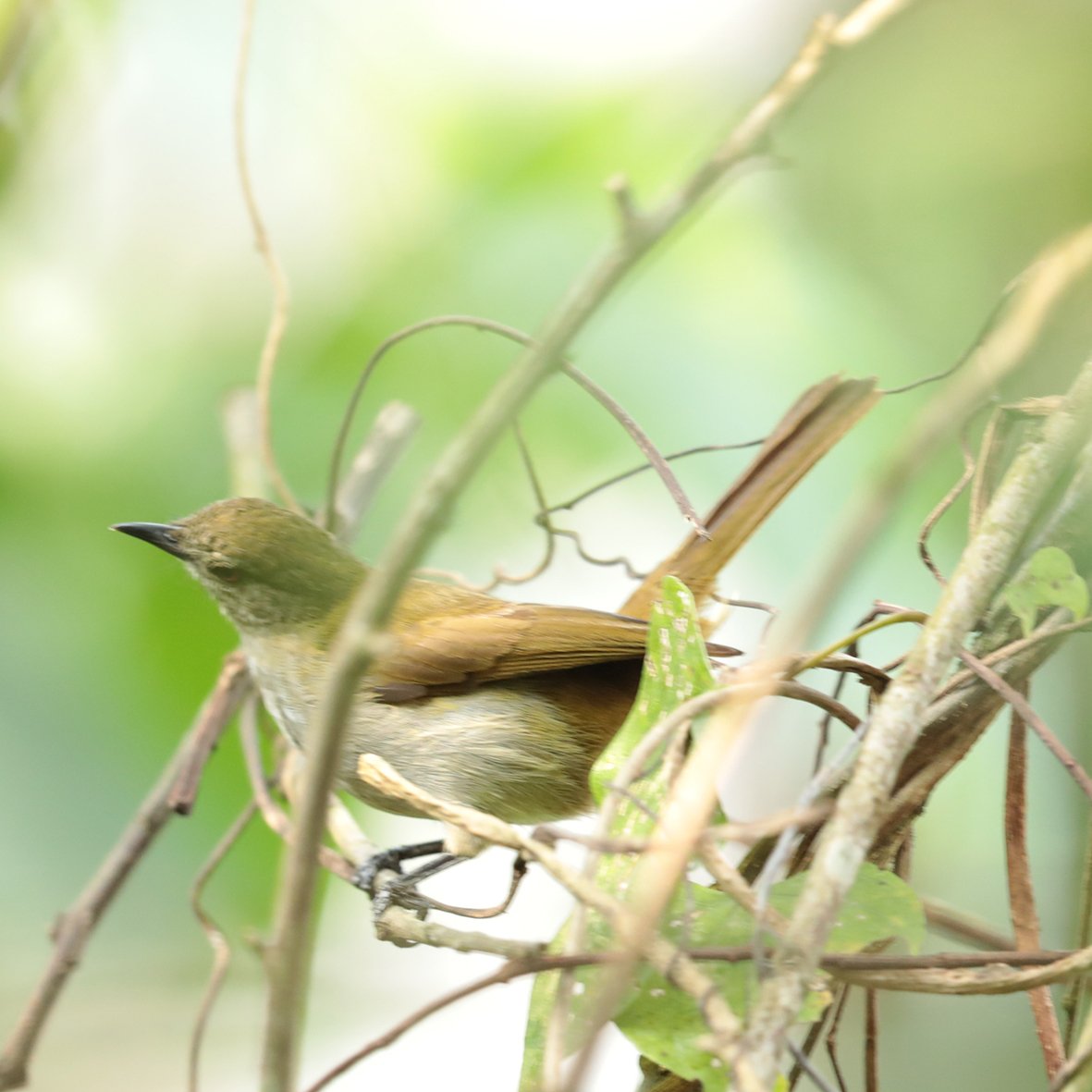
The Slender-Billed Greenbul is a grey, inconspicuous bulbul of the canopy of the Central African rainforest, which reaches the region only in northern Angola and the far north-west of Zambia. It is most easily recognised by its pure, falling whistle, which carries from high in the treetops.
Voice
The song is a long, clear, pure whistle that slowly falls, teeeee-oo, repeated at intervals and carrying far; sometimes preceded by a few short, soft notes. Also a soft nasal chatter and short calls from the foliage.
Recording: Étienne Leroy — CC BY-NC-SA 4.0 · converted to mono · xeno-canto
Identification
16–18 cm, slender, with a fine, straight, dark bill that is remarkably thin for a bulbul. Head and upperparts are grey-olive, the head greyer, wings and tail olive-brown. The underparts are plain pale grey, the throat slightly paler and the belly whitish; the undertail coverts are pale grey to dull yellowish. The eye is dark, with no eye-ring. The legs are grey. The sexes are alike. It keeps high in the trees, often on open branches in the crown, and eats much fruit as well as insects.
Confusion species
Little Grey Greenbul Eurillas gracilis is much smaller, more olive-green above, with a narrow pale eye-ring, and lives in the middle stratum. Little Greenbul Eurillas virens is olive-green, has a short, thick bill and lives low in dense undergrowth; its song is a fast, hoarse chatter. Plain Greenbul Eurillas curvirostris is darker olive with a grey throat, a slightly curved bill and a pale eye-ring. Honeyguide Greenbul Baeopogon indicator also lives in the canopy but has white outer tail feathers and a pale iris. In every case the long, pure, falling whistle of this species is the best feature.
Habitat
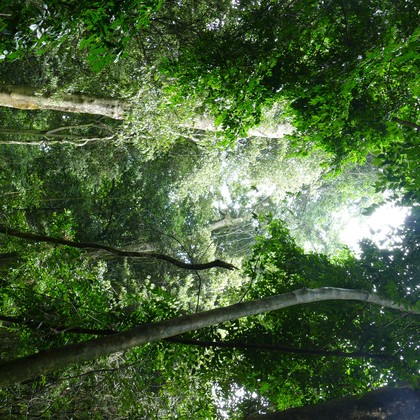
The canopy of moist lowland forest, gallery forest and secondary forest, also forest edges, clearings with tall remnant trees and patches in farmland with emergent forest giants. In Angola mainly in the forests on the slopes of the escarpment and in the coffee forests of the north-west.
Where the bird is most at home, classified by the vegetation units of southern Africa.

Range and movements
Within the region in northern Angola: Cabinda, Uíge, Cuanza Norte, the Cuanza Sul escarpment, Malanje and the Lunda provinces. In Zambia only a few records from gallery forest in the Jimbe drainage in the far north-west (Mwinilunga District). Beyond the region from Guinea and Sierra Leone east through the Congo Basin to Uganda, western Kenya and north-western Tanzania.
- Resident
- dark = core range, pale = thinly spread
How and when to look
Year-round. In Angola it is most easily found in the forests around N'dalatando and Uíge and in Kumbira Forest; in Zambia the gallery forest at Madman's Crossing in the Jimbe drainage is the only known site. Listen for the falling whistle, then scan the open branches in the crowns with binoculars.
Conservation status
Not threatened and common in Central African forest. In the region the species is scarce and tied to the remaining forests of northern Angola and a small area of gallery forest in Zambia, which are under pressure from logging and cultivation.
Scientific name
Stelgidillas gracilirostris | (Strickland, 1844)
Strickland described the species in 1844 as Andropadus gracilirostris; because it was later moved to another genus, the author and year stand in brackets. The genus Stelgidillas was introduced in 1899 by Oberholser. Stelgidillas comes from the Greek stelgis (genitive stelgidos), 'strigil, scraper', and illas, 'thrush' — for the distinctly serrated cutting edge of the upper mandible near the tip (Oberholser 1899). gracilirostris comes from the Latin gracilis, 'slender', and rostrum, 'bill' — for the thin bill. The specimen the first description was based on came from Bioko (Fernando Po), Equatorial Guinea.