All species › Passerines › Bulbuls › Common Bulbul
Common Bulbul | Pycnonotus barbatus
Grauwe buulbuul | Bulbul Naranjero
The Common Bulbul is one of the commonest and noisiest birds of the region, found everywhere in woodland, along rivers and in gardens. The southern birds, with a dark head and yellow undertail-coverts, are often treated as a separate species, Dark-Capped Bulbul Pycnonotus tricolor; in this guide they are included in the widespread Pycnonotus barbatus.
Voice
One of the best-known sounds of the region: short, clear and cheerful whistled phrases, such as kweet-kweet-kwirrikwit and chook-chook-kleep-kleep, often by pairs in duet. The alarm is a harsh, rapidly repeated kwit-kwit-kwit or chit-chit, sustained for long periods at a snake, owl or cat and attracting other birds.
Recording: Zsombor Károlyi — CC BY-NC-SA 4.0 · converted to mono · xeno-canto
Identification
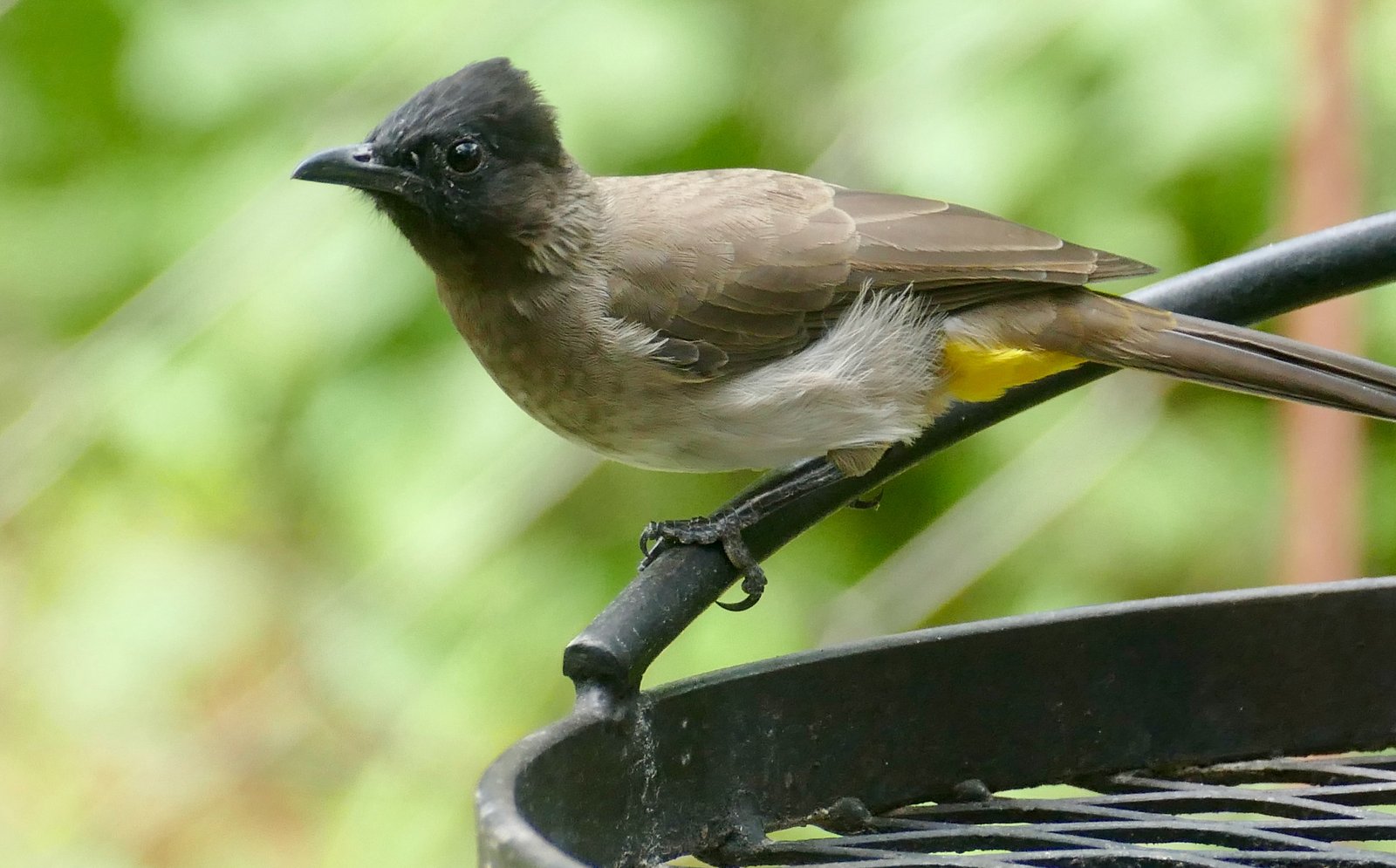
19–22 cm. The head is dark sooty brown to almost black, with a short crest raised when excited, and merges gradually into the grey-brown breast. Around the dark eye is a narrow black eye-ring without colour. The upperparts are grey-brown, the belly dirty white and the undertail-coverts bright yellow. Bill and legs black. The sexes are alike; juveniles are duller and browner on the head. It likes to sit in the open on a branch or wire and is often the first to raise the alarm at a predator.
Confusion species
African Red-Eyed Bulbul Pycnonotus nigricans has an orange-red eye-ring and a more sharply demarcated jet-black hood. Cape Bulbul Pycnonotus capensis has a white eye-ring and a brown rather than white belly. Hybrids occur in the contact zones. Sombre Greenbul Andropadus importunus and other greenbuls lack the dark head and yellow vent and keep more hidden.
Habitat
Almost any wooded or shrubby landscape with some cover: mixed woodland, miombo, mopane, riverine forest, forest edges, coastal forest and thicket, and at high densities in gardens, parks and orchards. It avoids the interior of closed forest, open grassland and the driest desert areas. It eats fruit, berries, nectar and insects.
Where the bird is most at home, classified by the vegetation units of southern Africa.



Range and movements
Almost everywhere in the north and east of the region: Angola (except the arid south-west), Zambia, Malawi, Mozambique and Zimbabwe; also northern and eastern Botswana, north-eastern Namibia (Kavango and the Zambezi Region), and in South Africa Limpopo, Mpumalanga, Gauteng, KwaZulu-Natal, the eastern Free State and the Eastern Cape west to about the Great Fish River; also in Lesotho and Eswatini. It is replaced in the west by African Red-Eyed Bulbul and in the south-west by Cape Bulbul. Beyond the region across almost all of sub-Saharan Africa and in north-west Africa.
- Resident
- Summer visitor (c. Oct–Mar)
- Winter visitor (c. Apr–Sep)
- Passage (Mar–Apr, Oct–Nov)
- dark = core range, pale = thinly spread
How and when to look
All year and present everywhere; a good reference species against which to check the calls and shape of the other bulbuls. Its alarm is an excellent pointer to a snake, owl or chameleon nearby: follow the persistent kwit-kwit.
Conservation status
Not threatened and one of the most numerous birds of the region. It benefits from gardens, orchards and planted fruit trees and has increased strongly in many towns. There are no significant threats.
Scientific name
Pycnonotus barbatus | (Desfontaines, 1789)
Desfontaines described the species in 1789 as Turdus barbatus; because it was later moved to another genus, the author and year stand in brackets. The genus Pycnonotus was introduced in 1826 by Boie. Pycnonotus is Greek, from puknos 'thick, compact' and -nōtos '-backed', from nōton 'back', after the dense plumage of the back. barbatus is Latin for 'bearded', from barba 'beard'. The specimen the first description was based on came from near Algiers.