All species › Passerines › Bulbuls › Cape Bulbul
Cape Bulbul | Pycnonotus capensis
Kaapse buulbuul | Bulbul del Cabo
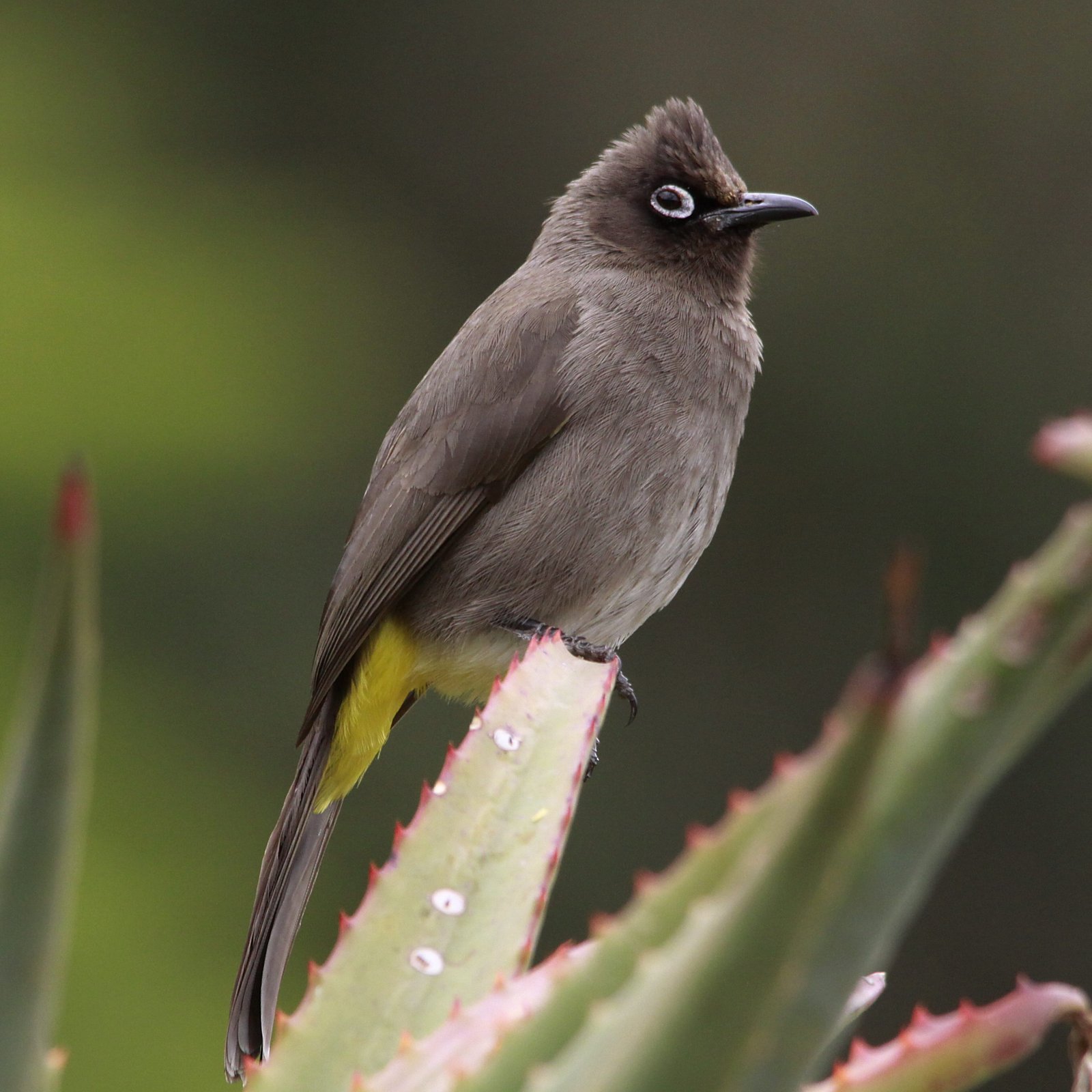
The Cape Bulbul is a dark brown bulbul with a conspicuous white eye-ring, found only in the south-west and south of South Africa. It is one of the best-known birds of the fynbos and of the gardens around Cape Town.
Voice
Clear, liquid whistles in short phrases, such as peetpeet-patata and peet-peet-peetpeetpeet, livelier and richer than those of Common Bulbul. The alarm is a sharp, repeated chik and a high chatter. Pairs often sing in duet from the top of a bush.
Recording: African Bioacoustics Community — CC BY-NC-SA 4.0 · converted to mono · xeno-canto
Identification
19–21 cm. Almost entirely dark chocolate-brown, darkest on the head, which has a small crest. Around the dark eye is a bare white eye-ring, which at close range can look slightly wrinkled. Throat and breast are brown and merge into the head without a clear border; the belly is slightly paler brown, sometimes with a faint pale wash. The undertail-coverts are bright lemon-yellow. Bill and legs black. The sexes are alike. Juveniles have a less conspicuous greyish eye-ring and are slightly warmer brown.
Confusion species
African Red-Eyed Bulbul Pycnonotus nigricans has a sharply demarcated black hood, an orange-red eye-ring and a pale belly. Common Bulbul Pycnonotus barbatus has a black eye-ring and a clearly paler, dirty-white belly. Hybrids with both species occur along the margins of the range, in the Karoo and in the Eastern Cape; a pale, not wholly white eye-ring or a paler belly can indicate such an intermediate.
Habitat
Fynbos, strandveld and coastal fynbos, coastal thickets and riverine scrub, and gardens, parks, orchards and vineyards within the fynbos region; also in plantations of alien trees. It eats fruit, berries, nectar and insects, and is an important seed disperser of native shrubs.
Where the bird is most at home, classified by the vegetation units of southern Africa.



Range and movements
Only in South Africa: in the Western Cape from southern Namaqualand southwards, across the Cape Peninsula and eastwards along the south coast, into the south-west of the Eastern Cape around the Great Fish River. Inland to the edge of the Karoo. The species does not occur outside the region.
- Resident
- dark = core range, pale = thinly spread
How and when to look
All year and common; certain at Kirstenbosch, in West Coast National Park and in almost any garden in Cape Town. As it is the only bulbul over most of the fynbos, identification there is simple; only at the margins of the range do intermediates need attention.
Conservation status
Not threatened and common. The species benefits from gardens and fruiting alien plants, but disappears where fynbos gives way entirely to cropland without shrubs. The range is small but densities are high.
Scientific name
Pycnonotus capensis | (Linnaeus, 1766)
Linnaeus described the species in 1766 as Turdus capensis; because it was later moved to another genus, the author and year stand in brackets. The genus Pycnonotus was introduced in 1826 by Boie. Pycnonotus is Greek, from puknos 'thick, compact' and -nōtos '-backed', from nōton 'back', after the dense plumage of the back. capensis is Latin for 'of the Cape', after the Cape of Good Hope, where the species was first collected. The specimen the first description was based on came from Cape of Good Hope.