All species › Passerines › Bulbuls › African Red-Eyed Bulbul
African Red-Eyed Bulbul | Pycnonotus nigricans
Maskerbuulbuul | Bulbul Encapuchado
The African Red-Eyed Bulbul is the bulbul of the arid west of southern Africa, from the Karoo and the Kalahari to south-western Angola. The black hood and the orange-red fleshy eye-ring make it easy to recognise; in the contact zones with Cape and Common Bulbul hybrids are frequent.

Voice
Clear, liquid whistled phrases, similar to those of Common Bulbul but often slightly higher and fuller, such as peet-peet-patata-peet. In alarm a dry, repeated chik-chik-chik and a scolding chatter, for example when an owl or a snake is discovered. It sings early in the morning from a high lookout.
Recording: Dawie de Swardt — CC BY-NC-SA 4.0 · converted to mono · xeno-canto
Identification
19–21 cm. The head, throat and upper breast are glossy black, forming a sharply defined hood with a slight crest. Around the dark eye is a bare, fleshy eye-ring that is orange to bright red. The upperparts are grey-brown, the breast grey-brown and the belly dirty white; the undertail-coverts are lemon-yellow. Tail and wings slightly darker brown. Bill and legs black. The sexes are alike. Juveniles have a pale pink to light orange eye-ring and a duller hood. It likes to perch conspicuously on top of a bush and pumps its tail up and down.
Confusion species
Common Bulbul Pycnonotus barbatus has a black, uncoloured eye-ring, a less sharply demarcated brownish-black head and a browner breast. Cape Bulbul Pycnonotus capensis is darker chocolate-brown, with a white eye-ring and a brown belly that merges gradually into the head. Where the species meet, for instance in eastern Botswana, in North West and Gauteng and along the margins of the Karoo, intermediates occur with a pale or partly coloured eye-ring; such birds cannot always be named.
Habitat
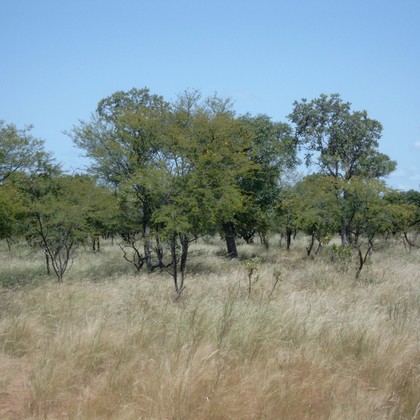
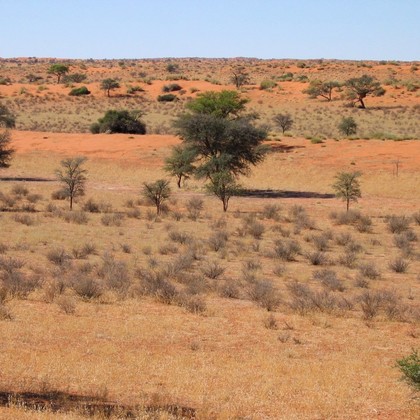
Dry savanna and thornveld, Kalahari thornveld, Nama-Karoo scrub, thickets along dry riverbeds, and gardens, farmsteads and rest camps in the arid interior. It needs shrubs or trees and drinking water nearby. It eats fruit and berries, nectar from aloes and other flowers, and insects. It lives in pairs or small groups.
Where the bird is most at home, classified by the vegetation units of southern Africa.

Range and movements
In Namibia almost everywhere except the Namib coast; in Botswana widespread, scarcer in the north-east; in South Africa in the Northern Cape, North West, the western Free State and the Karoo of the Western and Eastern Cape; also in western Lesotho, south-western Zimbabwe and south-western Angola (Namibe, Huíla and Cunene). The species does not occur outside the region.
- Resident
- Summer visitor (c. Oct–Mar)
- Winter visitor (c. Apr–Sep)
- Passage (Mar–Apr, Oct–Nov)
- dark = core range, pale = thinly spread
How and when to look
All year. In the rest camps of the Kgalagadi Transfrontier Park, at Augrabies and in the gardens of Windhoek it is tame and common. With bulbuls in the contact zones always check the colour of the eye-ring: bright orange-red is typical of this species, but pale or blotchy rings often indicate a hybrid.
Conservation status
Not threatened and common within its range. It benefits locally from gardens, farmyards and planted fruit trees in the arid interior and spreads along rivers and villages. Hybridisation with both related species is frequent and poses no threat.
Scientific name
Pycnonotus nigricans | (Vieillot, 1818)
Vieillot described the species in 1818 as Turdus nigricans; because it was later moved to another genus, the author and year stand in brackets. The genus Pycnonotus was introduced in 1826 by Boie. Pycnonotus is Greek, from puknos 'thick, compact' and -nōtos '-backed', from nōton 'back', after the dense plumage of the back. nigricans is Latin for 'blackish', from nigrare, 'to blacken' — for this bulbul's black head. The specimen the first description was based on came from banks of the Orange River, Namaqualand.