All species › Tubenoses › Petrels and shearwaters › Slender-Billed Prion
Slender-Billed Prion | Pachyptila belcheri
Dunbekprion | Prión Picofino
The Slender-Billed Prion is the palest and most finely built of the prions, with a narrow bill and a strikingly white face pattern. It breeds mainly on the Falklands and reaches the waters off southern Africa in winter in varying, usually small numbers.
Voice
Silent at sea. At the breeding sites a soft, cooing koo-roo and cackling calls at night.
Recording: Kevin Guille — CC BY-NC-SA 4.0 · shortened to the first 60 s, mono · xeno-canto
Identification
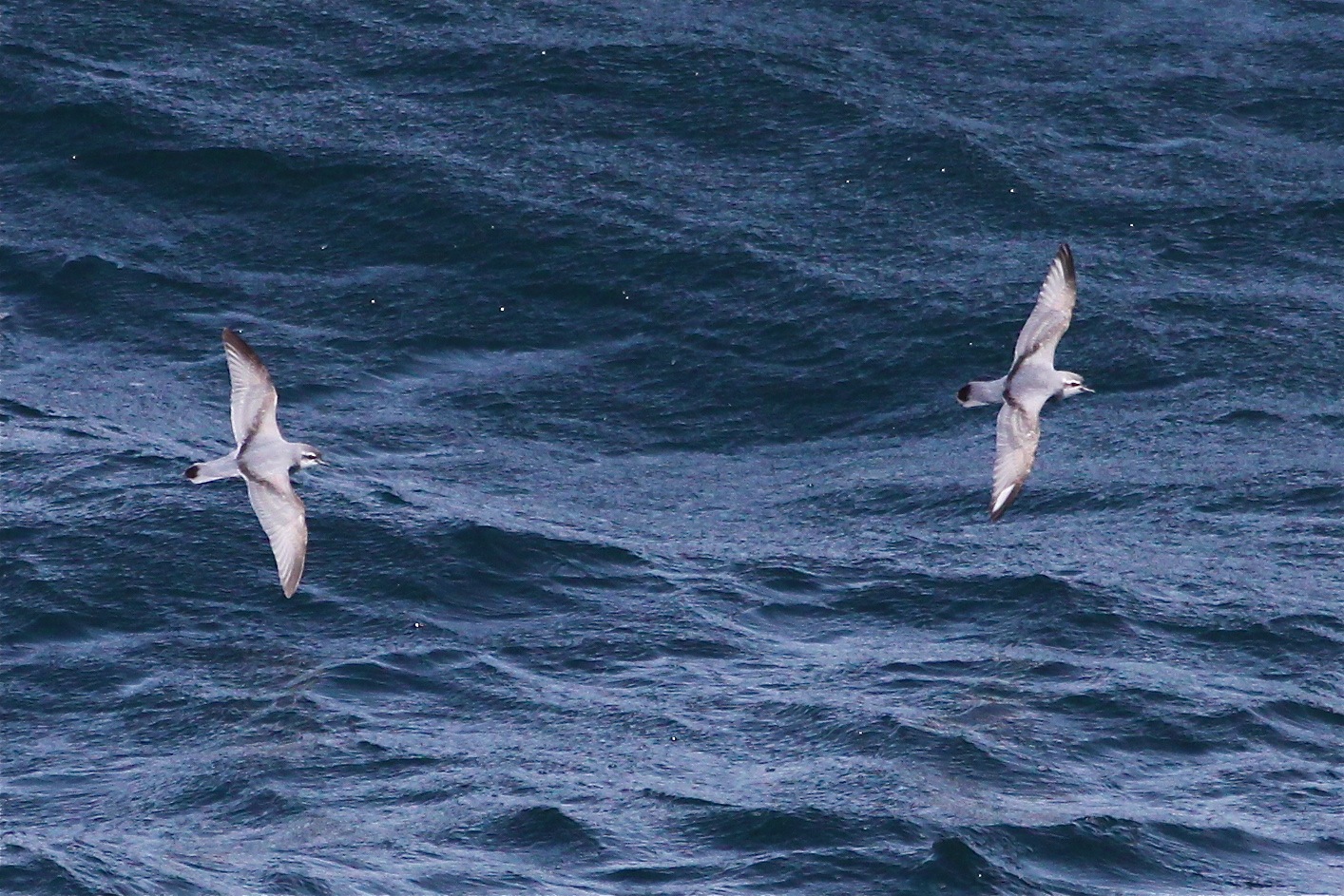
About 26 cm, a slim prion. The upperparts are pale blue-grey with a rather weak, thin black M across the wings. The face is striking: a broad, long white supercilium above a narrow dark eye-stripe gives the head a very pale look. The underparts are white, with only a small, faint grey patch on the side of the breast. The bill is narrow, slender and blue. The tail has a narrow black terminal band, sometimes barely visible from below, with grey outer tail feathers. It flies fast and twisting, often higher above the water than other prions.
Confusion species
Antarctic Prion (Pachyptila desolata) is darker, with a broader bill, a clearer M, darker sides to the head and a broader half-collar. Fairy Prion (Pachyptila turtur) is also pale but has a weak face pattern and a much broader black tail tip. Blue Petrel (Halobaena caerulea) has a white tail tip and a dark cap.
Habitat
Cold subantarctic ocean, outside the breeding season wandering far north into subtropical water. It feeds on small crustaceans, mainly amphipods and krill, picked from the surface. It breeds in burrows on grassy slopes on subantarctic islands.
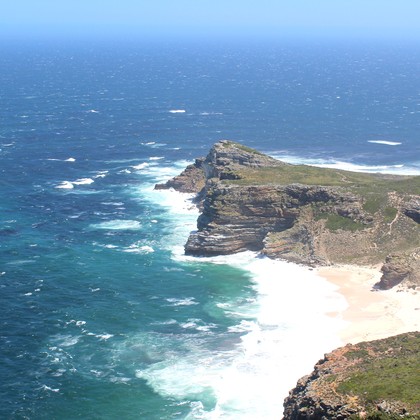
Where the bird is most at home, classified by the vegetation units of southern Africa.
Range and movements
In the region a scarce and irregular winter visitor far off the Western and Southern Cape; in some winters numbers of dead birds are found on beaches after storms, in other years almost none. It breeds on the Falklands, the Crozet and Kerguelen islands and islands off Tierra del Fuego, and wanders around the entire Southern Ocean to South America, Australia and New Zealand.
How and when to look
On winter pelagic trips out of Cape Town look for an exceptionally pale prion with a white head and a narrow tail band. Among beached prions the narrow bill separates the species well from Antarctic and Salvin's Prions.
Conservation status
Not threatened; the world population numbers millions of pairs, with the largest colonies on the Falklands and the Kerguelen Islands. Introduced rats and cats are a threat on some breeding islands.
Scientific name
Pachyptila belcheri | (Mathews, 1912)
Mathews described the species in 1912 as Heteroprion belcheri; because it was later moved to another genus, the author and year stand in brackets. The genus Pachyptila was introduced in 1811 by Illiger. Pachyptila comes from the Greek pakhus, 'dense, thick', and ptilon, 'feather' — for the dense, soft plumage of the prions. belcheri honours the Australian judge and amateur ornithologist Charles Frederic Belcher (1876–1970), who found the first specimens dead on a beach near Geelong. The specimen the first description was based on came from Geelong, Victoria, Australia.