All species › Birds of prey › Hawks, eagles and kites › Southern Banded Snake Eagle
Southern Banded Snake Eagle | Circaetus fasciolatus
Grijze slangenarend | Culebrera Barrada
The Southern Banded Snake Eagle is a stocky, grey-brown snake eagle of the coastal forests along the Indian Ocean. It sits for long periods unobtrusively in the canopy and gives itself away mainly by its loud, crowing call. In southern Africa it is one of the least known raptors.
Voice
Strikingly vocal for a snake eagle: a high, rapid, crowing ko-ko-ko-ko-kaaw, often from the canopy or while circling over the forest, and a drawn-out, plaintive kowaaa.
Recording: Magnus Wadstein — CC BY-NC-SA 4.0 · converted to mono · xeno-canto
Identification
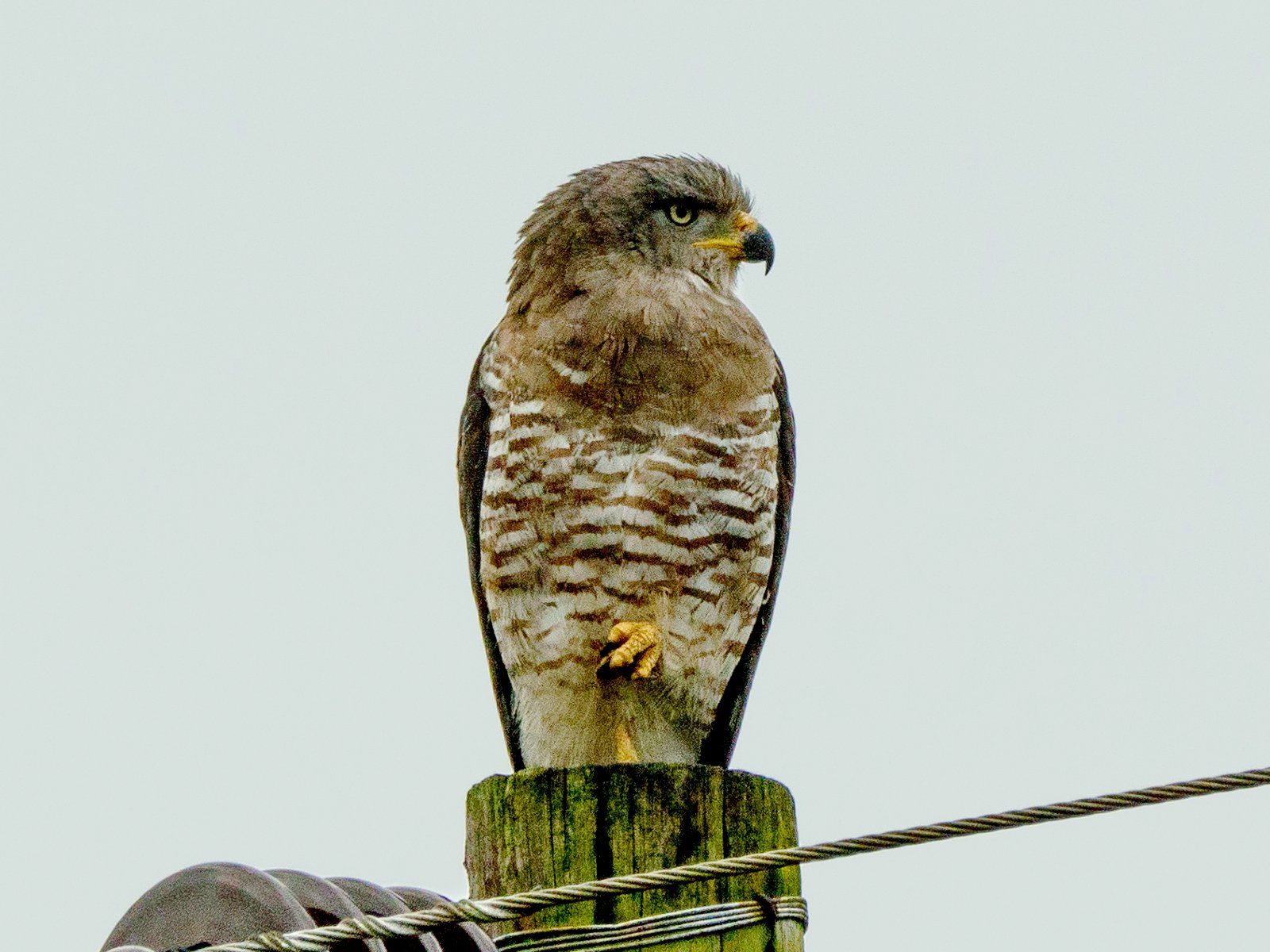
55–60 cm, wingspan 110–125 cm. Head, back and breast dark grey-brown; the lower breast and belly are closely barred white and brown. Large yellow eyes, yellow cere and bare yellow legs. The tail is fairly long, dark with three narrow pale bands and a pale tip. In flight the underwing is white with fine dark barring on the coverts and broad bands across the flight feathers; the wings are short and rounded, and the tail stands out for its length. The sexes are alike. Juveniles are browner, with a whitish, finely streaked head and breast and a paler, spotted belly.
Confusion species
Western Banded Snake Eagle (Circaetus cinerascens) is bulkier and short-tailed, with a single broad white band across the middle of the tail, a less barred belly and a whiter underwing; it lives in riverine forest inland. Lizard Buzzard (Kaupifalco monogrammicus) is much smaller and paler grey, with a white throat bearing a black central stripe, a white rump and one white tail band. Brown Snake Eagle is larger and uniformly brown.
Habitat
Coastal forest, lowland forest and forest edges, riverine forest and moist plantations on the coastal plain. It hunts snakes, lizards and frogs from a concealed perch at a forest edge. The nest is a small stick platform in a dense tree.
Where the bird is most at home, classified by the vegetation units of southern Africa.


Range and movements
Only the east of the region: the coastal plain of Mozambique, north-eastern KwaZulu-Natal (Zululand, south to about St Lucia), the extreme south-east of Zimbabwe along the Save and the lowlands of southern Malawi. Beyond the region along the coast of East Africa, from Tanzania and Kenya to southern Somalia.
- Resident
- Summer visitor (c. Oct–Mar)
- Passage (Mar–Apr, Oct–Nov)
- dark = core range, pale = thinly spread
How and when to look
Look for the species in the coastal forests of Zululand, for instance around iSimangaliso and Mkhuze, or on the Mozambican coastal plain, and listen for the crowing call early in the morning. A bird briefly circling and calling above the forest is the easiest to see; then check the long, triple-banded tail.
Conservation status
Near Threatened on the Red List. The world population is small and declining through clearance of coastal and lowland forest for agriculture, charcoal and tourism. Only a few dozen pairs are known in South Africa.
Scientific name
Circaetus fasciolatus | Kaup, 1847
Kaup described the species in 1847 as Circaëtus fasciolatus; because it was later moved to another genus, the author and year stand in brackets. The genus Circaetus was introduced in 1816 by Vieillot. Circaetus is Greek, from kirkos, a kind of hawk, and aetos 'eagle'. fasciolatus is modern Latin for 'finely banded', from fasciola, 'small band' — for the finely barred belly and tail. The specimen the first description was based on came from KwaZulu-Natal, South Africa.