All species › Passerines › Weavers › Southern Masked Weaver
Southern Masked Weaver | Ploceus velatus
Zuidelijke maskerwever | Tejedor Enmascarado Sureño
The Southern Masked Weaver is the weaver of gardens, campsites and thorn trees beside water. The breeding male is bright yellow with a black mask and a red eye. He weaves a kidney-shaped nest in a day, and tears it down again when the female rejects it.

Click a thumbnail to switch the photo above.
Voice
A rapid, harsh, sizzling jumble of rasping notes, a swizz-swizz-chrrr delivered while the bird hangs upside down beneath the nest with quivering wings. There is also a sharp chuk contact call and a hard zzzzt in alarm. A colony produces a sustained hiss of dozens of birds at once.
Recording: Marna Buys — CC BY-NC-SA 4.0 · converted to mono · xeno-canto
Identification
11–14.5 cm. The breeding male is bright yellow on head, neck and underparts, with a black mask over forehead, face and throat that ends rounded at the lower throat, and a yellow-green, dark-streaked back. The eye is bright red and the bill black and heavy. The female and the non-breeding male are dull yellow-green above with faint streaking and off-white to pale yellow below, with a horn-coloured bill; the eye stays red in the male and is brown in the female. Juveniles resemble the female. The bird climbs and hangs nimbly from branches and reed stems.
Confusion species
Village Weaver (Ploceus cucullatus) is larger, with a heavily black-blotched back; in the male the black mask extends onto the nape. Lesser Masked Weaver (Ploceus intermedius) has a pale whitish eye, blue-grey legs and a mask that continues over the crown. Cape Weaver (Ploceus capensis) is larger and longer-billed and lacks the black mask; the male has an orange-buff face. Eye colour and the shape of the mask always settle it.
Habitat
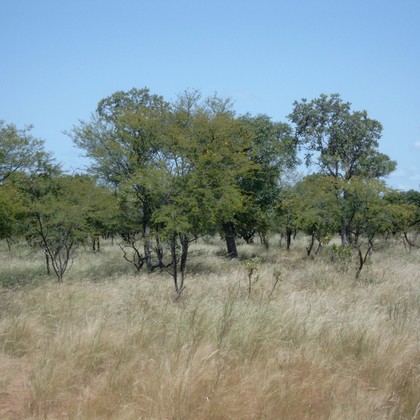
Almost everywhere except closed forest and true desert: savanna, thornveld, riverine scrub, farmland, villages, parks and gardens. It breeds in colonies of a few to dozens of nests, slung from the tips of thorn branches, in reeds or from palm fronds, often over water and increasingly in gardens. It eats seeds, insects and nectar.
Where the bird is most at home, classified by the vegetation units of southern Africa.

Range and movements
Across almost all of southern Africa: South Africa, Lesotho, Eswatini, Namibia, Botswana, Zimbabwe, southern Mozambique, Zambia and Angola. It is absent from the core Namib and from closed coastal forest. Beyond the region it scarcely reaches past the northern edge of the area.
- Resident
- Summer visitor (c. Oct–Mar)
- Winter visitor (c. Apr–Sep)
- Passage (Mar–Apr, Oct–Nov)
- dark = core range, pale = thinly spread
How and when to look
September to March, when the males are building. Find a thorn tree or a reedbed over water at a campsite or garden and watch for half an hour: the male weaves the nest from the outside in, then hangs upside down below the entrance with quivering wings, and pulls the nest apart himself when the female inspects it and leaves. One male may build dozens of nests in a season this way.
Conservation status
Not threatened; common and increased in numbers through gardens, irrigation, alien trees and grain farming. It is parasitised by the Diederik Cuckoo. In grain and fruit growing the species is locally regarded as damaging, and colonies are removed under licence.
Scientific name
Ploceus velatus | Vieillot, 1819
Vieillot described the species in 1819 and placed it straight away in the genus where it still stands. The genus Ploceus was introduced in 1816 by Cuvier, GLCFD. Ploceus comes from the Greek plokeus, 'plaiter, weaver', for the tightly woven, ball-shaped nest that gives weavers their name. velatus is Latin for 'veiled, masked', for the black facial mask of the male in breeding plumage. The specimen the first description was based on came from Namaqualand, near the Orange River.