All species › Woodpeckers and allies › African barbets › Southern Red-Fronted Tinkerbird
Southern Red-Fronted Tinkerbird | Pogoniulus pusillus
Zuidelijke roodvoorhoofdketellapper | Barbudito Frentirrojo Sureño
The Southern Red-Fronted Tinkerbird is a small streaked barbet with a scarlet forehead patch, almost confined to the south-east of the region. Where its range meets that of the Yellow-Fronted Tinkerbird, hybrids with orange foreheads occur.

Voice
A long, monotonous series of tinking notes, pop-pop-pop-pop, at about two per second and sometimes unbroken for minutes; barely separable from Yellow-Fronted Tinkerbird, but clearly different from the short groups of Yellow-Rumped Tinkerbird. Also a fast, dry trill.
Recording: Maarten Sluijter — CC BY-NC-SA 4.0 · converted to mono · xeno-canto
Identification
About 10 cm, with a short tail and a small black bill. The face has a black-and-white striped pattern with a narrow pale supercilium; the forehead is bright red. Upperparts black streaked with yellow and white, rump lemon-yellow, wings black with yellow edges to the feathers. Underparts pale yellow to greyish white. The sexes are alike; juveniles lack the red forehead or show only a trace of it, and have a pale bill base.
Confusion species
Yellow-Fronted Tinkerbird (Pogoniulus chrysoconus) is identical apart from the forehead, which is yellow to orange; in the contact zone in Mpumalanga, Eswatini and northern KwaZulu-Natal, birds with orange foreheads cannot safely be assigned to either species. Yellow-Rumped Tinkerbird (Pogoniulus bilineatus) has an unstreaked black back and no coloured forehead.
Habitat
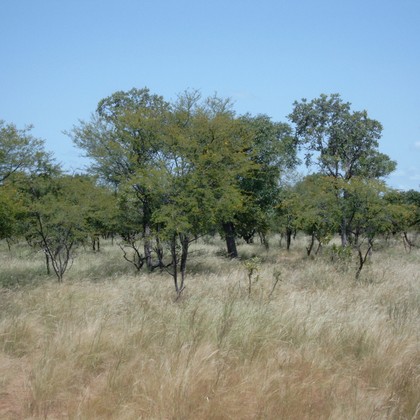
Coastal bush, dry forest edges, thornveld, riverine woodland and thickets with mistletoe; often in drier and more open country than Yellow-Rumped Tinkerbird. It eats mainly mistletoe berries and other small fruits, supplemented with insects. It excavates a nest hole in a thin dead branch.
Where the bird is most at home, classified by the vegetation units of southern Africa.

Range and movements
Only the south-east of the region: the Eastern Cape from around Gqeberha north-eastwards, KwaZulu-Natal, Eswatini, eastern Mpumalanga and southern Mozambique. It does not occur outside this area; the red-fronted tinkerbirds of north-east and East Africa are now treated as a separate species, Northern Red-Fronted Tinkerbird (Pogoniulus uropygialis).
- Resident
- Summer visitor (c. Oct–Mar)
- Winter visitor (c. Apr–Sep)
- Passage (Mar–Apr, Oct–Nov)
- dark = core range, pale = thinly spread
How and when to look
Most often recorded in the coastal bush of the Eastern Cape and KwaZulu-Natal, where the call series can be heard all year. Check mistletoe clumps in thorn trees: the bird returns to them repeatedly to pick berries. In the contact zone with Yellow-Fronted Tinkerbird, it pays to judge the forehead colour in good light.
Conservation status
Not threatened and common within its small range. As a species almost restricted to the region, it merits attention for the conservation of coastal bush in the Eastern Cape and KwaZulu-Natal.
Scientific name
Pogoniulus pusillus | (Dumont, 1816)
Dumont described the species in 1816 as Bucco pusillus; because it was later moved to another genus, the author and year stand in brackets. The genus Pogoniulus was introduced in 1842 by De Lafresnaye. Pogoniulus is a diminutive of Pogonias, from the Greek pōgōnias, 'bearded' — thus 'little barbet', fitting for these smallest barbets. pusillus is Latin for 'very small' — for the tiny size of this bird. The specimen the first description was based on came from Sundays and Swartkops rivers, Eastern Cape, South Africa.