All species › Woodpeckers and allies › African barbets › Yellow-Fronted Tinkerbird
Yellow-Fronted Tinkerbird | Pogoniulus chrysoconus
Geelvoorhoofdketellapper | Barbudito Frentigualdo
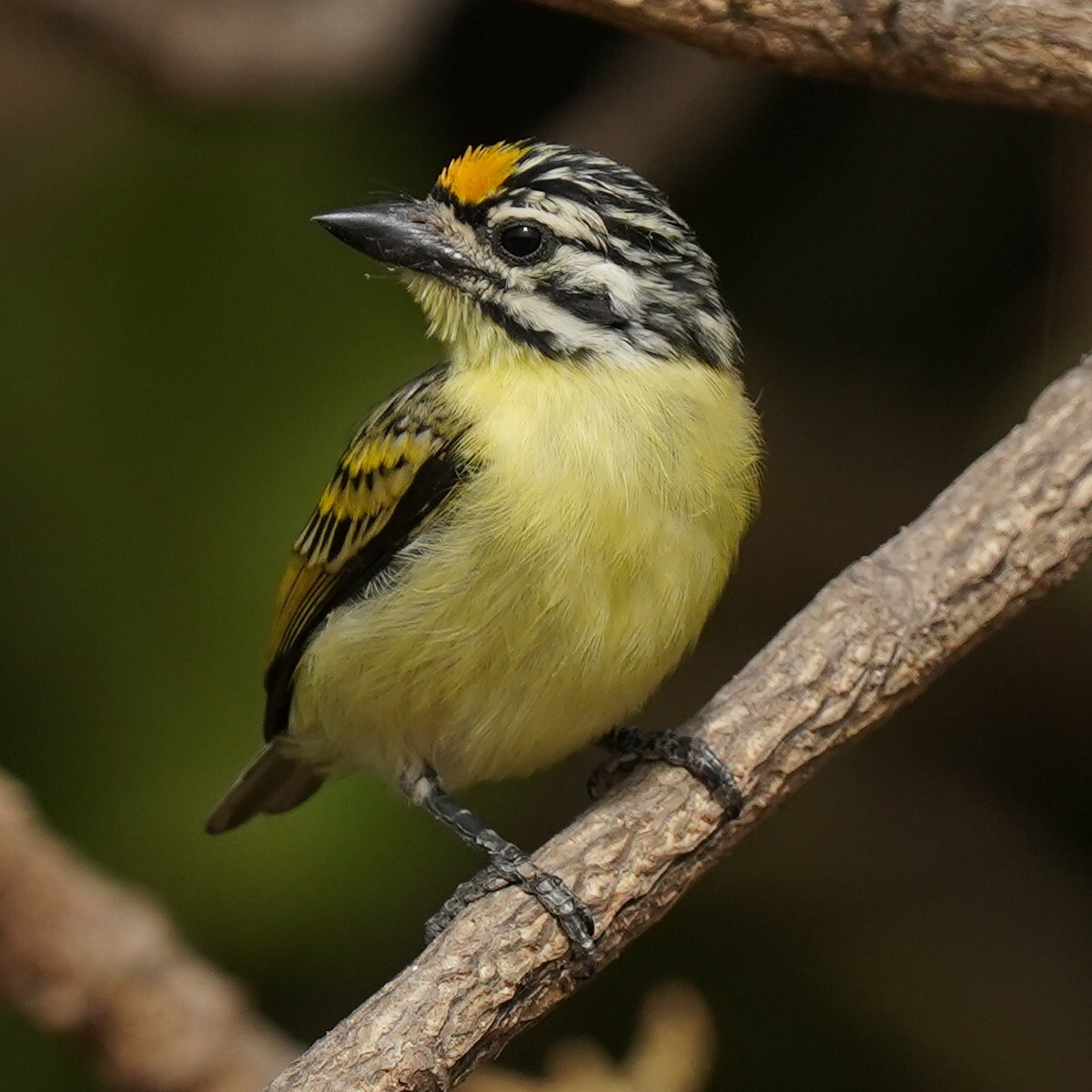
The Yellow-Fronted Tinkerbird is the common tinkerbird of savanna woodland in the north of the region: a small streaked barbet with a yellow to orange forehead patch. Its tinking call, repeated endlessly from a treetop, is one of the most frequently heard sounds of the bushveld.
Voice
A long, monotonous series of tinking notes, tonk-tonk-tonk-tonk, slightly more than one per second and running for minutes, like a hammer on an anvil. Also a fast trill and, when excited, a series of dry chirps.
Recording: Zsombor Károlyi — CC BY-NC-SA 4.0 · converted to mono · xeno-canto
Identification
About 10–11 cm, with a short tail and a small black bill. The face is striped black and white with a narrow pale supercilium and a white moustachial stripe; the forehead is yellow, golden-yellow to orange in many birds. Upperparts black streaked with yellow and white, rump lemon-yellow, wings black with yellow edges to the feathers. Underparts pale yellow to greyish white. The sexes are alike; juveniles have a black or speckled forehead and a pale bill base.
Confusion species
Southern Red-Fronted Tinkerbird (Pogoniulus pusillus) has a scarlet forehead and replaces this species in the south-east; orange foreheads in the contact zone may indicate hybrids. Yellow-Rumped Tinkerbird (Pogoniulus bilineatus) has an unstreaked black back, no coloured forehead and lives in evergreen forest. Juveniles without a forehead patch resemble those of Southern Red-Fronted Tinkerbird and outside the contact zone are best identified on range.
Habitat
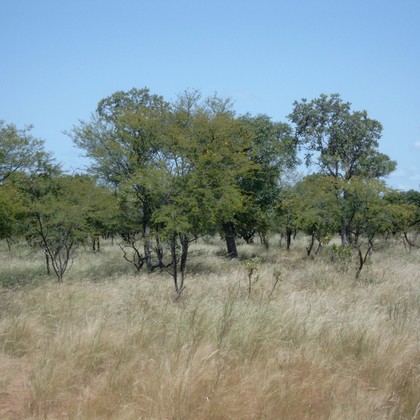
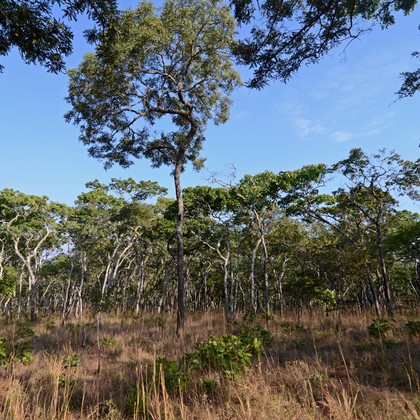
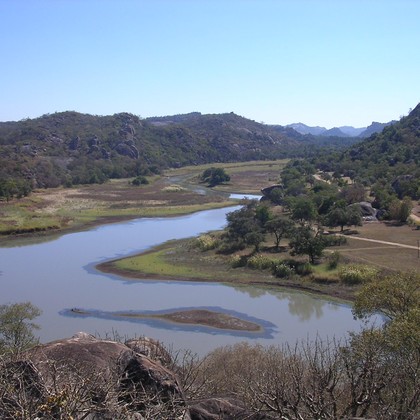
Dry and moist woodland: acacia savanna, miombo, mopane, mixed broadleaved woodland and riverine woodland, into gardens and orchards. It eats mainly mistletoe berries and plays an important role in dispersing mistletoes; insects supplement the diet. It excavates a nest hole in a thin dead branch.
Where the bird is most at home, classified by the vegetation units of southern Africa.
Range and movements
The north and north-east of the region: Limpopo, Mpumalanga, North West and northern Gauteng in South Africa, northern and eastern Botswana, northern Namibia, Zimbabwe, Zambia, Malawi, Mozambique and Angola. Absent from the arid Kalahari and from southern and western South Africa. Beyond the region across the savanna belt from Senegal to Ethiopia and through East Africa.
- Resident
- Summer visitor (c. Oct–Mar)
- Winter visitor (c. Apr–Sep)
- Passage (Mar–Apr, Oct–Nov)
- dark = core range, pale = thinly spread
How and when to look
Heard all year in almost any stretch of woodland in the north; follow the call series to the crown of a tree carrying mistletoe. The bird often sits in the outer twigs and shuffles along, so with some patience it can be seen well. Judge the forehead in good light: in shade, orange can look red.
Conservation status
Not threatened and common to very common in woodland. It benefits from mistletoe in planted and disturbed vegetation and is little affected by human influence.
Scientific name
Pogoniulus chrysoconus | (Temminck, 1832)
Temminck described the species in 1832 as Bucco chrysoconus; because it was later moved to another genus, the author and year stand in brackets. The genus Pogoniulus was introduced in 1842 by De Lafresnaye. Pogoniulus is a diminutive of Pogonias, from the Greek pōgōnias, 'bearded' — thus 'little barbet', fitting for these smallest barbets. chrysoconus comes from the Greek khrusos, 'gold', and kōnos, 'peak of a helmet' — for the yellow patch on the forehead. The specimen the first description was based on came from Galam, Senegal.