All species › Tubenoses › Albatrosses › Southern Royal Albatross
Southern Royal Albatross | Diomedea epomophora
Zuidelijke koningsalbatros | Albatros Real
The Southern Royal Albatross shares with the Snowy Albatross the title of the world's largest seabird. It breeds on the subantarctic islands of New Zealand and is a rare sight in southern African waters, seen mainly in winter off the Cape.

Voice
Almost silent at sea. At the breeding site a display with spread wings, bill clapping and a deep groaning bray.
Recording: Sander Lagerveld — CC BY-NC-SA 4.0 · shortened to the first 60 s, mono · xeno-canto
Identification
Huge: 107 to 122 cm, with a wingspan of 2.9 to 3.5 m. Head, body and tail are white from fledging; there is no brown juvenile plumage. The massive bill is pale pink with a yellowish tip and a thin black cutting edge along the upper mandible, visible at close range. The upperwing of young birds is black with small white flecks and whitens with age, starting at the leading edge and shoulder, so that old birds show a broad white forewing and a black trailing edge. The underwing is white with a narrow black trailing edge and tip. Young birds sometimes have dark flecks on the crown and tail.
Confusion species
The Northern Royal Albatross (Diomedea sanfordi) is smaller and keeps a wholly black upperwing even when old, with a small black mark at the carpal on the underwing. The Snowy Albatross (Diomedea exulans) lacks the black cutting edge, has a brown juvenile plumage and whitens from the centre of the upperwing rather than from the leading edge; immatures are often finely vermiculated on the body. The Tristan Albatross (Diomedea dabbenena) is darker and also lacks the cutting edge.
Habitat
Open ocean, both over deep water and along the continental shelf edge, in cool and temperate waters. It feeds mainly on squid and fish, and at times follows fishing vessels. It breeds in the upland grassland and scrub of Campbell Island, where the nest is a low mound of plant material.
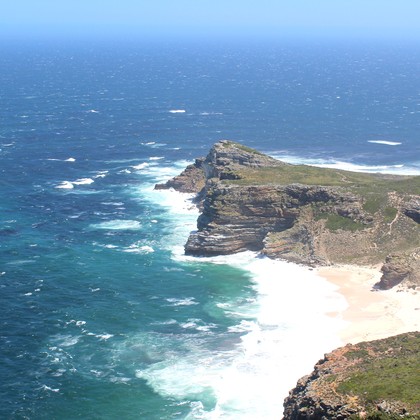
Where the bird is most at home, classified by the vegetation units of southern Africa.
Range and movements
It breeds almost only on Campbell Island, with a small number of pairs on the Auckland Islands (New Zealand). After breeding the birds move east to waters off South America, and some range around the whole southern ocean. Within the region rare: a few sightings a year over deep water off the Western Cape, mainly from May to September, and seldom off the Eastern Cape.
How and when to look
A possibility on winter pelagic trips to trawlers beyond the shelf edge off Cape Town. Check the bill of every large white albatross at close range or on a photograph: a black cutting edge means a royal albatross. Then look at the upperwing and the carpal mark on the underwing.
Conservation status
Vulnerable, because of the small number of breeding sites and slow reproduction. The population on Campbell has recovered from a historical crash caused by sheep grazing and introduced rats and is fairly stable. The main threat at sea is bycatch in longline and, to a lesser extent, trawl fisheries.
Scientific name
Diomedea epomophora | Lesson, 1825
Lesson described the species in 1825 as Diomedaea epomophora; because it was later moved to another genus, the author and year stand in brackets. The genus Diomedea was introduced in 1758 by Linnaeus. Diomedea refers to Diomedes, the Greek hero whose companions, according to myth, were turned into seabirds. epomophora comes from the Greek epōmis, 'shoulder', and -phoros, 'bearing' — 'shoulder-bearer'; possibly for the whitening upperwing of older birds, but the intent is uncertain. The specimen the first description was based on came from Campbell Island, New Zealand (designated later).