All species › Tubenoses › Albatrosses › Northern Royal Albatross
Northern Royal Albatross | Diomedea sanfordi
Noordelijke koningsalbatros | Albatros Real del Norte
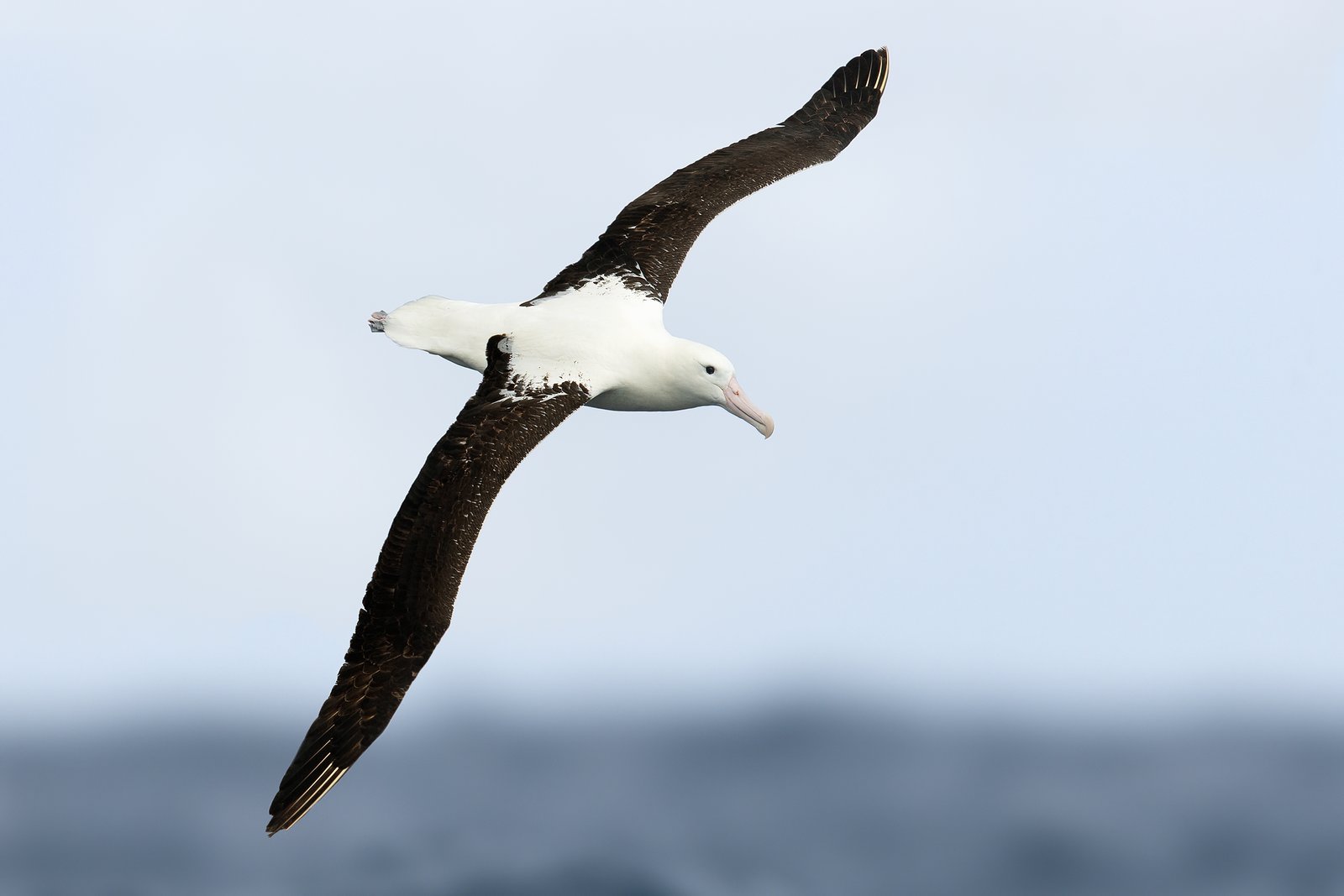
The Northern Royal Albatross is the smaller of the two royal albatrosses, with a white body and a wholly black upperwing. It breeds mainly on the Chatham Islands and in a famous small colony on the New Zealand mainland, and only rarely reaches southern African waters.
Voice
Almost silent at sea. At the breeding site a display with bill clapping, spread wings and a deep groaning bray.
Recording: Oscar Thomas — CC BY-SA 4.0 · converted to mono · xeno-canto
Identification
Very large: 107 to 120 cm, with a wingspan of 2.7 to 3.05 m. Head, body and tail are white, and the upperwing is plain blackish brown at all ages, with no white on the leading edge. The bill is pale pink with a yellowish tip and a black cutting edge along the upper mandible. The underwing is white with a narrow black trailing edge and tip, and a narrow black line along the leading edge at the carpal that shows as a dark mark. Young birds sometimes have fine dark flecks on the crown and back.
Confusion species
The Southern Royal Albatross (Diomedea epomophora) is larger, develops a white forewing on the upperwing with age and lacks the black carpal mark on the underwing. The Snowy Albatross (Diomedea exulans) lacks the black cutting edge, has a brown juvenile plumage and with age also becomes white on the upperwing. It differs at once from the smaller albatrosses such as the Black-Browed Albatross (Thalassarche melanophris) by its size and pale bill.
Habitat
Open ocean and the continental shelf edge, in cool and temperate waters. It feeds mainly on squid and fish. It breeds on rocky, windswept islands with sparse vegetation, and at Taiaroa Head on a grassy headland.
Where the bird is most at home, classified by the vegetation units of southern Africa.
Range and movements
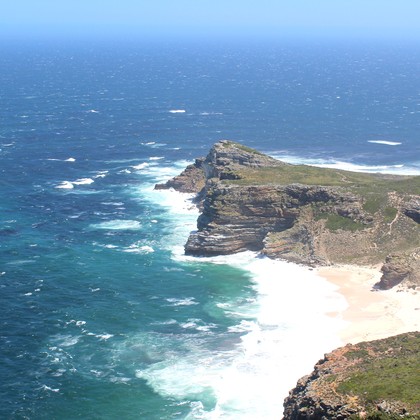
It breeds almost entirely on the Chatham Islands (New Zealand), with a small colony at Taiaroa Head on the South Island and a handful of pairs on the Auckland Islands. Outside the breeding season it crosses the Pacific to waters off Chile and Argentina and from there ranges further around the southern ocean. Within the region a very rare visitor over deep water off the Western Cape, with a few winter records.
How and when to look
To be looked for among the albatrosses behind trawlers beyond the shelf edge off Cape Town, but only with much luck. On a large white albatross with a black cutting edge, look at the upperwing: wholly dark in an adult points to this species; photograph the underwing as well for the carpal mark.
Conservation status
Endangered. Storms in the 1980s destroyed much of the vegetation on the Chatham Islands, after which nests on bare rock were poorly protected and breeding success remained low. At sea longline bycatch is a threat. The colony at Taiaroa Head is intensively protected and monitored.
Scientific name
Diomedea sanfordi | Murphy, 1917
Murphy described the species in 1917 and placed it straight away in the genus where it still stands. The genus Diomedea was introduced in 1758 by Linnaeus. Diomedea refers to Diomedes, the Greek hero whose companions, according to myth, were turned into seabirds. sanfordi honours the American surgeon and ornithologist Leonard Cutler Sanford (1868–1950), a leading patron of the bird department of the American Museum of Natural History. The specimen the first description was based on came from Off Corral, Chile.