All species › Passerines › Shrikes › Southern White-Crowned Shrike
Southern White-Crowned Shrike | Eurocephalus anguitimens
Witkruinklauwier | Alcaudón Coroniblanco
The Southern White-Crowned Shrike is a large, sedate shrike that moves in small groups through mopane and dry thornveld. The snow-white crown above a broad black mask can be seen from far off, and a gliding group with stiffly spread wings and white rumps is unmistakable. The species is confined to southern Africa.
Voice
Noisy in groups: a high, nasal squeaking or whistling such as kweep-kweep and kweer-kweer, repeated in chorus by the group, often with chattering and creaking notes in between. In flight a soft, plaintive pee-oo.
Recording: Derek Solomon — CC BY-NC-SA 4.0 · shortened to the first 60 s, mono · xeno-canto
Identification
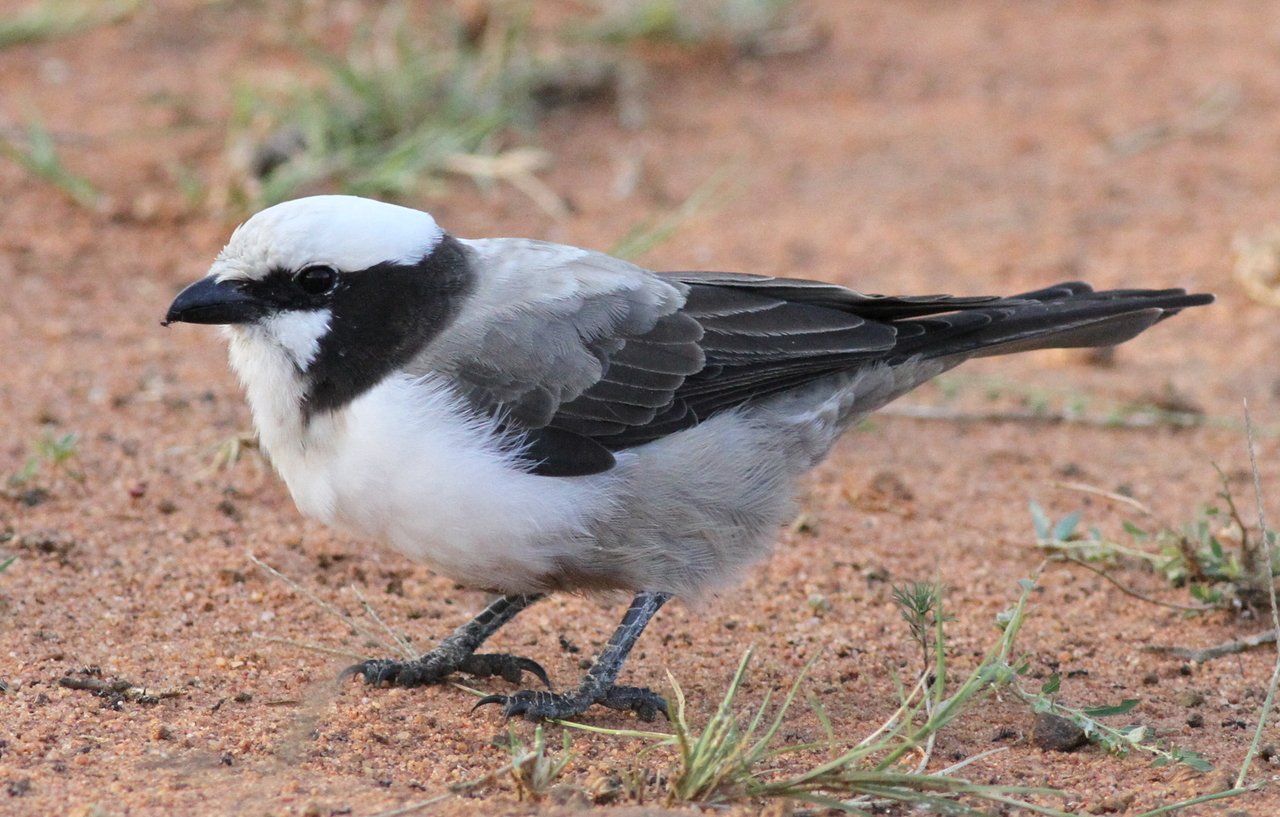
23–25 cm. The crown and forehead are pure white, separated from the white throat by a broad black mask running from the base of the bill through the eye and over the ear-coverts. The nape, back and wings are grey-brown, the rump is white and the tail dark brown. The breast is white, grading into grey-brown to dull brown belly and flanks. The bill is heavy, black and slightly hooked, and the eye is dark. The sexes are alike. Juveniles have a greyish, finely streaked crown and a paler bill. The flight is slow and gliding on flat wings.
Confusion species
White-Crested Helmetshrike Prionops plumatus also lives in groups but is smaller, black and white with a white crest, a yellow eye-ring and a long white wing stripe. Southern Pied Babbler Turdoides bicolor has an all-white head and underparts without a mask, and black wings and tail. White-Tailed Shrike Lanioturdus torquatus of Namibia and south-western Angola is smaller, with a black head, a black breast band and a short white tail.
Habitat
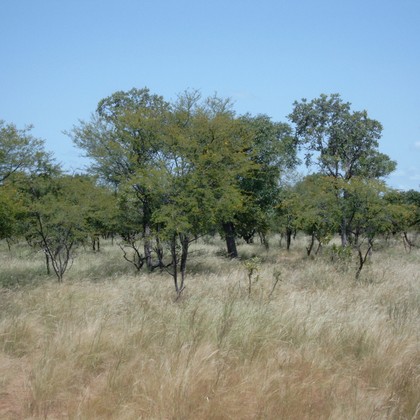
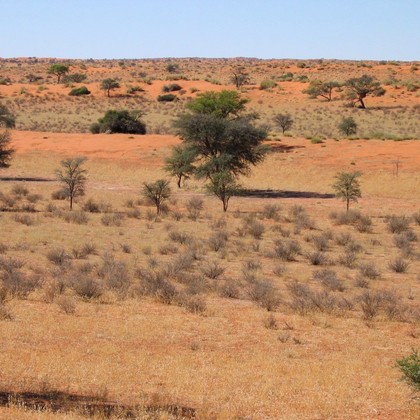
Dry, open woodland: mopane, acacia thornveld, Kalahari thornveld, dry mixed woodland and open areas along rivers in dry country. It often perches openly on low branches and drops to the ground for insects, spiders and small lizards. It breeds cooperatively; the nest is a thick, cobweb-bound cup on a horizontal branch.
Where the bird is most at home, classified by the vegetation units of southern Africa.

Range and movements
Confined to southern Africa: south-western Angola (Namibe, Huíla, Cunene), northern and central Namibia, almost all of Botswana except the extreme south-west, western and southern Zimbabwe and the Zambezi valley, southern Zambia, southern Mozambique (Limpopo valley) and north-eastern South Africa (Limpopo, Kruger and the north of North West and Mpumalanga). In East Africa it is replaced by the related Eurocephalus rueppelli.
- Resident
- Summer visitor (c. Oct–Mar)
- Winter visitor (c. Apr–Sep)
- Passage (Mar–Apr, Oct–Nov)
- dark = core range, pale = thinly spread
How and when to look
Year-round, often seen during the day in the mopane of northern Kruger, Mapungubwe, Hwange, Chobe and Etosha. Look for a small group of large birds on low branches along the road; they usually allow a leisurely view.
Conservation status
Not threatened. The species is fairly common in suitable habitat and its range is large. Locally woodland is lost to cutting for firewood and to cultivation, but no large-scale threats are known.
Scientific name
Eurocephalus anguitimens | Smith, 1836
Smith described the species in 1836 and placed it straight away in the genus where it still stands. He introduced the genus Eurocephalus in that same work. Eurocephalus comes from the Greek eurus, 'broad', and kephalē, 'head' — for the large, broad head of these shrikes. anguitimens is Latin for 'snake-fearing', from anguis, 'snake', and timere, 'to fear' — for describer Andrew Smith's claim that the bird was afraid of snakes. The specimen the first description was based on came from Between Kuruman (Latakoo) and the Tropic of Capricorn.