All species › Woodpeckers and allies › Woodpeckers › Speckle-Throated Woodpecker
Speckle-Throated Woodpecker | Campethera scriptoricauda
Reichenows specht | Pito de Tanzania
The Speckle-Throated Woodpecker is the north-eastern counterpart of Bennett's Woodpecker and was long treated as a subspecies of it. Within the region it is confined to Malawi and northern Mozambique, where it lives in miombo and dry savanna woodland.
Voice
A fast, high, repeated wirrr-it wirrr-it, very like that of Bennett's Woodpecker, and a dry chik. Pairs duet with wings spread.
Recording: Niall Perrins — CC BY-NC-SA 4.0 · converted to mono · xeno-canto
Identification
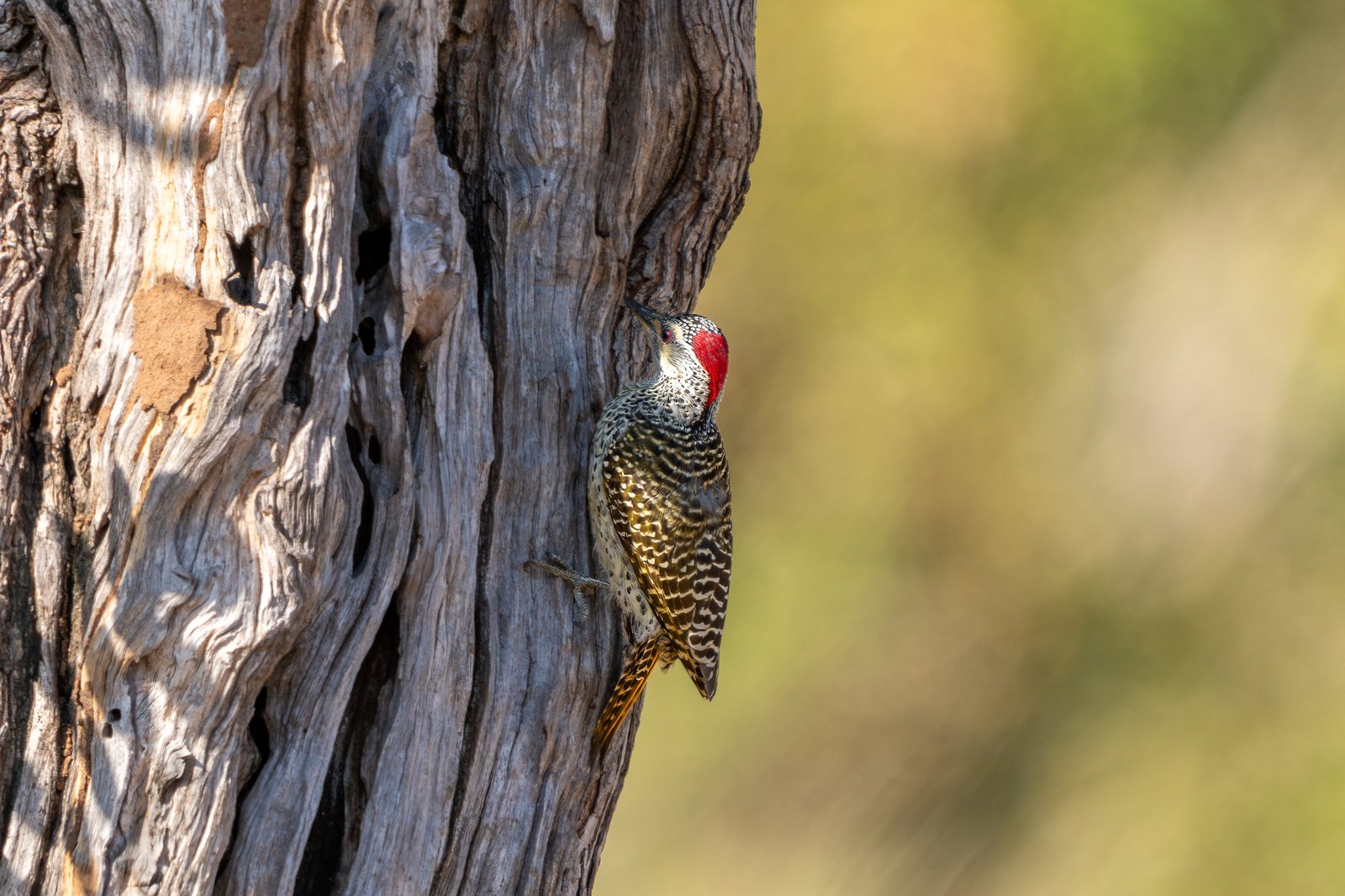
About 21 cm. Build and back pattern as in Bennett's Woodpecker: olive-brown with pale barring and a yellowish tail. The underparts are pale yellowish with small black spots. The key feature is the throat and cheek, which in both sexes are white densely speckled with black. The male has a red crown and red moustachial stripe; the female has a black forehead dotted white, a red hind crown and a black-speckled moustachial stripe, but no brown throat.
Confusion species
Bennett's Woodpecker (Campethera bennettii) has a white, unspotted throat in the male and a plain brown throat and cheek-stripe in the female. Golden-Tailed Woodpecker (Campethera abingoni) is streaked rather than spotted on breast and belly. Cardinal Woodpecker (Dendropicos fuscescens) is smaller, with a barred back and brown forehead.
Habitat
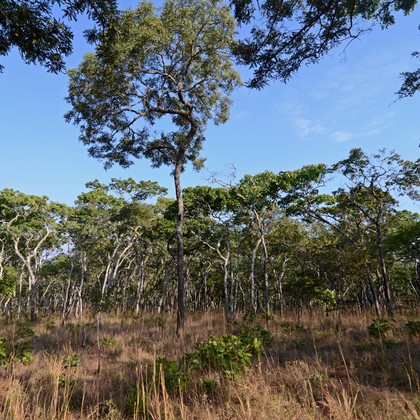
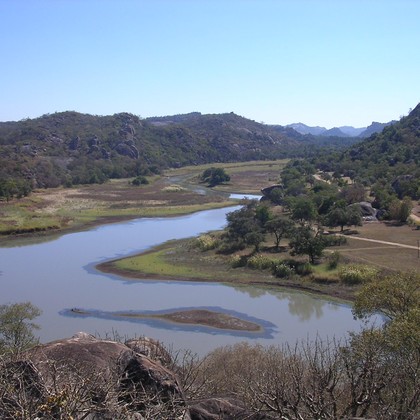
Miombo and other dry broadleaved woodland, savanna with scattered trees and the edges of farmland with old trees. It forages both in trees and on the ground, mainly for ants and termites.
Where the bird is most at home, classified by the vegetation units of southern Africa.
Range and movements
Within the region in Malawi (mainly in the south and centre) and northern Mozambique north of the Zambezi (Tete, Zambezia, Niassa, Nampula and Cabo Delgado). Beyond the region in eastern and central Tanzania. Where its range meets that of Bennett's Woodpecker, intermediates occur.
- Resident
- dark = core range, pale = thinly spread
How and when to look
In Malawi and northern Mozambique any spotted Campethera woodpecker in miombo is a candidate; look at the throat. A female with a speckled rather than a brown throat rules out Bennett's Woodpecker.
Conservation status
Not threatened, but poorly known and locally scarce. Clearance for farming and charcoal in the miombo of Mozambique and Malawi is the main threat.
Scientific name
Campethera scriptoricauda | (Reichenow, 1896)
Reichenow described the species in 1896 as Dendromus scriptoricauda; because it was later moved to another genus, the author and year stand in brackets. The genus Campethera was introduced in 1841 by Gray. Campethera comes from the Greek kampē, 'caterpillar', and thēras, 'hunter' — 'caterpillar hunter', for the insect diet of these woodpeckers. scriptoricauda probably comes from the Latin scriptor, 'writer', and cauda, 'tail' — for the tail with its 'written' markings. The specimen the first description was based on came from Bumi, Tanzania (type in Berlin; no locality given).