All species › Woodpeckers and allies › Woodpeckers › Bennett's Woodpecker
Bennett's Woodpecker | Campethera bennettii
Bennetts specht | Pito de Bennett
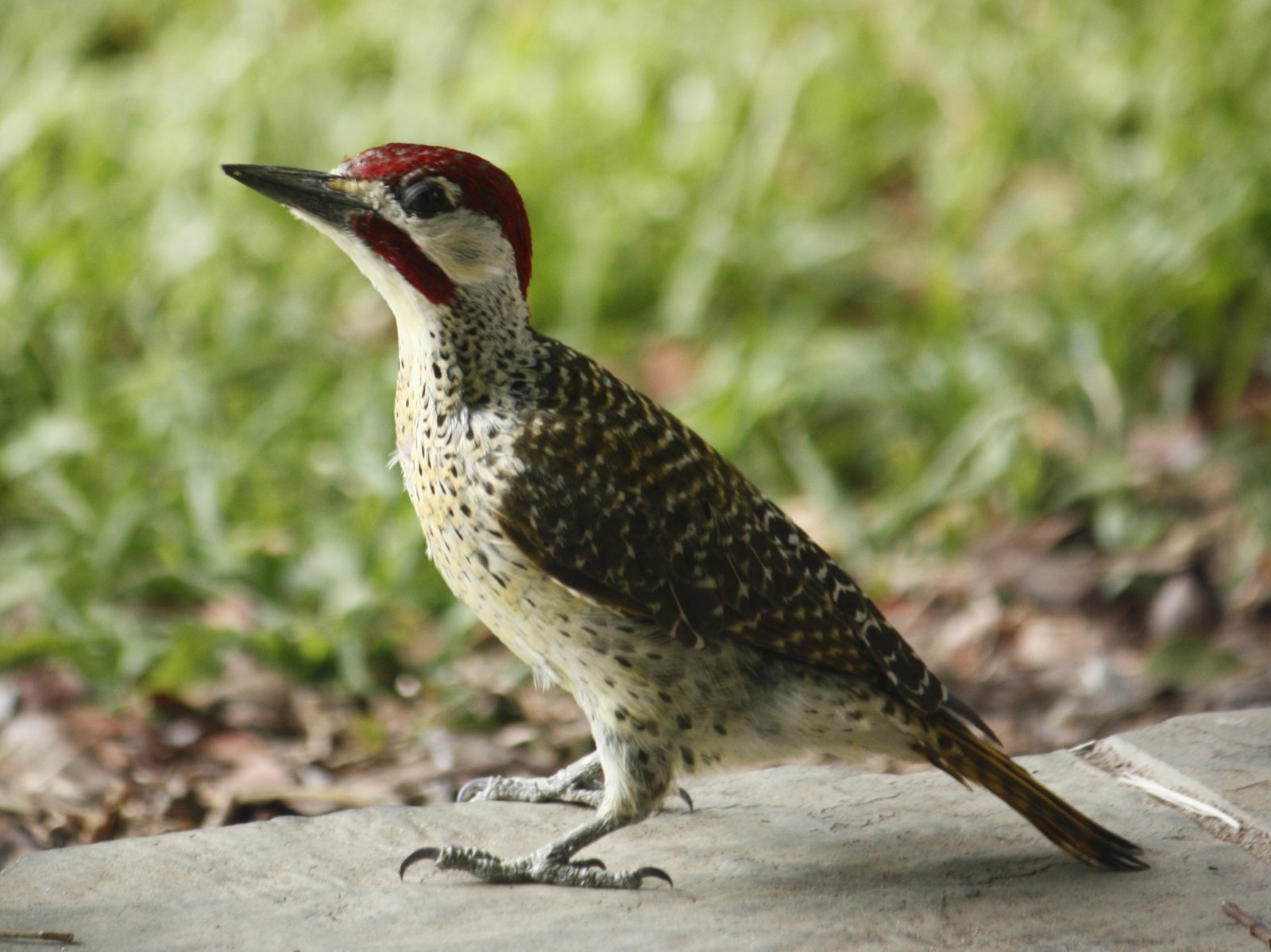
Bennett's Woodpecker is a woodpecker of open savanna woodland that spends a striking amount of time on the ground, where it opens up ant and termite galleries with its bill. The sexes differ clearly in head pattern: the female has a brown throat and cheek-patch, the male a white one.
Voice
A high, fast, repeated wirrr-it wirrr-it or whi-rr whi-rr, often in duet with both birds facing each other with wings spread. Also a sharp chik. It drums little.
Recording: Dries Van de Loock — CC BY-NC-SA 4.0 · converted to mono · xeno-canto
Identification
About 23 cm. The back is olive-brown with pale barring, the tail olive-yellow. The underparts are pale yellowish to cream with round black spots, denser on the breast than the belly. The male has a wholly red crown and a red moustachial stripe, with white cheeks and a white, unspotted throat. The female has a black forehead dotted white, a red hind crown and a chocolate-brown throat and stripe below the eye. Juveniles resemble the female but are more heavily spotted below.
Confusion species
Golden-Tailed Woodpecker (Campethera abingoni) is streaked rather than spotted below and has a black-flecked moustachial stripe. Speckle-Throated Woodpecker (Campethera scriptoricauda) has a black-speckled throat and cheek in both sexes and lacks the female's brown throat; take care in northern Mozambique and Malawi. Cardinal Woodpecker (Dendropicos fuscescens) is smaller and streaked, with a brown forehead.
Habitat
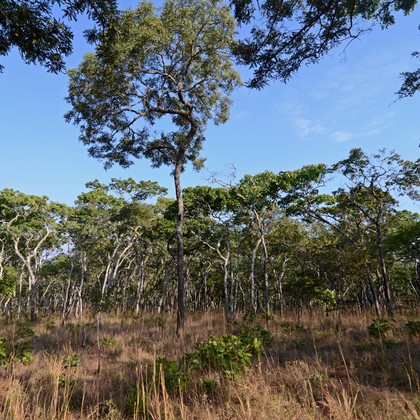
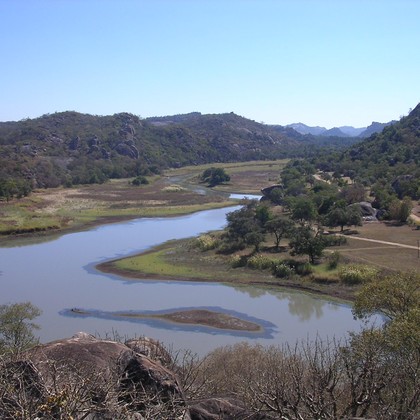
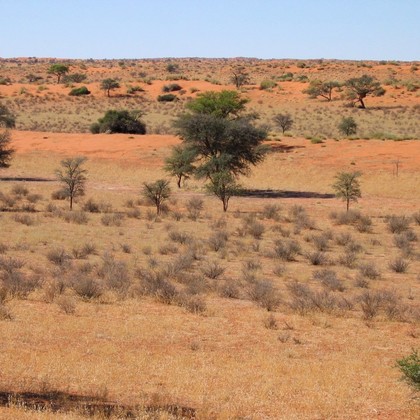
Miombo, broadleaved savanna woodland, Kalahari sand woodland with kiaat and Zambezi teak, and open woodland with tall trees and bare ground between them. It forages much on the ground and on low wood, mainly for ants and termites. It nests in a hole, often an old barbet or woodpecker nest.
Where the bird is most at home, classified by the vegetation units of southern Africa.
Range and movements
In the north and east of the region: Angola, Zambia, Malawi, Zimbabwe, northern and eastern Botswana, north-eastern Namibia (Kavango and the Zambezi Strip), Mozambique, north-eastern South Africa (Limpopo and Mpumalanga, including the Kruger National Park) and rarely Eswatini. Beyond the region north to the southern DR Congo, Burundi and southern Tanzania.
- Resident
- Summer visitor (c. Oct–Mar)
- Winter visitor (c. Apr–Sep)
- Passage (Mar–Apr, Oct–Nov)
- dark = core range, pale = thinly spread
How and when to look
In miombo and sand woodland watch for woodpeckers flushing from bare ground around a termite mound; Bennett's Woodpecker often feeds low or on the ground and then flies up to a low branch. The brown-throated female is the best confirmation. In South Africa the northern half of the Kruger National Park is a reliable site.
Conservation status
Not threatened and common in suitable woodland. Clearance of miombo and sand woodland for agriculture and charcoal reduces habitat locally.
Scientific name
Campethera bennettii | (Smith, 1836)
Smith described the species in 1836 as Chrysoptilus Bennettii; because it was later moved to another genus, the author and year stand in brackets. The genus Campethera was introduced in 1841 by Gray. Campethera comes from the Greek kampē, 'caterpillar', and thēras, 'hunter' — 'caterpillar hunter', for the insect diet of these woodpeckers. bennettii honours the British zoologist Edward Turner Bennett (1797–1836). The specimen the first description was based on came from western Transvaal (now North West), South Africa.