All species › Waders, gulls and terns › Stone-curlews › Spotted Thick-Knee
Spotted Thick-Knee | Burhinus capensis
Kaapse griel | Alcaraván del Cabo
The Spotted Thick-Knee is a large, spotted ground bird with a round head, huge yellow eyes and long yellow legs with thickened 'knees'. By day it stands motionless in the shade of a bush or presses itself flat on the ground; at night it becomes active and its plaintive whistling fills the dark, even in the middle of suburbs.

Voice
A loud, plaintive whistle that swells and then dies away, tee-tee-tee-TEEU-TEEU-teeu-teeu-tiu, mainly at dusk and at night, continuous in moonlight and often from several birds at once. When alarmed a sharp kwee-kwee.
Recording: Campbell Fleming — CC BY-NC-SA 4.0 · converted to mono · xeno-canto
Identification
40–44 cm. The upperparts are sandy to ochre-brown, densely marked with blackish-brown drop-shaped spots; the closed wing lacks the pale wing panel of Water Thick-Knee. The breast is streaked pale brown and the belly white. The large eye is bright yellow, with a pale supercilium and a dark loral stripe. The short, thick bill is yellow at the base and black at the tip; the legs are long and yellow. In flight two small white patches show in the black primaries. The sexes are alike; juveniles are slightly duller and more finely marked.
Confusion species
Water Thick-Knee Burhinus vermiculatus is finely streaked and vermiculated rather than spotted, shows a grey wing panel with a white bar above it on the closed wing and a greenish tinge to the bill base, and almost always lives near water. Coursers such as Burchell's Courser Cursorius rufus are much smaller, slimmer and unspotted.
Habitat
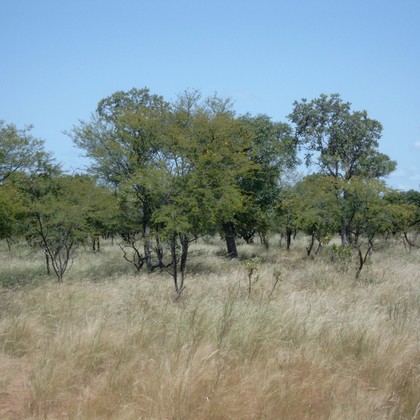
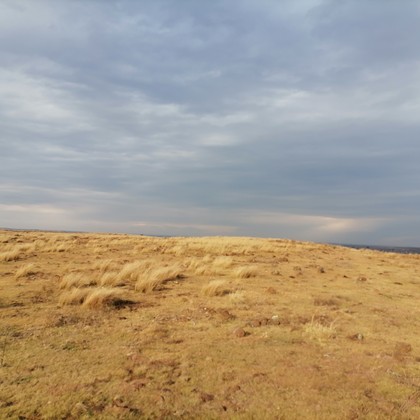
Open and semi-open dry country: thornveld, Kalahari savanna, Karoo scrub, grassland with bare patches, fallow land and ploughed fields, and increasingly parks, sports fields, industrial sites and flat roofs in towns. It hunts at night on foot for insects, especially beetles and termites, and small lizards and snails. The nest is a scrape on bare ground, often beside a stone or dead wood, and nowadays also in flower boxes and on gravel roofs.
Where the bird is most at home, classified by the vegetation units of southern Africa.

Range and movements
Across almost the whole region: South Africa, Lesotho, Eswatini, Namibia, Botswana, Zimbabwe, Mozambique, Zambia, Malawi and Angola; most numerous in the drier western and central parts and scarcest in dense woodland and on the highest slopes of Lesotho. Beyond the region in open country in East Africa north to Ethiopia and Somalia, west through the Sahel to Senegal and Mauritania, and in south-western Arabia.
- Resident
- Summer visitor (c. Oct–Mar)
- Winter visitor (c. Apr–Sep)
- Passage (Mar–Apr, Oct–Nov)
- dark = core range, pale = thinly spread
How and when to look
After sunset drive slowly along a dirt road in the Kalahari or the Karoo and watch for yellow eyeshine in the headlights. By day, scan quietly beside bushes for a 'stone' with eyes. At the nest the adult performs a threat display with spread wings and raised tail.
Conservation status
Not threatened; common and locally increasing as the species has adapted to urban areas. Many birds are killed by night-time traffic, and nests in parks and on sites are lost to mowers, dogs and cats.
Scientific name
Burhinus capensis | (Lichtenstein, 1823)
Lichtenstein described the species in 1823 as Oedicnemus capensis; because it was later moved to another genus, the author and year stand in brackets. The genus Burhinus was introduced in 1811 by Illiger. Burhinus is Greek, from bous 'ox' and rhis 'nose', after the heavy, broad base of the bill. capensis refers to the Cape of Good Hope, where the first specimen came from. The specimen the first description was based on came from Cape of Good Hope.