All species › Nightjars › Nightjars › Square-Tailed Nightjar
Square-Tailed Nightjar | Caprimulgus fossii
Gabonnachtzwaluw | Chotacabras de Fosse
The Square-Tailed Nightjar is the nightjar of sandy ground in the warm lowlands: riverbanks, coastal dunes and open woodland on sand. Its long churring, which keeps shifting pitch, sounds like a distant motorcycle changing gear.

Voice
A long, sustained churring, trrrrrrrrr, that repeatedly changes pitch abruptly, as if an engine were changing gear; often for minutes without a break. It calls from the ground, mainly at dusk and by moonlight.
Recording: Magnus Wadstein — CC BY-NC-SA 4.0 · converted to mono · xeno-canto
Identification
23–26 cm. A medium-sized, rather elongated nightjar with a square-cut tail. The upperparts are grey-brown with fine vermiculation and little contrast; striking is a pale, sandy band across the wing coverts and a row of pale spots along the scapulars. The rufous hind collar is narrow and indistinct, and the throat has a white patch. The male has white spots on the four outer primaries and a white outer edge along the full length of the outer tail feather, with white tips to the next; in the female these markings are pale buff.
Confusion species
The Rufous-Cheeked Nightjar (Caprimulgus rufigena) has only white tail corners, no white outer edge, and lives in the arid west. The Fiery-Necked Nightjar (Caprimulgus pectoralis) is warmer, with a broad rufous collar and rufous breast. The Swamp Nightjar (Caprimulgus natalensis) is smaller, shorter-tailed and more boldly spotted. The white along the whole tail edge and the pale wing band are the best features, together with the voice.
Habitat
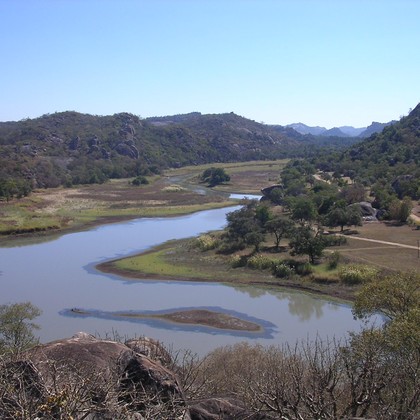
Open woodland and savanna on sandy soils, sandy riverbanks and sandbars, floodplain edges, coastal dunes and clearings in coastal forest. It roosts by day on sand or among leaf litter and hunts low over open ground and water.
Where the bird is most at home, classified by the vegetation units of southern Africa.


Range and movements
In the north and east of the region: Angola, Zambia, Malawi, Mozambique, Zimbabwe, northern and eastern Botswana, north-eastern Namibia (Kavango and Zambezi Region) and, in South Africa, the lowveld of Limpopo and Mpumalanga and the coastal plain of KwaZulu-Natal; also Eswatini. Partly a summer visitor in the south. Beyond the region north to Gabon, DR Congo, Tanzania and southern Kenya.
- Resident
- Summer visitor (c. Oct–Mar)
- Winter visitor (c. Apr–Sep)
- Passage (Mar–Apr, Oct–Nov)
- dark = core range, pale = thinly spread
How and when to look
Best along sandy riverbanks, such as on the Zambezi, the Okavango or the Limpopo, or on the coastal dunes of Mozambique, on a still evening. The engine-like churring gives the bird away; with a torch it can be found on a sandbar or sandy track, and in flight the white tail edge stands out.
Conservation status
Not threatened and fairly common in suitable habitat. Local threats are coastal development, disturbance of sandbars and road kills on sandy tracks. There is no evidence of major declines.
Scientific name
Caprimulgus fossii | Hartlaub, 1857
Hartlaub described the species in 1857 and placed it straight away in the genus where it still stands. The genus Caprimulgus was introduced in 1758 by Linnaeus. Caprimulgus is Latin, from capra 'nanny goat' and mulgere 'to milk', after the old belief that nightjars suckled goats at night. fossii honours W. Fosse (fl. 1856), a French collector in tropical Africa. The specimen the first description was based on came from Gabon.