All species › Passerines › Cisticolas › Stierling's Wren-Warbler
Stierling's Wren-Warbler | Calamonastes stierlingi
Kleine savannezanger | Camaróptera de Stierling
Stierling's Wren-Warbler is a brown-backed warbler with white, crisply black-barred underparts and a long, cocked tail. It lives hidden in the scrub of broadleaved woodland and is heard far more often than seen. Its monotonous, metallic song is one of the typical sounds of the eastern bushveld.

Voice
The song is a long, even series of clear, somewhat metallic notes, plee-plee-plee-plee-plee or bee-bee-bee-bee, sometimes repeated for hours and ventriloquial, so that the singer is hard to find. Pairs sometimes duet. The alarm is a dry, rasping trrrrt.
Recording: Niall Perrins — CC BY-NC-SA 4.0 · converted to mono · xeno-canto
Identification
12–13 cm. The upperparts are warm greyish-brown, crown and nape a little greyer, the wings brown with rusty edges. Throat and breast are white with narrow, crisp black bars; on the belly the bars become fainter and the flanks and undertail coverts are warm sandy. The long, narrow tail is often cocked at an angle. The iris is pale orange-brown to yellowish, the bill black, the legs pink. The sexes are alike and there is no distinct seasonal plumage; juveniles are browner and more faintly barred.
Confusion species
Barred Wren-Warbler Calamonastes fasciolatus is larger and paler, with sandy underparts and brown, less crisp barring, and in the non-breeding season wears a drab, almost unbarred plumage; it lives in dry thornveld, so habitat and range usually decide. In eastern Zambia this species meets the range of Miombo Wren-Warbler Calamonastes undosus, which is grey above and below. Bleating Camaroptera Camaroptera brachyura shares the tail-cocking habit but is unbarred, with green wings and a short tail. Female Chinspot Batis Batis molitor sings a similar series of notes, but lives higher in the trees.
Habitat
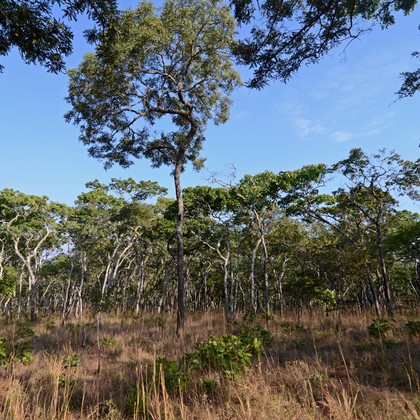
Dense scrub and undergrowth in broadleaved woodland: miombo, mixed bushveld, rank mopane woodland and scrub on termite mounds and along dry watercourses. It avoids open thornveld. Singly or in pairs; it forages low in bushes and on the ground for insects and spiders.
Where the bird is most at home, classified by the vegetation units of southern Africa.


Range and movements
Within the region in Zimbabwe, where it is widespread in broadleaved woodland on the plateau and in the lowveld, in Mozambique, Malawi and eastern and southern Zambia, and in north-eastern South Africa (the lowveld of Limpopo and Mpumalanga, including the Kruger Park), south into eastern Eswatini and northern KwaZulu-Natal. Beyond the region only in southern Tanzania.
- Resident
- Summer visitor (c. Oct–Mar)
- Winter visitor (c. Apr–Sep)
- Passage (Mar–Apr, Oct–Nov)
- dark = core range, pale = thinly spread
How and when to look
Year-round, but best in spring and early summer (September–December) when the song is persistent. In the Kruger Park and around Hwange and Gonarezhou it is a common bird of scrub beneath trees; follow the monotonous series of notes and wait by the bush it comes from, and the bird often shuffles briefly onto an open twig.
Conservation status
Not threatened. Common and widespread over a large range, and tolerant of moderate disturbance of bushveld as long as the shrub layer remains intact.
Scientific name
Calamonastes stierlingi | Reichenow, 1901
Reichenow described the species in 1901 and placed it straight away in the genus where it still stands. The genus Calamonastes was introduced in 1883 by Sharpe. Calamonastes comes from the Greek kalamos, 'reed', and nastēs, 'inhabitant' — 'reed-dweller', although these warblers actually live in dry scrub. stierlingi honours Dr Stierling, a German army doctor who collected birds in German East Africa (Tanzania) and Malawi around 1900. The specimen the first description was based on came from Songea, southern Tanzania.