All species › Passerines › Cisticolas › Miombo Wren-Warbler
Miombo Wren-Warbler | Calamonastes undosus
Miombosavannezanger | Camaróptera del Miombo
The Miombo Wren-Warbler is a grey, finely barred warbler with a long, often cocked tail that lives low in the scrub of miombo woodland. It was long treated as one species with Stierling's Wren-Warbler. Within the region it occurs only in Angola and northern and western Zambia.

Voice
The song is a long series of even, clear notes, plee-plee-plee-plee-plee, which sounds ventriloquial and is hard to pinpoint, often given from a hidden perch in the undergrowth. Also a dry, rattling trrrt in alarm and soft clicking notes.
Recording: isaac kilusu — CC BY-NC-SA 4.0 · converted to mono · xeno-canto
Identification
13–14 cm, with a long, narrow tail that is often held upright or angled above the back. The upperparts are plain grey to brownish-grey, the wings slightly browner. Chin and throat are pale grey to off-white, sometimes strikingly pale; breast and flanks are grey with fine dark bars, which become fainter on the belly. The iris is pale orange to orange-brown, the bill black, the legs pink. The sexes are alike; juveniles are browner and less clearly barred. The grey ground colour of the whole body is the best feature: in the region's other wren-warblers the underparts are whiter or pale sandy.
Confusion species
Stierling's Wren-Warbler Calamonastes stierlingi has a brown back and white underparts with crisp black bars, and occurs in the region mainly to the east and south of this species; where the two meet, in eastern Zambia, the grey ground colour settles it. Barred Wren-Warbler Calamonastes fasciolatus is brown above, has sandy underparts with brown barring and lives in dry thornveld in south-western Angola and extreme south-western Zambia. Bleating Camaroptera Camaroptera brachyura also cocks its tail, but has a short tail, green wings, no barring and a nasal bleat.
Habitat
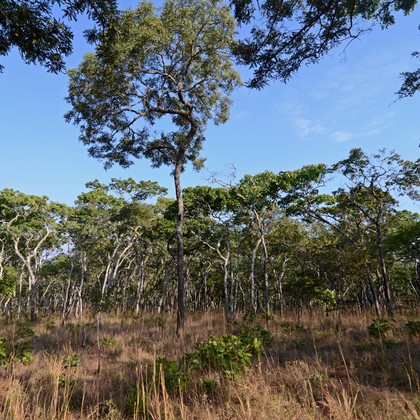
Undergrowth and scrub in miombo and other broadleaved woodland, preferably where dense bushes, young regrowth and scrub-covered termite mounds occur. It lives singly or in pairs, forages low and often on the ground for insects, and stays largely hidden.
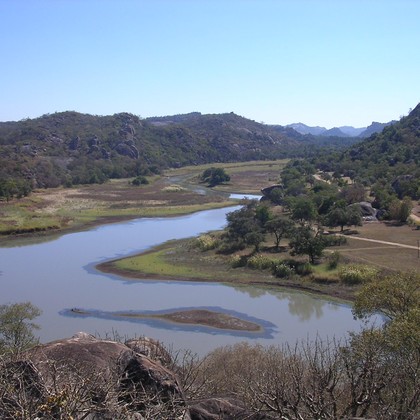
Where the bird is most at home, classified by the vegetation units of southern Africa.
Range and movements
Within the region in Angola, from the north and the Lunda provinces south across the central plateau, with a separate subspecies in the west of the central part (Huíla highlands), and in north-western and northern Zambia. Beyond the region from Congo-Brazzaville and southern DR Congo east to Rwanda, Burundi, Tanzania and south-western Kenya.
- Resident
- dark = core range, pale = thinly spread
How and when to look
Year-round; mostly found by ear. Walk slowly in the morning through miombo with a rich shrub layer, for example around Mwinilunga or on the Angolan plateau, and follow the monotonous, repeated series of notes. The bird responds inquisitively to soft pishing and then climbs briefly higher in a bush, tail cocked.
Conservation status
Not threatened. Common over a large range and not dependent on pristine woodland: lightly disturbed miombo with a dense shrub layer is sufficient. In the long term, conversion of miombo to farmland is the main threat.
Scientific name
Calamonastes undosus | (Reichenow, 1882)
Reichenow described the species in 1882 as Drymoeca undosa; because it was later moved to another genus, the author and year stand in brackets. The genus Calamonastes was introduced in 1883 by Sharpe. Calamonastes comes from the Greek kalamos, 'reed', and nastēs, 'inhabitant' — 'reed-dweller', although these warblers actually live in dry scrub. undosus is Latin for 'wavy', for the fine wavy barring on the underparts. The specimen the first description was based on came from Kakoma, Tanzania.