All species › Passerines › Cisticolas › Long-Billed Forest Warbler
Long-Billed Forest Warbler | Artisornis moreaui
Moreaus snijdervogel | Sastrecillo de Moreau
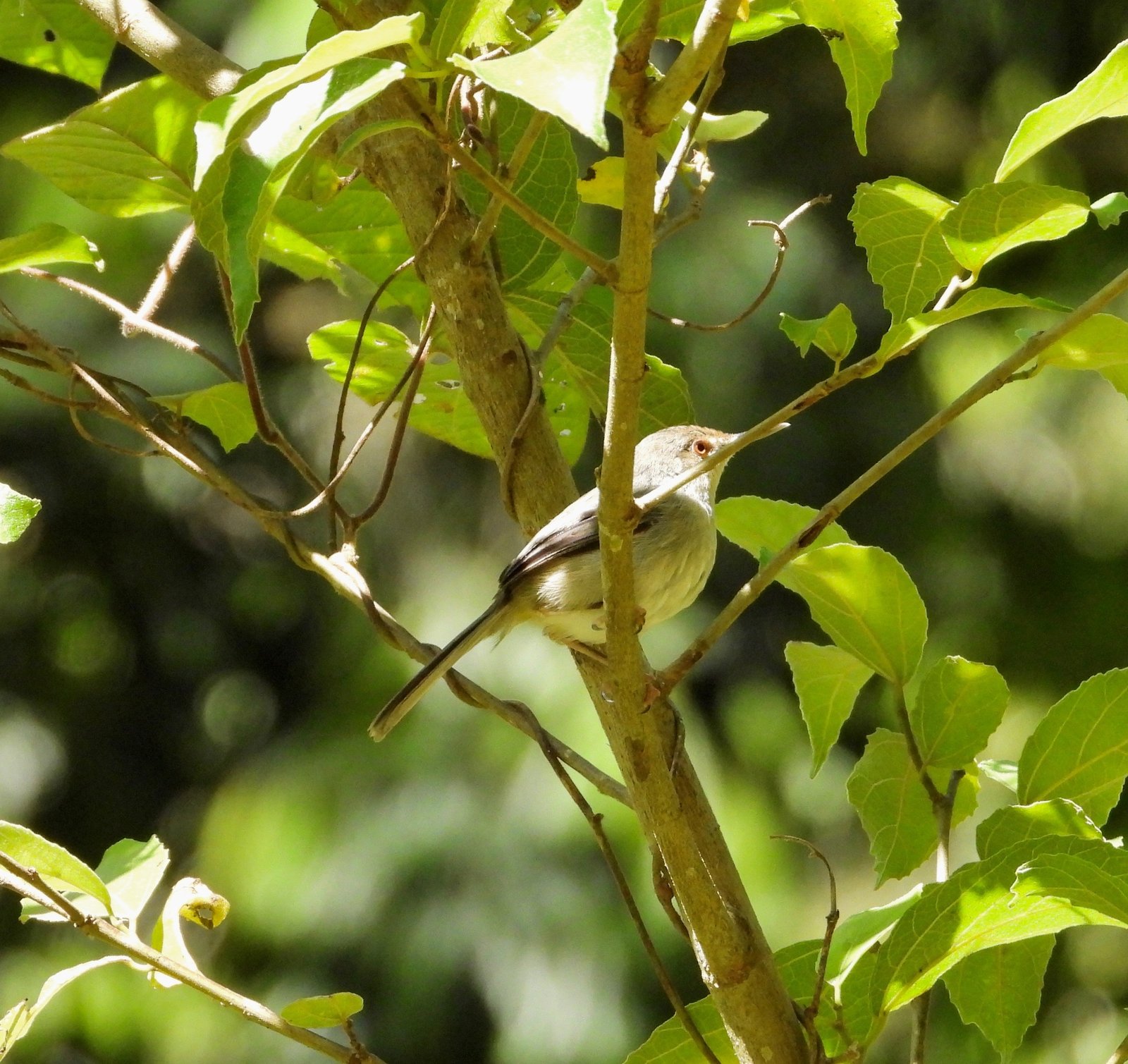
The Long-Billed Forest Warbler is a small, inconspicuous grey warbler with a strikingly long, thin bill that lives in the mid-levels and creepers of montane forest. It is one of the rarest birds of the region: in Mozambique known only from the remote Njesi Plateau, and elsewhere only from the East Usambara Mountains in Tanzania.
Voice
A distinctive metallic, repeated pee-doo pee-doo, often in duet, with the partner joining in with a faster, higher series. Also a soft chip as contact call. The species is heard far more often than seen.
Recording: isaac kilusu — CC BY-NC-SA 4.0 · converted to mono · xeno-canto
Identification
10–11 cm, with a short, often cocked tail and a long, straight, thin bill. The upperparts are grey to olive-grey, the head with a faint brown tinge on crown and forehead; the underparts are pale grey, slightly whiter on the throat and belly. The legs are pinkish-brown. The sexes are alike. Mozambican birds (subspecies sousae) have a slightly warmer brown head than those from Tanzania. It moves quietly through creepers and leaves and clambers along thin branches.
Confusion species
Red-Capped Forest Warbler Artisornis metopias, which occurs alongside this species on the Njesi Plateau, has a short bill, a rich chestnut head and neck sides, an olive-brown back and white underparts with a rusty wash on the breast. Bleating Camaroptera Camaroptera brachyura is also grey but has green wings, a short bill and a nasal bleat. Check the bill length and the absence of a red head.
Habitat
Moist Afromontane forest and riverine forest in stream valleys, especially the mid-stratum and lower canopy around clearings with many creepers and lianas. In Mozambique between about 1,400 and 1,850 metres. It forages for small insects among leaves and creepers, usually in pairs.
Where the bird is most at home, classified by the vegetation units of southern Africa.

Range and movements
Within the region only on the Njesi Plateau (Serra Jeci) in Niassa province in northern Mozambique, in a handful of forest fragments. Beyond the region only in the East Usambara Mountains of north-eastern Tanzania, some 1,000 kilometres further north. The Mozambican population is also treated as a separate species, Mozambique Forest Warbler Artisornis sousae.
- Resident
- dark = core range, pale = thinly spread
How and when to look
A visit requires an organised expedition from Lichinga to the Njesi Plateau, camping in the mountains. Listen early in the morning at forest edges and in stream valleys for the metallic pee-doo and look for the bird in the mass of creepers at mid-height; wait patiently until it appears in a gap and check the long bill.
Conservation status
Endangered. The Mozambican population is estimated at a few dozen to at most about 250 mature birds in a very small area, and the Tanzanian population is even smaller. The main threats on the Njesi Plateau are forest fires, clearance for agriculture and further fragmentation of the last forest patches.
Scientific name
Artisornis moreaui | (Sclater, 1931)
Sclater described the species in 1931 as Apalis moreaui; because it was later moved to another genus, the author and year stand in brackets. The genus Artisornis was introduced in 1928 by Friedmann. Artisornis comes from the Greek artaō, 'to fasten, to hang', and ornis, 'bird' — after the tailorbirds, which fasten leaves together to form a nest. moreaui honours the British ornithologist Reginald Ernest Moreau (1897–1970), who worked for many years at Amani in the Usambara Mountains. The specimen the first description was based on came from forest near Amani, East Usambara, Tanzania.