All species › Passerines › Cisticolas › Red-Capped Forest Warbler
Red-Capped Forest Warbler | Artisornis metopias
Roodkapsnijdervogel | Sastrecillo Africano
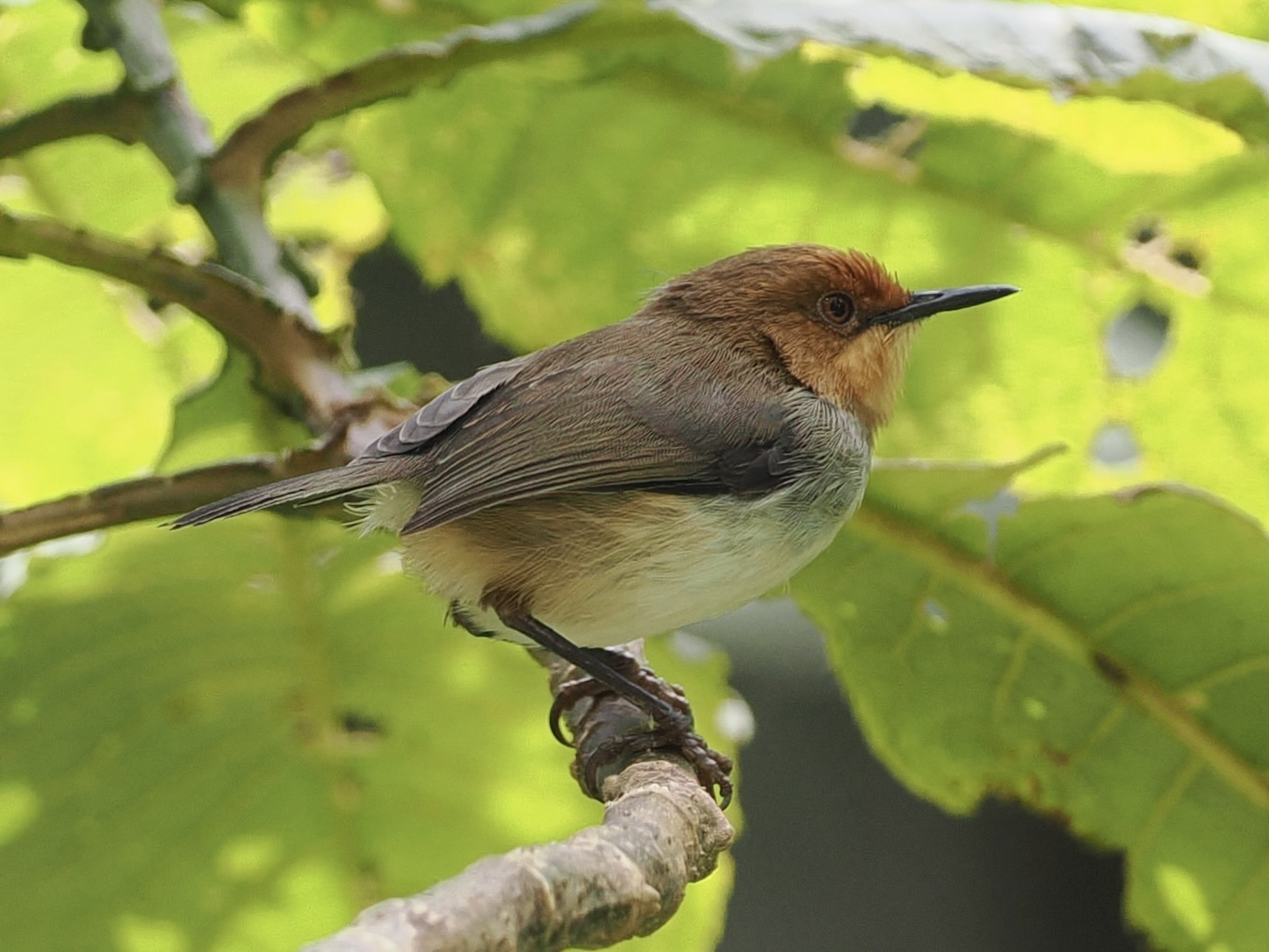
The Red-Capped Forest Warbler is a small, short-tailed warbler of montane forest undergrowth, with a warm chestnut head contrasting with an olive-brown back. It is one of the few African relatives of the Asian tailorbirds and, like them, stitches leaves together for its nest. Within the region it occurs only on the Njesi Plateau in northern Mozambique.
Voice
A loud, clear, far-carrying series of whistles, tee-tee-tee-tee or chwee-chwee-chwee, often in duet with the partner answering in a faster, buzzy series. The contact call is a soft chip. The song is detected far more often than the bird itself.
Recording: Kileo Jumah — CC0 · converted to mono · xeno-canto
Identification
About 10 cm, compact, with a short tail that is often flicked up. Crown, forehead, ear-coverts and sides of the neck are rich chestnut; the rest of the upperparts is olive-brown. The underparts are white from throat to vent, with grey-washed flanks. The bill is fairly short and dark, the legs pinkish-brown. The sexes are alike; juveniles have a duller head and a pale yellow wash on the underparts. It creeps low through creepers and saplings in the undergrowth and usually stays out of view.
Confusion species
The only real confusion is with Long-Billed Forest Warbler Artisornis moreaui, which also occurs on the Njesi Plateau: it has a clearly longer, thin bill, a less rufous, rather grey-brown head, greyer upperparts and no rusty wash on the breast. Yellow-Throated Woodland Warbler Phylloscopus ruficapilla also has a rufous crown, but is yellow on the throat and undertail coverts, slimmer and forages higher in the forest. Bleating Camaroptera Camaroptera brachyura is grey with green wings and lacks a red head.
Habitat
Undergrowth and edges of moist Afromontane forest, especially dense creepers, ferns and young regrowth in clearings and along streams, mostly above about 1,400 metres. It forages in pairs low in the vegetation for small insects. The nest is made by stitching a few large leaves together with spider silk.
Where the bird is most at home, classified by the vegetation units of southern Africa.

Range and movements
Within the region only on the Njesi Plateau (Serra Jeci) in Niassa province in northern Mozambique, where a small population lives in the remaining forest fragments. Beyond the region in the Eastern Arc mountain forests of Tanzania, including the Usambara, Nguru, Uluguru and Udzungwa Mountains.
- Resident
- dark = core range, pale = thinly spread
How and when to look
Year-round; the Njesi Plateau is remote and can only be reached by an organised expedition from Lichinga. Work slowly along forest edges and clearings with creepers, listen for the clear whistled duet and wait for the bird to appear on a low twig. Always compare bill length and head colour to separate it from Long-Billed Forest Warbler.
Conservation status
Not globally threatened, since the Tanzanian mountain forests hold a reasonable population. The isolated Mozambican population on the Njesi Plateau, however, is small and vulnerable to forest fires and clearance of the few remaining forest fragments.
Scientific name
Artisornis metopias | (Reichenow, 1907)
Reichenow described the species in 1907 as Prinia metopias; because it was later moved to another genus, the author and year stand in brackets. The genus Artisornis was introduced in 1928 by Friedmann. Artisornis comes from the Greek artaō, 'to fasten, to hang', and ornis, 'bird' — after the tailorbirds, which fasten leaves together to form a nest. metopias is Greek for 'having a (broad) forehead', from metōpon, 'forehead' — for the striking rufous crown and forehead. The specimen the first description was based on came from Usambara Mountains, Tanzania.