All species › Passerines › Cisticolas › Brown-Headed Apalis
Brown-Headed Apalis | Apalis alticola
Bruinkopapalis | Apalis Cabecipardo
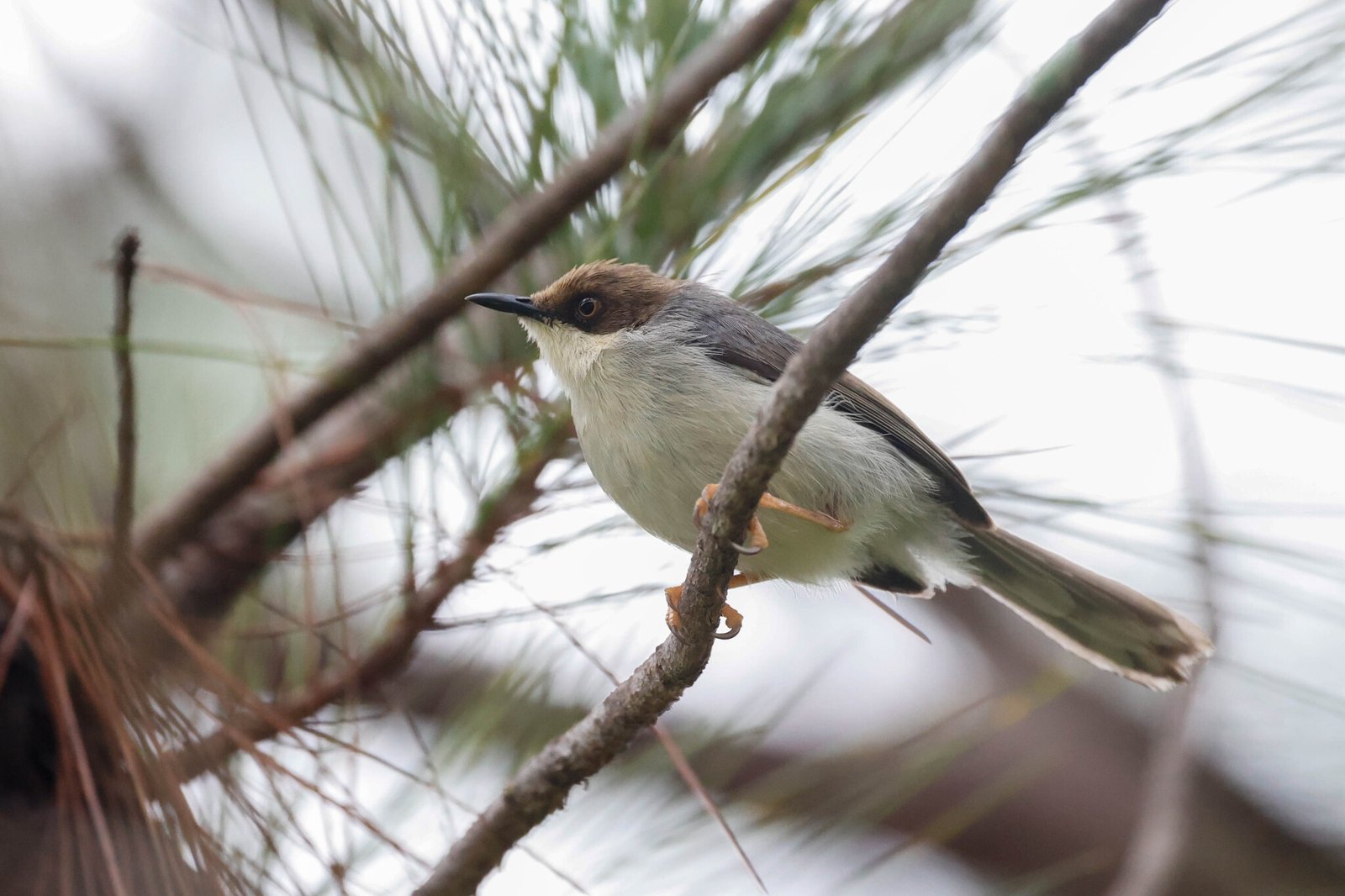
The Brown-Headed Apalis is a grey apalis with a warm brown crown and white underparts, which moves in pairs through the canopy of forest and forest edges. It was long regarded as a subspecies of Grey Apalis. Within the region it occurs in northern Angola, northern Zambia and northern Malawi.
Voice
A fast, penetrating duet: one bird sings a repeated tchuwee-tchuwee-tchuwee, the other joins with a dry trrrip-trrrip. The contact call is a short tsik. The duet is often all that gives a pair away in the canopy.
Recording: isaac kilusu — CC BY-NC-SA 4.0 · converted to mono · xeno-canto
Identification
About 13 cm, with a long graduated tail. Crown and forehead are warm brown, sharply set off against the grey nape and back; the cheeks are greyer. The underparts are white, lightly washed grey on the flanks. The tail is grey with white tips and white outer edges to the outer feathers. Bill black, legs pinkish-brown. The sexes are alike; juveniles have a duller, less brown crown. It usually keeps high in the vegetation and swings its tail busily from side to side.
Confusion species
Grey Apalis Apalis cinerea of the western Angolan highlands has at most a brownish wash on the forehead without a sharp border, and more white in the tail. Bar-Throated Apalis Apalis thoracica of the Zambian and Malawian highlands has a black breast band and a greenish or grey back. Yellow-Breasted Apalis Apalis flavida has a green back and yellow breast. Bleating Camaroptera Camaroptera brachyura has a short tail and green wings. The brown cap above a grey back and white underparts without a band are decisive.
Habitat
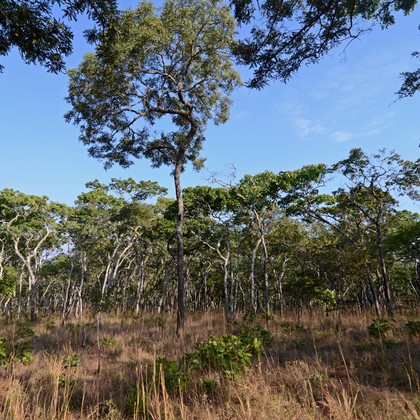
Edges of Afromontane and submontane forest, gallery forest, dense thickets and rich, moist miombo with plenty of undergrowth, from about 1000 to 2400 metres. It forages in pairs or in mixed parties for insects in the crowns and mid-stratum.
Where the bird is most at home, classified by the vegetation units of southern Africa.


Range and movements
Within the region in northern Angola (among others Uíge), in northern and north-eastern Zambia (the northern plateau and the highlands along the borders with Malawi and Tanzania) and in the highlands of northern Malawi. Beyond the region in southern DR Congo, western and southern Tanzania and south-western Kenya.
- Resident
- dark = core range, pale = thinly spread
How and when to look
Year-round; search forest edges around Uíge in Angola, or forest and rich miombo on the northern plateau of Zambia and in the highlands of northern Malawi. The duet gives the pair away; wait for a bird to come into the light and look for the brown crown against the grey back.
Conservation status
Not threatened. Fairly common over a large range. Habitat is lost locally through clearance of forest and miombo and through fire, but the species also uses forest edges and secondary growth.
Scientific name
Apalis alticola | (Shelley, 1899)
Shelley described the species in 1899 as Cisticola alticola; because it was later moved to another genus, the author and year stand in brackets. The genus Apalis was introduced in 1833 by Swainson. Apalis comes from the Greek hapalos, 'delicate, gentle' — for these slender, finely built little warblers. alticola is Latin for 'dweller on high', from altus, 'high', and -cola, 'inhabitant' — for its highland forest habitat. The specimen the first description was based on came from Fife, near Isoka, northern Zambia.