All species › Passerines › Cisticolas › Grey Apalis
Grey Apalis | Apalis cinerea
Grijze apalis | Apalis Gris
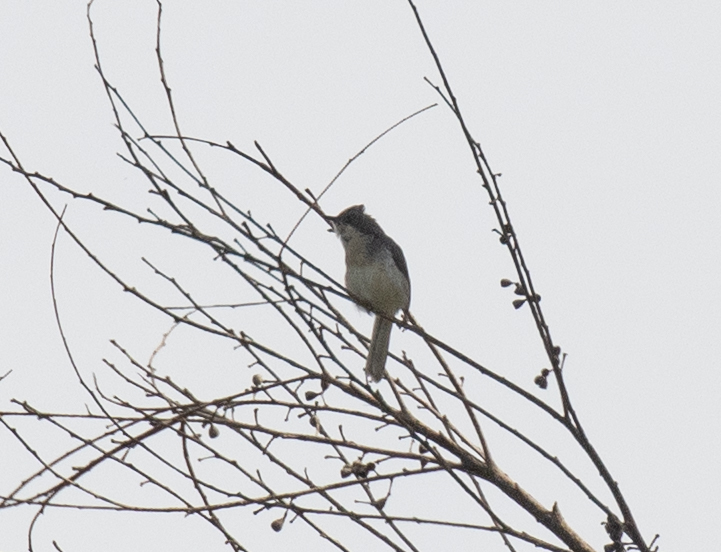
The Grey Apalis is a grey-backed apalis with white underparts and much white in the tail, a bird of the montane forest canopy. Within the region it occurs only in the highland forests of western Angola, far from the East African core of its range. For visitors to Mount Moco it is one of the more conspicuous forest birds.
Voice
A loud, rapidly repeated series of sharp notes, chip-chip-chip-chip or cherk-cherk-cherk, often in duet with the partner joining in a different rhythm. The contact call is a short tsip; when alarmed a dry rattle.
Recording: James Bradley — CC BY-NC-SA 4.0 · converted to mono · xeno-canto
Identification
About 13 cm, with a long graduated tail. The upperparts are plain grey, crown and forehead slightly browner but without a sharp border against the back. The underparts are white, washed grey on the flanks, with no breast band. The wings are grey with darker flight feathers. The tail is grey in the centre, the outer feathers largely white, which shows when it is fanned and in flight. Bill black, legs pinkish-brown. The sexes are alike. It moves actively through the foliage and often holds the tail slightly cocked.
Confusion species
Brown-Headed Apalis Apalis alticola is very similar and was long treated as the same species; it has a warm brown crown sharply set off against the grey back and less white in the tail, and in Angola lives mainly in the north. White-Chinned Prinia Schistolais leucopogon is much darker grey, with a grey breast and only the throat white, and lives in parties low in rank growth. Bleating Camaroptera Camaroptera brachyura has a short tail and green wings. A grey back, white underparts without a band and white outer tail feathers in highland forest point to Grey Apalis.
Habitat
The canopy and mid-stratum of Afromontane forest and the forest patches in highland ravines, also forest edges and tall shrubs in the transition to montane grassland. It forages in pairs or small groups, often in mixed parties with other warblers, for insects among the leaves.
Where the bird is most at home, classified by the vegetation units of southern Africa.

Range and movements
Within the region only in the west-central highlands of Angola, in the forest patches of Mount Moco and other high-lying forest remnants in Huambo and Cuanza Sul. Beyond the region in the mountains of Cameroon and of East Africa, from South Sudan, Uganda and eastern DR Congo through Rwanda and Kenya to northern Tanzania.
- Resident
- dark = core range, pale = thinly spread
How and when to look
Year-round; the ravine forest patches of Mount Moco are the known site, where the species is conspicuous in the lower forest remnants. Walk the forest edges in the morning and listen for the sharp repeated series; the birds often come quite low in the edge trees, where the white in the tail shows well.
Conservation status
Not threatened across its range. In Angola, however, the population is small and confined to a few highland forest patches, which are shrinking fast through logging, fire and the spread of agriculture; the forest patches of Mount Moco are of great importance for the species here.
Scientific name
Apalis cinerea | (Sharpe, 1891)
Sharpe described the species in 1891 as Euprinodes cinereus; because it was later moved to another genus, the author and year stand in brackets. The genus Apalis was introduced in 1833 by Swainson. Apalis comes from the Greek hapalos, 'delicate, gentle' — for these slender, finely built little warblers. cinerea is Latin for 'ash-grey', for the grey upperparts. The specimen the first description was based on came from Mount Elgon (Uganda/Kenya).