All species › Passerines › Cisticolas › Chirinda Apalis
Chirinda Apalis | Apalis chirindensis
Chirinda-apalis | Apalis del Chirinda
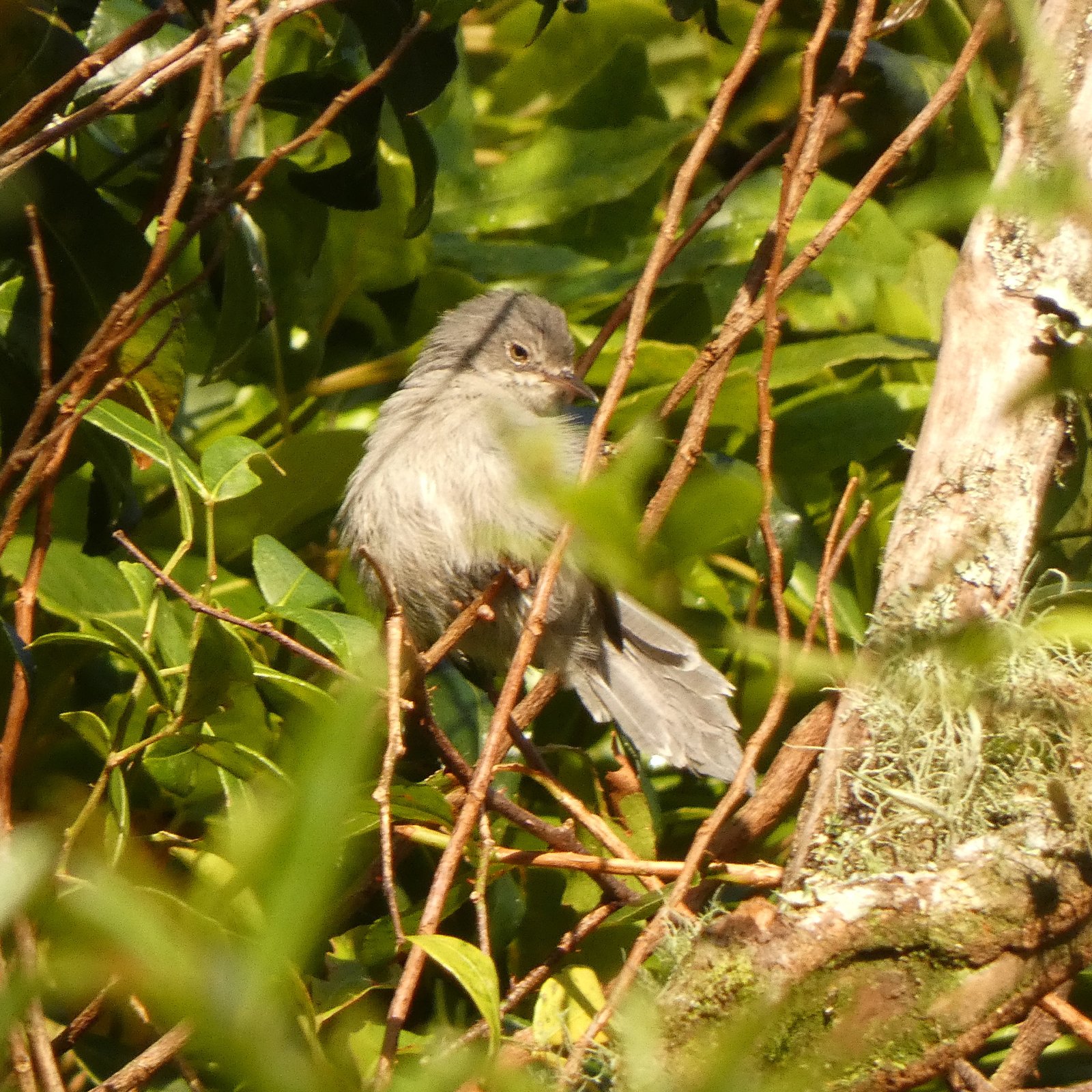
The Chirinda Apalis is a plain grey, long-tailed apalis of montane forest on the border of Zimbabwe and Mozambique. It lacks a breast band or any other markings apart from white tail tips, and is endemic to the Eastern Highlands and Gorongosa. Because of rapid deforestation it has been listed as Vulnerable since 2022.
Voice
A repeated series of sharp chirping notes, chpip-chipip or sweek-sweek-sweek, often long sustained from the canopy; pairs answer each other in duet. The contact call is a soft tsip.
Recording: Mark Harper — CC BY-NC-SA 3.0 · converted to mono · xeno-canto
Identification
12–13 cm, slender with a long graduated tail. Plain dark grey above, paler grey below, with no breast band, supercilium or throat pattern. The tail feathers have white tips that show mainly from below and when the tail is fanned. The bill is black in the male and pale-based in the female. There are two subspecies: the nominate form of Chirinda and Gorongosa is darker grey, vumbae of the more northerly highlands paler grey, with larger white tail tips and a paler upper mandible. It moves calmly through the foliage, the tail often slightly cocked.
Confusion species
Bar-Throated Apalis Apalis thoracica in the same forest has a black breast band, a white throat and a greenish or grey back. Black-Headed Apalis Apalis melanocephala of lower-lying forest has a black head and white underparts. Roberts's Warbler Oreophilais robertsi is also grey with a long tail, but lives low in scrub and bracken at forest edges, has a striking pale iris and moves in noisy parties. Bleating Camaroptera Camaroptera brachyura has a short tail and green wings. A wholly grey, unmarked apalis high in the canopy is always Chirinda Apalis in this area.
Habitat
The mid-stratum and canopy of evergreen montane forest, also dense riverine forest and thicket at forest edges, from about 1200 to 2200 metres. It forages in pairs or in mixed parties with other warblers for insects in the foliage, often high in the crowns.
Where the bird is most at home, classified by the vegetation units of southern Africa.

Range and movements
Endemic to the east of the region: in Zimbabwe in the Eastern Highlands, from Nyanga through the Bvumba to the Chimanimani Mountains and Chirinda Forest, and in adjacent Mozambique in the Chimanimani Mountains and on Mount Gorongosa. Nowhere else in the world.
- Resident
- dark = core range, pale = thinly spread
How and when to look
Year-round; Chirinda Forest near Mount Selinda, Bunga Forest in the Bvumba and the forests of Haroni-Rusitu are good sites. Follow the chirping series upwards and wait for the bird to show in a gap; the white tail tips when the tail is fanned and the absence of any other markings clinch it.
Conservation status
Vulnerable (2022). The population is declining rapidly with the loss of montane forest: within its range an estimated third of tree cover disappeared in the decade before 2022, through logging, agriculture, plantations and fire. The species depends on the protection of the remaining forests in the Zimbabwean highlands and on Gorongosa.
Scientific name
Apalis chirindensis | Shelley, 1906
Shelley described the species in 1906 and placed it straight away in the genus where it still stands. The genus Apalis was introduced in 1833 by Swainson. Apalis comes from the Greek hapalos, 'delicate, gentle' — for these slender, finely built little warblers. chirindensis refers to the Chirinda Forest in eastern Zimbabwe, where the species was discovered. The specimen the first description was based on came from Chirinda Forest, eastern Zimbabwe.