All species › Passerines › Cisticolas › Black-Headed Apalis
Black-Headed Apalis | Apalis melanocephala
Tanzania-apalis | Apalis Cabecinegro
The Black-Headed Apalis is a slender, long-tailed apalis with a black head, a dark back and clean white underparts, which moves high through the forest canopy. It is mainly a bird of the East African coast and mountains; within the region it reaches its southern limit in southern Malawi, central Mozambique and the far east of Zimbabwe. To find it you need to look up and listen carefully.

Voice
A loud, rapidly repeated series of clear whistles, tchwee-tchwee-tchwee-tchwee, often as a duet in which the partner joins with a drier tchrrrt. The contact call is a short, sharp tsip. The song carries far through the forest and is usually the first sign that the species is present.
Recording: Richard Dunn — CC BY-NC-SA 4.0 · converted to mono · xeno-canto
Identification
12–14 cm, with a long graduated tail. Head and neck are black, merging into dark grey-brown to blackish back and wings; chin, throat and all the underparts are bright white, sharply set off against the black head, with no breast band. The tail is blackish, the outer feathers tipped white, which shows when the tail is fanned. The bill is black and fine, the legs pinkish-brown. Females are somewhat duller, with a greyer black head; juveniles are brownish above with a grey head. It often holds the tail cocked and swings it from side to side as it hops through the foliage.
Confusion species
Bar-Throated Apalis Apalis thoracica has a narrow black breast band on white or yellow underparts and a grey or greenish back, and usually lives in higher montane forest. Chirinda Apalis Apalis chirindensis, which occurs alongside Black-Headed Apalis in eastern Zimbabwe and on Gorongosa, is wholly grey, with neither a black head nor white underparts. Rudd's Apalis Apalis ruddi of the coastal forests of southern Mozambique has a green back, a white supercilium and a black breast band. A black head, a dark back and unbroken white underparts without a band are decisive for this species.
Habitat
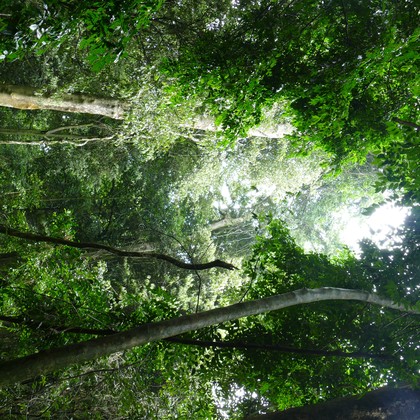
The canopy and mid-stratum of moist lowland forest, coastal forest and forest on mid-altitude slopes, also dense riverine forest, stands of tall trees in tea estates and forest edges, up to about 1500 metres. It forages in pairs or in mixed parties with other warblers for insects among leaves and creepers, often high in the crowns.
Where the bird is most at home, classified by the vegetation units of southern Africa.

Range and movements
Within the region only at the southern edge of its range: in southern Malawi (among others Thyolo forest), in central Mozambique (Gorongosa and surrounding forests) and in the far east of Zimbabwe in the lowland forests of Haroni-Rusitu. Beyond the region from southern Somalia and the Kenyan coast south through eastern Tanzania into northern Mozambique.
- Resident
- Summer visitor (c. Oct–Mar)
- Winter visitor (c. Apr–Sep)
- Passage (Mar–Apr, Oct–Nov)
- dark = core range, pale = thinly spread
How and when to look
Year-round; in Zimbabwe Haroni-Rusitu is the known site, where Chirinda Apalis can also be found, and in Malawi Thyolo forest. Listen for the repeated whistled series and then scan the canopy; the white underparts shine against the dark foliage. Mixed warbler parties, which the apalis often joins, are the best lead.
Conservation status
Not threatened across its range, but scarce and local within the region. The small forest remnants at the southern edge, such as Haroni-Rusitu and Thyolo, are highly fragmented and suffer from logging, agriculture and the spread of plantations; protecting these forests decides the fate of the populations here.
Scientific name
Apalis melanocephala | (Fischer & Reichenow, 1884)
Fischer & Reichenow described the species in 1884 as Burnesia melanocephala; because it was later moved to another genus, the author and year stand in brackets. The genus Apalis was introduced in 1833 by Swainson. Apalis comes from the Greek hapalos, 'delicate, gentle' — for these slender, finely built little warblers. melanocephala comes from the Greek melas, 'black', and kephalē, 'head' — for the dark head. The specimen the first description was based on came from Pangani, coastal Tanzania.