All species › Passerines › Finches › Thick-Billed Seedeater
Thick-Billed Seedeater | Crithagra burtoni
Bergkanarie | Serín de Burton
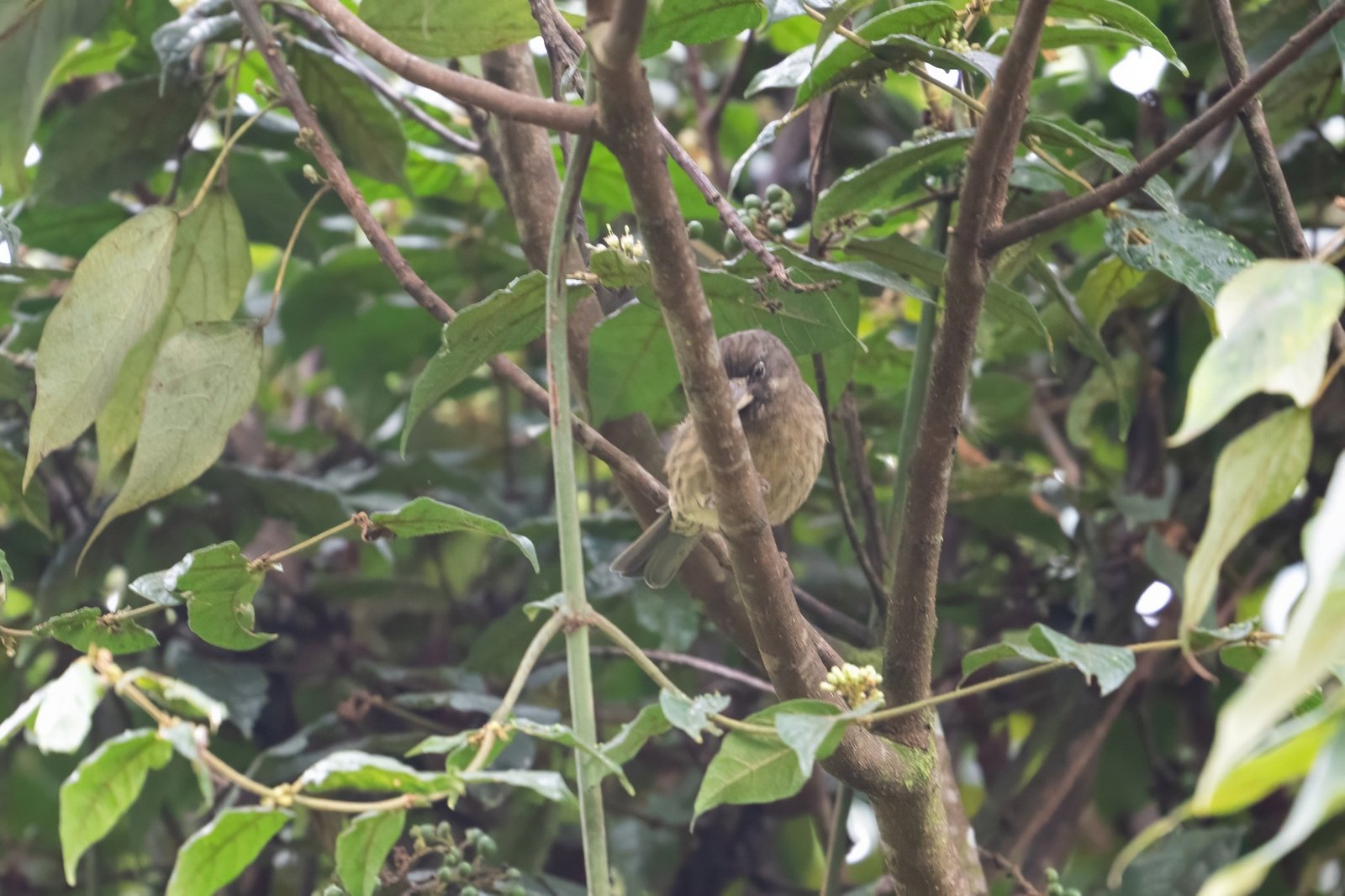
The Thick-Billed Seedeater is a large, dark and very heavy-billed seedeater of montane forest edges. Within the region it occurs only in the highlands of west-central Angola, an isolated outpost of a range that otherwise lies in Cameroon and East Africa.
Voice
Usually silent. The call is a soft, clear weep or tsweet; the song is a short, slow series of rich whistles with a few harsh notes.
Recording: Bram Piot — CC BY-NC-SA 4.0 · converted to mono · xeno-canto
Identification
15–17 cm. Dark olive-brown above with faint dark streaking; the underparts are brown with dark streaking on breast and flanks, paler on the belly. The bill is very heavy and deep, dark horn with a paler lower mandible. Depending on subspecies there is a small white forehead spot and a white chin; the wings show two narrow pale wingbars. The sexes are alike. It often sits motionless for long periods in the shade of the undergrowth.
Confusion species
The Brimstone Canary (Crithagra sulphurata) also has a heavy bill but is yellow and olive-green. The Streaky-Headed Seedeater (Crithagra gularis) is smaller and paler, with a broad white supercilium, a finer bill and an unstreaked breast, and lives in open woodland. In montane forest in Angola a dark, streaked canary with such a heavy bill is almost certainly this species.
Habitat
The edges and clearings of Afromontane forest, dense scrub in ravines, secondary forest and gardens and fields right next to forest. It eats seeds, fruit, buds and flowers, mostly at mid-height in shrubs and trees.
Where the bird is most at home, classified by the vegetation units of southern Africa.

Range and movements
Within the region only in the central highlands of Angola: the forest patches of Huambo, including Mount Moco, and the Cuanza Sul escarpment. Beyond the region from Nigeria and Cameroon through eastern DR Congo, Rwanda, Burundi and Uganda to Kenya and northern Tanzania.
How and when to look
The forest patches around Mount Moco are the best site, and many other Angolan montane specialities live there too. Listen for the soft weep from dense scrub and wait for the bird to come to a fruiting shrub. The heavy outline of the bill then settles it.
Conservation status
Not threatened across its range. In Angola the isolated population is small and vulnerable to the rapid clearing and burning of the last montane forest patches.
Scientific name
Crithagra burtoni | (Gray, 1862)
Gray described the species in 1862 as Strobilophaga burtoni; because it was later moved to another genus, the author and year stand in brackets. The genus Crithagra was introduced in 1827 by Swainson. Crithagra comes from the Greek krithē, 'barley', and agra, 'hunting' — a 'barley hunter', for the seed-eating diet of these canaries and seedeaters. burtoni honours the British explorer Richard Francis Burton (1821–1890), who as consul in West Africa climbed Mount Cameroon in 1862. The specimen the first description was based on came from Mount Cameroon, Cameroon.