All species › Passerines › Finches › Yellow-Browed Seedeater
Yellow-Browed Seedeater | Crithagra whytii
Geelbrauwkanarie | Serín de Whyte
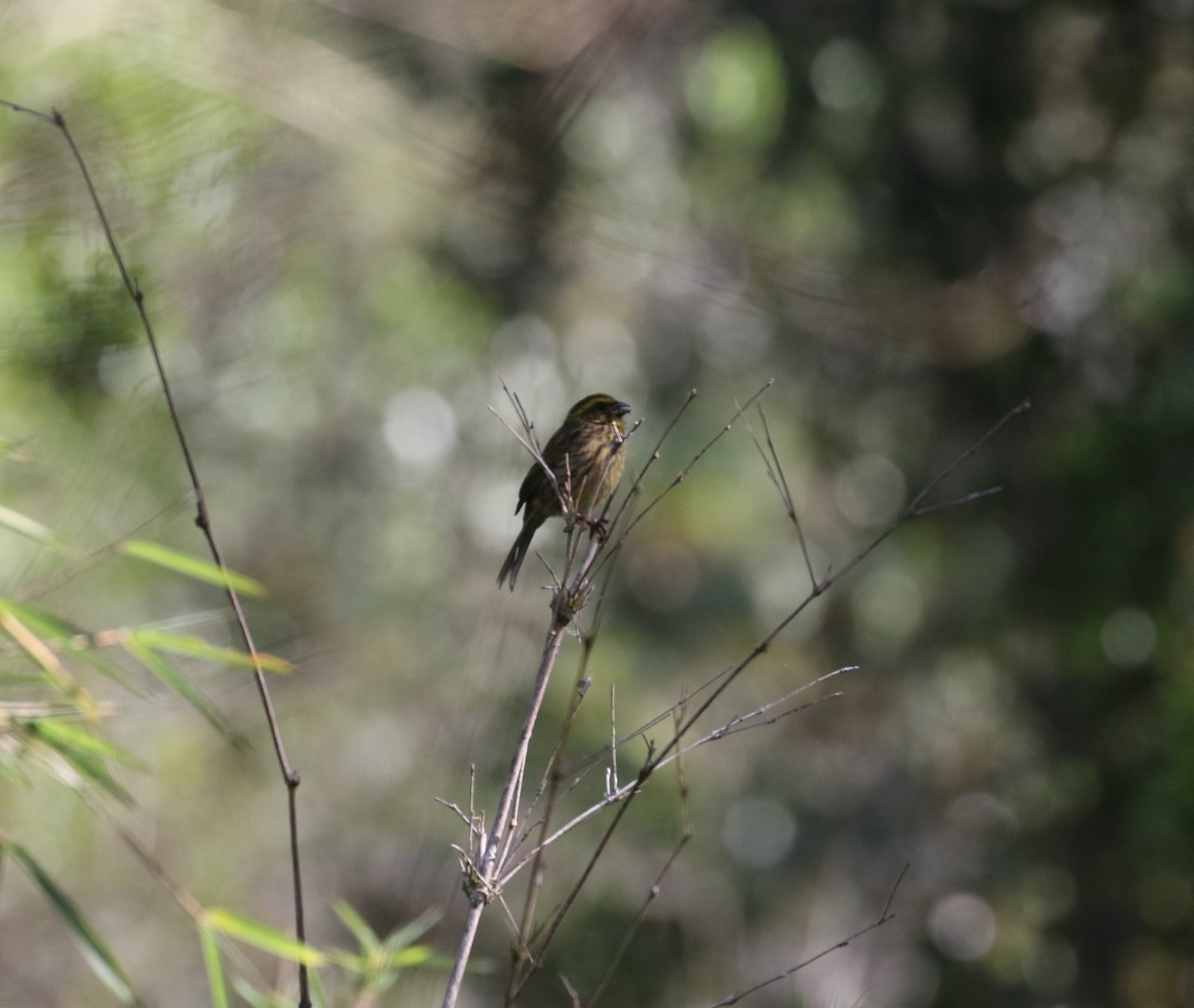
The Yellow-Browed Seedeater is a dark, heavily streaked canary of montane scrub in northern Malawi and north-eastern Zambia, recognised by a broad yellowish supercilium. It was long treated as a subspecies of the East African Crithagra striolata and is now often regarded as a separate species.
Voice
A pleasant, varied and rather slow song of clear whistles and trills, often from a bush top or dead branch, along the lines of tseep-cheroo-tsiwee-choo. The call is a thin rising tsweee.
No recording with a suitable Creative Commons licence is available for this species yet.
Identification
14–15 cm. The upperparts are dark brown with heavy blackish-brown streaking; the crown is streaked too. A broad pale yellow to buffy-yellow supercilium contrasts with a dark eye-stripe and dark ear-coverts. The throat is yellowish-white with a dark moustachial stripe; breast and flanks are buffy-yellow to off-white and densely streaked dark. The bill is conical and horn-coloured. The sexes are alike; juveniles are duller, with a less yellow supercilium.
Confusion species
Reichard's Seedeater (Crithagra reichardi) of lower-lying miombo is smaller and paler, with a white rather than yellow supercilium and finer streaking. The Streaky-Headed Seedeater (Crithagra gularis) has an unstreaked breast and a white supercilium. The Black-Eared Seedeater (Crithagra mennelli) has black ear-coverts and a white supercilium and lives in miombo. In the montane scrub of Nyika and Viphya the Yellow-Browed Seedeater is the only heavily streaked canary with a yellow supercilium.
Habitat
Montane scrub, the edges of Afromontane forest, bracken, rank growth along forest edges and grassland with scattered bushes, high in the mountains. It eats seeds, flower buds and fruit, mostly in shrubs and low vegetation.
Where the bird is most at home, classified by the vegetation units of southern Africa.


Range and movements
Within the region only in the highlands of northern Malawi (Nyika Plateau, Misuku, Viphya) and adjacent north-eastern Zambia (the Zambian side of Nyika, Mafinga). Beyond the region in the southern highlands of Tanzania.
- Resident
- Summer visitor (c. Oct–Mar)
- Passage (Mar–Apr, Oct–Nov)
- dark = core range, pale = thinly spread
How and when to look
On the Nyika Plateau it is the common canary of scrub around forest edges, often in pairs or small parties singing from bush tops. A canary with a dark-streaked body and a striking yellow supercilium in montane scrub is almost certainly this species.
Conservation status
Not assessed separately by the IUCN; it is included in Stripe-Breasted Seedeater (Crithagra striolata, Least Concern). Locally fairly common in its small montane range, but dependent on forest edges and scrub that are under pressure in the highlands from clearing and fire.
Scientific name
Crithagra whytii | (Shelley, 1897)
Shelley described the species in 1897 as Serinus whytii; because it was later moved to another genus, the author and year stand in brackets. The genus Crithagra was introduced in 1827 by Swainson. Crithagra comes from the Greek krithē, 'barley', and agra, 'hunting' — a 'barley hunter', for the seed-eating diet of these canaries and seedeaters. whytii honours the Scottish naturalist Alexander Whyte (1834–1905), who collected in present-day Malawi. The specimen the first description was based on came from Nyika Plateau, Malawi.