All species › Passerines › Finches › White-Throated Canary
White-Throated Canary | Crithagra albogularis
Witkeelkanarie | Serín Gorjiblanco
The White-Throated Canary is a large grey-brown canary of the arid west with a very heavy bill, a white throat and a yellow-green rump. Its colours are unremarkable, but its song is rich and varied, full of mimicry.

Voice
A long, rich and very varied song of clear whistles, trills and imitations of other birds' calls, from a bush top or rock. The call is a rising sweeh or a two-note cherry-wee.
Recording: Campbell Fleming — CC BY-NC-SA 4.0 · shortened to the first 60 s, mono · xeno-canto
Identification
15–16 cm. Grey-brown above with faint streaking and no obvious wingbars; the rump is yellow-green and shows mainly in flight. A narrow white supercilium, a white throat contrasting sharply with the grey-brown breast, and a whitish belly. The bill is strikingly large, deep and pale horn. The sexes are alike; juveniles are finely streaked on the breast. Birds in Namibia are paler and sandier than those of the Cape.
Confusion species
The Streaky-Headed Seedeater (Crithagra gularis) has a much broader, bright white supercilium, a finely streaked crown, a smaller bill and no yellow rump. The female Yellow Canary (Crithagra flaviventris) has a smaller bill and is clearly streaked on breast and flanks. The Protea Canary (Crithagra leucoptera) of the mountain fynbos of the Western Cape has a black chin, two thin white wingbars and no yellow rump. The Black-Throated Canary (Crithagra atrogularis) is small, with a black-speckled throat. The heavy bill together with the white throat is always decisive.
Habitat
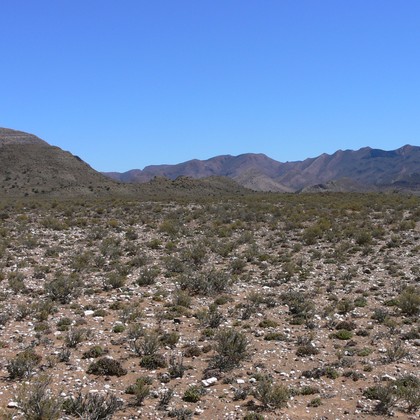
Karoo veld, dry shrubland on rocky slopes, dry watercourses with bushes, the edges of the Namib and the dry fynbos and renosterveld of the west, also around farmsteads and in gardens in dry villages. It eats seeds, buds, flowers and fruit, cracking hard seeds with its heavy bill. It drinks daily.
Where the bird is most at home, classified by the vegetation units of southern Africa.


Range and movements
Within the region in western South Africa (Northern Cape, the interior of the Western Cape, the west of the Eastern Cape and south-western Free State), western Lesotho, virtually all of Namibia except the north-east, the extreme south-west of Botswana and south-western Angola. Not found beyond: an endemic of south-western Africa.
- Resident
- Summer visitor (c. Oct–Mar)
- Winter visitor (c. Apr–Sep)
- Passage (Mar–Apr, Oct–Nov)
- dark = core range, pale = thinly spread
How and when to look
Search rocky slopes with bushes in the Karoo and Namibia, best at waterholes in the morning. Once known, the bird is recognised by its proportions: a canary with a bill like a small grosbeak. At close range the white throat is the best feature, in flight the yellow-green rump.
Conservation status
Not threatened. Common within its range and locally increasing around farmsteads and in village gardens.
Scientific name
Crithagra albogularis | Smith, 1833
Smith described the species in 1833 and placed it straight away in the genus where it still stands. The genus Crithagra was introduced in 1827 by Swainson. Crithagra comes from the Greek krithē, 'barley', and agra, 'hunting' — a 'barley hunter', for the seed-eating diet of these canaries and seedeaters. albogularis comes from the Latin albus, 'white', and gula, 'throat' — for the white throat. The specimen the first description was based on came from near Piketberg, Western Cape, South Africa.