All species › Waders, gulls and terns › Pratincoles and coursers › Three-Banded Courser
Three-Banded Courser | Rhinoptilus cinctus
Driebandrenvogel | Corredor Escamoso Grande
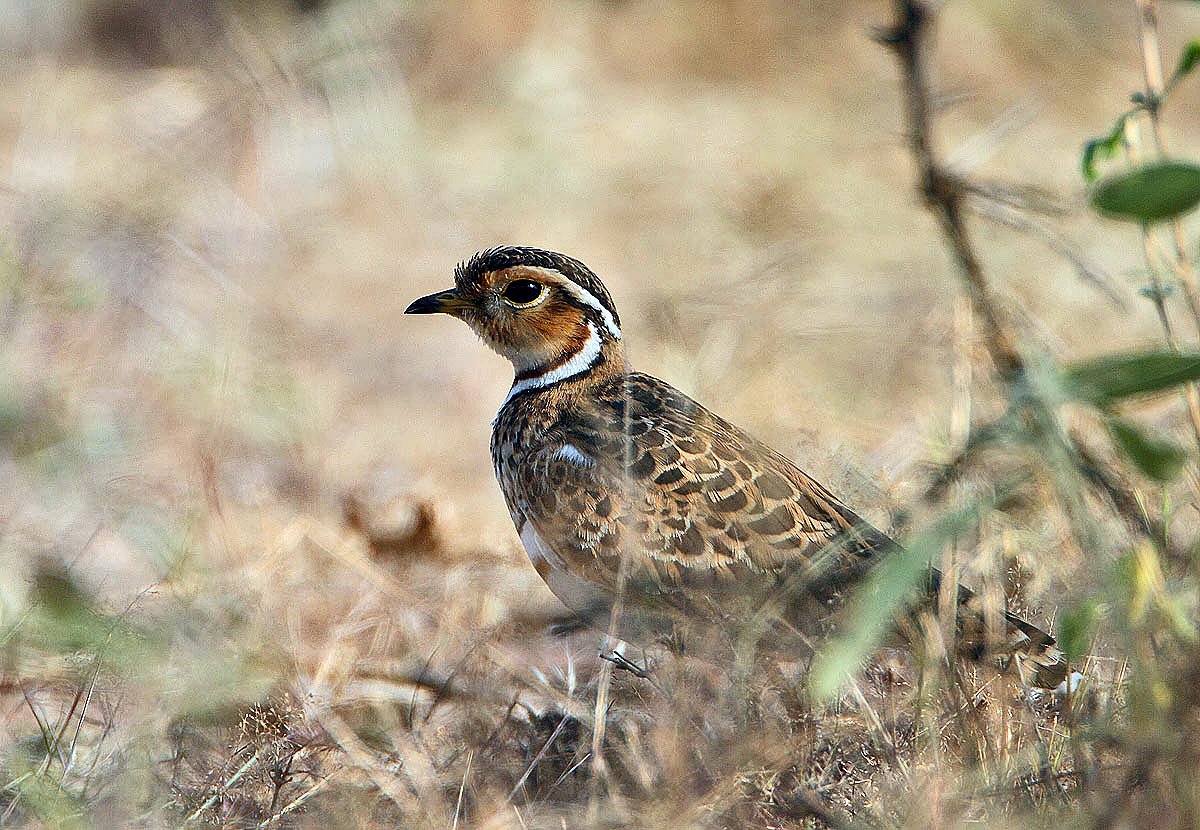
The Three-Banded Courser is a large, nocturnal courser of dry lowland woodland, with a large head, large eyes and an intricate pattern of bands on the neck and breast. Within South Africa it is a rarity of the far north of the Kruger National Park and one of the most sought-after night birds of the region.
Voice
Mainly at night a far-carrying, accelerating series, ka-ka-ka-ka-kaa-kaa, rising and then falling, and a soft kee-woo; silent by day.
Recording: Andrew Spencer — CC BY-NC-SA 4.0 · converted to mono · xeno-canto
Identification
25–28 cm. The upperparts are brown, scaled with dark centres and rufous fringes. The head is large, with a pale supercilium, a dark stripe behind the eye, a rufous patch on the ear coverts and a large dark eye. On the pale neck dark streaks form a V; below this comes a broad rufous breast band, bordered below by a narrow black band, and then a white belly. The bill is black with a yellow base, the legs yellowish. In flight it shows a white band across the uppertail coverts and dark flight feathers. The sexes are alike.
Confusion species
Bronze-Winged Courser Rhinoptilus chalcopterus is slightly larger and darker, with a plain grey-brown breast band, a white throat, a red eye-ring and red legs. Double-Banded Courser Smutsornis africanus is smaller, paler and more finely scaled, with two narrow black breast bands, and lives on bare plains in the dry west.
Habitat
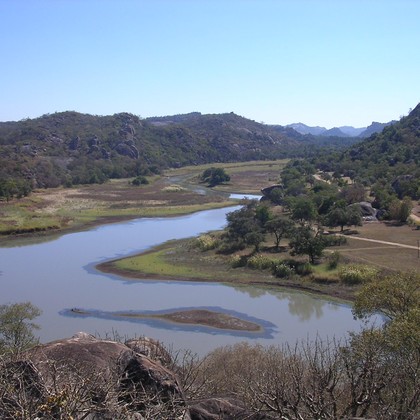
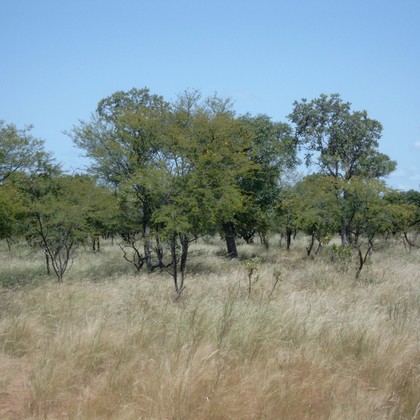
Dry lowland woodland, especially mopane and mixed woodland on sandy soils, with scattered bushes and open patches, also dense acacia bush and rough ground along dry riverbeds. By day it rests under a bush, sometimes partly buried in sand, and at night forages for insects. The nest is a scrape in which the two eggs are partly buried in sand.
Where the bird is most at home, classified by the vegetation units of southern Africa.

Range and movements
In the region mainly in the Zambezi, Luangwa and Limpopo valleys: eastern Zambia, Zimbabwe (Zambezi Valley and the south-eastern lowveld), Mozambique, northern Botswana, north-eastern Namibia (Zambezi Region) and southern Angola. In South Africa rare and confined to the far north of the Kruger National Park and the Limpopo Valley. Beyond the region in East Africa, from South Sudan, Ethiopia and Somalia to Kenya and Tanzania.
- Resident
- Summer visitor (c. Oct–Mar)
- Winter visitor (c. Apr–Sep)
- Passage (Mar–Apr, Oct–Nov)
- dark = core range, pale = thinly spread
How and when to look
Join a night drive in the north of the Kruger National Park (around Pafuri or Punda Maria), or search in the Zambezi Valley or the Zimbabwe lowveld, ideally in the dry season. Listen after sunset for the accelerating call series and scan road verges with a spotlight. By day it can sometimes be found under mopane bushes, thanks to its very still posture.
Conservation status
Not globally threatened, but poorly known in the region and scarce in South Africa, where it is confined to a small area. Loss of woodland to agriculture and disturbance along roads are local threats.
Scientific name
Rhinoptilus cinctus | (Heuglin, 1863)
Heuglin described the species in 1863 as Hemerodromus cinctus; because it was later moved to another genus, the author and year stand in brackets. The genus Rhinoptilus was introduced in 1852 by Strickland. Rhinoptilus comes from the Greek rhis (genitive rhinos), 'nostrils', and ptilon, 'feather' — according to Strickland (1852) for the forward-reaching frontal feathers. cinctus is Latin for 'girdled' — for the bands across the neck and breast. The specimen the first description was based on came from near Gondokoro on the White Nile, South Sudan.