All species › Waders, gulls and terns › Pratincoles and coursers › Double-Banded Courser
Double-Banded Courser | Smutsornis africanus
Dubbelbandrenvogel | Corredor Escamoso Chico
The Double-Banded Courser is a slender, long-legged courser of bare plains in the dry western half of the region, with a finely scaled sandy back and two narrow black bands across the breast. It is partly nocturnal but can also be seen by day, standing still or making short sprints over the gravel.

Voice
A thin, plaintive whistle, pee-wee or tee-wee-wee, mainly at night and at dusk; usually silent by day.
No recording with a suitable Creative Commons licence is available for this species yet.
Identification
20–24 cm, standing upright with a large head, large dark eyes and long whitish legs. The upperparts are pale sandy, each feather with a dark centre and a pale fringe, giving a finely scaled pattern. The head is pale with a finely streaked crown and a creamy supercilium; the throat and neck are light buff and finely streaked, and two narrow black bands encircle the lower neck and upper breast. The belly is white and the short bill black. In flight the rufous secondaries and inner primaries are conspicuous. The sexes are alike; juveniles are duller, with fainter bands.
Confusion species
Three-Banded Courser Rhinoptilus cinctus is larger, with a dark eye stripe, a streaked V on the neck and a rufous and black breast band, and lives in woodland. Burchell's Courser Cursorius rufus and Temminck's Courser Cursorius temminckii have an unscaled, plain brown back, a black-and-white stripe behind the eye and a dark belly patch or bar instead of two breast bands.
Habitat
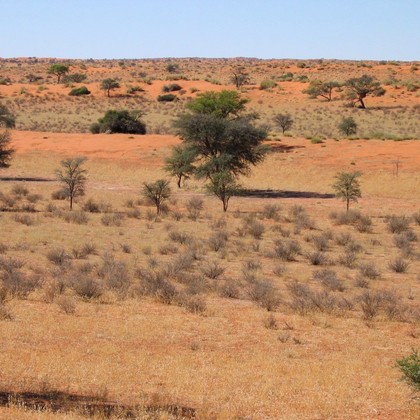
Bare gravel plains, stony and sandy flats with scattered low shrubs, short grass in dry savanna and the edges of salt pans. It avoids dense vegetation. It eats mainly ants, termites and beetles, caught with a short sprint and a quick peck. The single egg is laid on bare ground, often among stones or antelope droppings, where it is well camouflaged.
Where the bird is most at home, classified by the vegetation units of southern Africa.


Range and movements
The dry west and centre of the region: almost all of Namibia (including the Namib and the inland plains), south-western Angola, most of Botswana and in South Africa the Northern Cape, the Karoo (into the interior of the Western and Eastern Cape), the western Free State and North West. Absent from the moist east. Beyond the region a separate population in East Africa, from Ethiopia and Somalia to Kenya and Tanzania.
- Resident
- Summer visitor (c. Oct–Mar)
- Winter visitor (c. Apr–Sep)
- Passage (Mar–Apr, Oct–Nov)
- dark = core range, pale = thinly spread
How and when to look
Drive slowly along gravel roads through the Karoo, the Kalahari or the inland plains of Namibia and scan the bare ground; despite the scaly pattern a motionless bird is inconspicuous. Often you notice it only when it runs off. At dusk it sometimes comes onto the road; listen in the evening for the thin whistle.
Conservation status
Not threatened and locally fairly common in the dry west of the region. Numbers fluctuate with rainfall; overgrazing has little effect, but bush encroachment makes ground unsuitable.
Scientific name
Smutsornis africanus | (Temminck, 1807) (GBIF: Rhinoptilus africanus)
Temminck described the species in 1807 as Cursorius africanus; because it was later moved to another genus, the author and year stand in brackets. The genus Smutsornis was introduced in 1922 by Roberts. Smutsornis honours the South African statesman Jan Christiaan Smuts (1870–1950), combined with the Greek ornis, 'bird'. africanus means 'African', for its range in eastern and southern Africa. The specimen the first description was based on came from Namaqualand.