All species › Waders, gulls and terns › Oystercatchers › African Oystercatcher
African Oystercatcher | Haematopus moquini
Afrikaanse zwarte scholekster | Ostrero Negro Africano
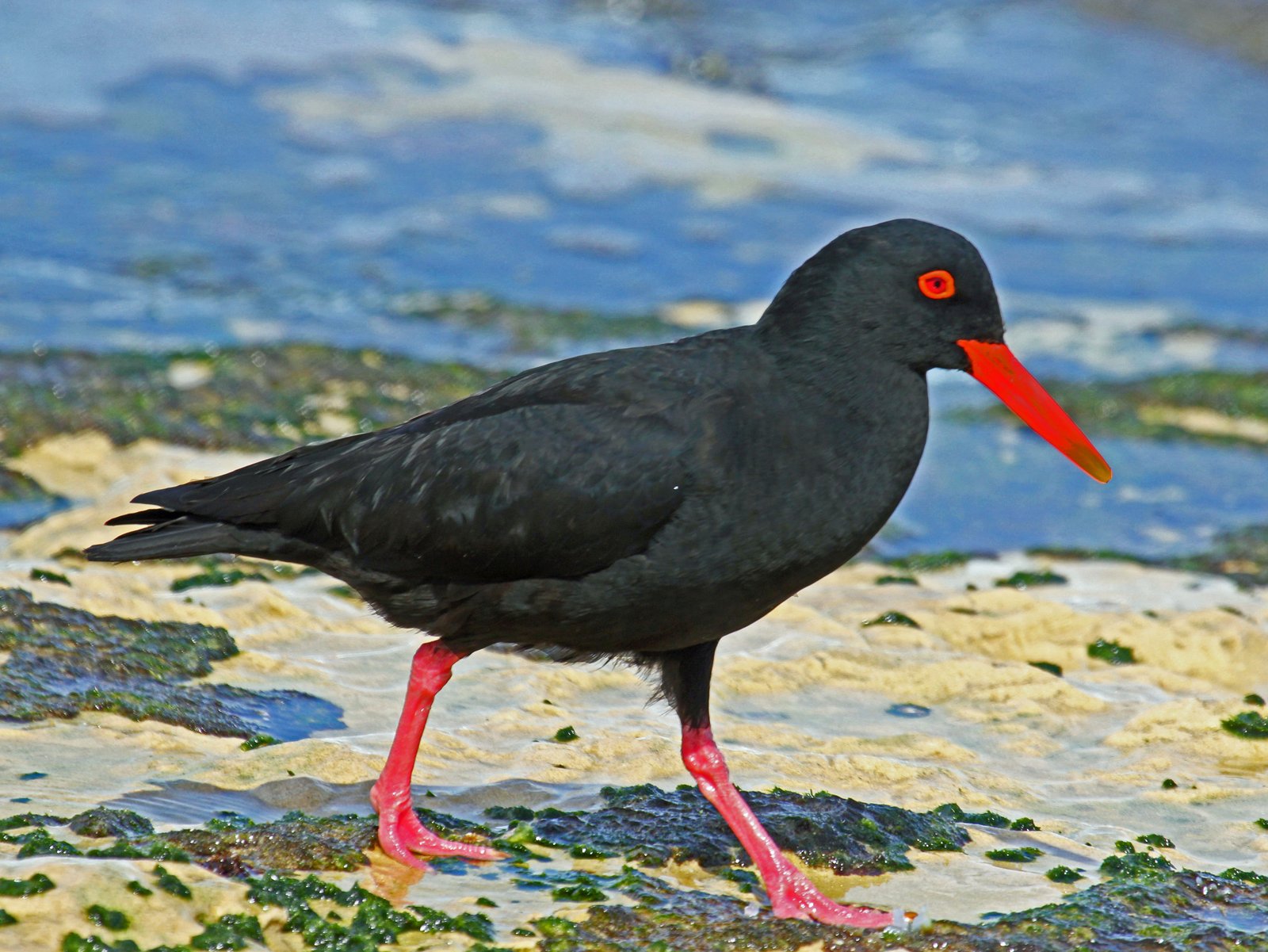
The African Oystercatcher is an all-black coastal bird with a bright red bill, a red eye-ring and pink legs, and occurs only along the coasts of Namibia and South Africa. Pairs hold the same stretch of rocky shore or beach year after year and are impossible to miss there with their high calls.
Voice
A loud, high, whistled klee-eep or kleep, repeated rapidly in alarm. Pairs call in duet with a fast, excited series kleep-kleep-kleep, head bowed and bill pointed down; when the nest is disturbed, a sustained, piercing piping.
Recording: Walter Wallner — CC BY-NC-SA 4.0 · shortened to the first 60 s, mono · xeno-canto
Identification
42–45 cm. Adults are uniform glossy black, with no white at all in wing or tail. The bill is long, straight, laterally compressed and orange-red, slightly paler at the tip; the eye is red with an orange-red eye-ring. The legs are short, thick and dull pink. The female averages a distinctly longer bill. Juveniles are brownish black with pale feather edges, a duller bill with a dark tip and greyish legs; full colour is reached only after about three years.
Confusion species
Eurasian Oystercatcher Haematopus ostralegus, a rare visitor to the coast, is unmistakably black and white with a white belly, a white wing bar and a white rump. At a distance a black bird on the rocks might also be a cormorant or a young Kelp Gull Larus dominicanus, but neither has the red bill and the stocky oystercatcher build.
Habitat
Rocky shores, sandy beaches, estuaries and coastal lagoons, and the rocky offshore islands. It forages in the intertidal zone on mussels, limpets, worms and crustaceans; mussels are prised or hammered open. The nest is a shallow scrape above the high-water mark, on an island, a beach or among dunes, often lined with shell fragments or pebbles.
Where the bird is most at home, classified by the vegetation units of southern Africa.

Range and movements
An endemic breeder of Namibia and South Africa: along the coast from about Lüderitz south via the West Coast and the Cape Peninsula to the Eastern Cape at Mazeppa Bay. The largest numbers breed on the islands of the Western Cape and in Algoa Bay. Non-breeding and young birds wander north beyond Walvis Bay and rarely into southern Angola, and east into KwaZulu-Natal and rarely southern Mozambique.
- Resident
- Summer visitor (c. Oct–Mar)
- Passage (Mar–Apr, Oct–Nov)
- dark = core range, pale = thinly spread
How and when to look
On almost any rocky shore between Lüderitz and East London, best at low tide when the mussel beds are exposed. Good places are the Cape Peninsula, the West Coast around Langebaan and the Garden Route. The breeding season runs from November to April, in the middle of the beach season: keep away from pairs walking around you calling, because nest and chicks lie inconspicuously in the sand.
Conservation status
Not threatened since 2017, previously Near Threatened. The population numbers over 6,000 adults and has increased. This growth is linked to the ban on off-road vehicles on South African beaches since 2001 and to the introduced Mediterranean mussel, which provides an additional food source. Disturbance by beachgoers and dogs, predation by Kelp Gulls and oil pollution remain threats to breeding success.
Scientific name
Haematopus moquini | Bonaparte, 1856
Bonaparte described the species in 1856 and placed it straight away in the genus where it still stands. The genus Haematopus was introduced in 1758 by Linnaeus. Haematopus is Greek, from haima 'blood' and pous 'foot', after the red legs. moquini honours the French naturalist Alfred Moquin-Tandon (1804–1863). The specimen the first description was based on came from Africa (not further specified).