All species › Waders, gulls and terns › Oystercatchers › Eurasian Oystercatcher
Eurasian Oystercatcher | Haematopus ostralegus
Scholekster | Ostrero Euroasiático
The Eurasian Oystercatcher is the familiar pied oystercatcher of European coasts and a rare but almost annual visitor to southern Africa. Most records involve single birds that join African Oystercatchers or keep to estuaries and lagoons.
Voice
A loud, high kleep or ke-peep, often in flight; the alarm is a fast, hard kip-kip-kip. On the non-breeding grounds single birds call little, often only when flushed.
Recording: Stanislas Wroza — CC BY-NC-SA 4.0 · converted to mono · xeno-canto
Identification
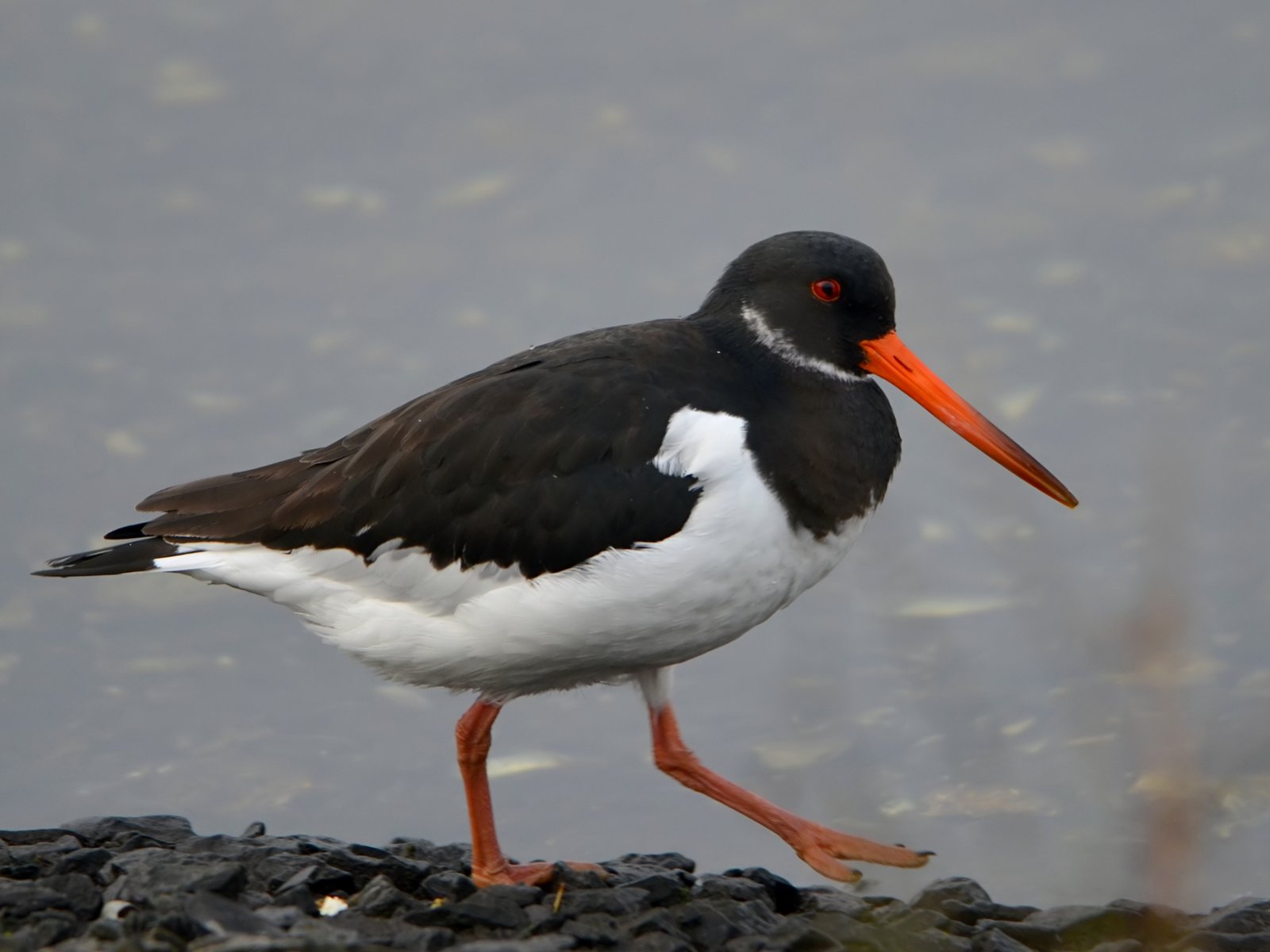
40–45 cm. Head, breast and upperparts are black, the belly white. In flight a broad white wing bar and a white rump and lower back stand out, ending in a black tail band. The bill is long, straight and orange-red, the eye red with an orange eye-ring, and the legs are dull pink. In southern Africa almost all birds are in non-breeding plumage or immature: these have a white throat band, a duller bill with a dark tip and greyish legs.
Confusion species
African Oystercatcher Haematopus moquini is entirely black, with no white belly, wing bar or rump, and has a heavier bill. In mixed groups the Eurasian Oystercatcher stands out even at rest by its white flanks; in flight the difference is unmistakable.
Habitat
Estuaries, tidal lagoons, sandy beaches and rocky shores, rarely saltmarsh or coastal lakes a little inland. It forages on mudflats and in the intertidal zone for shellfish, worms and crabs, together with African Oystercatchers or among other waders.
Where the bird is most at home, classified by the vegetation units of southern Africa.


Range and movements
A rare visitor to the region, mainly along the coast of Namibia (Walvis Bay and Sandwich Harbour), the South African West Coast, KwaZulu-Natal and Mozambique; almost unknown inland. It breeds in Europe and western and central Asia and winters mainly along the coasts of western Europe and West Africa, and to a lesser extent along the East African coast south to Mozambique.
- Resident
- Summer visitor (c. Oct–Mar)
- Passage (Mar–Apr, Oct–Nov)
- dark = core range, pale = thinly spread
How and when to look
Search the estuaries and lagoons of the west coast between September and April, with Walvis Bay the most reliable site, or river mouths in KwaZulu-Natal and Mozambique. Check every group of African Oystercatchers for a bird with white flanks, and look at flying birds for the white wing bar.
Conservation status
Near Threatened globally; populations in Europe, especially in the Wadden Sea, have declined steeply through overfishing of shellfish, loss of breeding habitat and flooding of nests. In southern Africa it is always a matter of a few birds, so the region carries little weight for the species as a whole.
Scientific name
Haematopus ostralegus | Linnaeus, 1758
Linnaeus described the species in 1758 and placed it straight away in the genus where it still stands. He introduced the genus Haematopus in that same work. Haematopus is Greek, from haima 'blood' and pous 'foot', after the red legs. ostralegus is Latin, from ostrea 'oyster' and legere 'to gather'. The specimen the first description was based on came from Öland, Sweden.