All species › Waders, gulls and terns › Gulls and terns › Whiskered Tern
Whiskered Tern | Chlidonias hybrida
Witwangstern | Fumarel Cariblanco
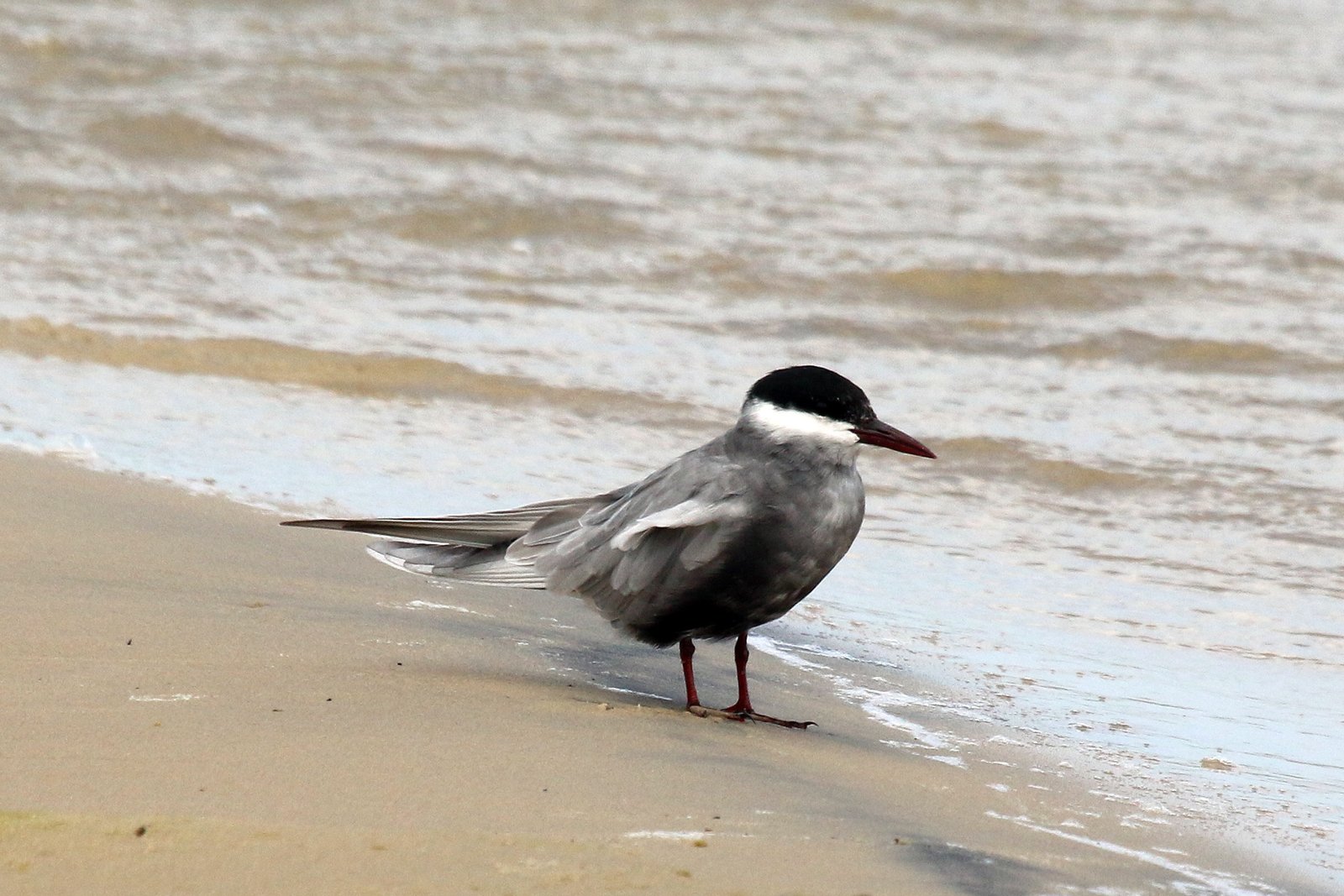
The Whiskered Tern is the largest and most heavily built of the marsh terns and the only one that breeds in the region. In breeding plumage, with its black cap, white cheeks and dark grey belly, it is unmistakable; in non-breeding plumage separation from White-Winged Tern needs more care.
Voice
A hoarse, rasping krsheck or kerrsh, lower and fuller than in the other marsh terns. Persistent at colonies and swelling into a loud, grating chorus when disturbed.
Recording: Christian Kerihuel — CC BY-NC-SA 4.0 · converted to mono · xeno-canto
Identification
About 25 cm, with a relatively long, stout bill, fairly broad wings and a short, shallowly forked tail. In breeding plumage the bird has a black cap down to eye level, a sharply defined white cheek, a dark grey belly and breast darker than the back, white undertail coverts, and a deep red bill and legs. The upperparts, rump and tail are uniform pale grey. In non-breeding plumage the underparts are white, the bill black and the crown white with fine black streaks merging into a dark rear crown and a dark patch behind the eye. Juveniles have a brown and black scaled mantle that contrasts strongly with the grey wings.
Confusion species
White-Winged Tern Chlidonias leucopterus in non-breeding plumage is smaller, with a shorter, finer bill, a white rump contrasting with the grey back and tail, and an isolated dark ear patch that stands apart from the crown like a headphone. Black Tern Chlidonias niger has a dark patch on the breast sides and a darker back. Common Tern Sterna hirundo is larger, with a deeply forked tail, and plunge-dives rather than dipping.
Habitat
Freshwater marshes, pans, vleis, flooded grasslands, rice fields and the shallow margins of dams with floating or emergent vegetation. It flies low back and forth over the water and dips prey from the surface, such as insects, tadpoles and small fish; it sometimes makes short dives. It breeds colonially on floating nests of water plants, often among water lilies.
Where the bird is most at home, classified by the vegetation units of southern Africa.

Range and movements
Distributed throughout the region wherever suitable water occurs, with breeding colonies in the Free State, Gauteng, Mpumalanga and KwaZulu-Natal in South Africa, and in Zimbabwe, the Okavango in Botswana, northern Namibia, Zambia, Malawi, Mozambique and Angola; scarce in the arid western half. Beyond the region across much of sub-Saharan Africa, Madagascar, southern Europe, southern and eastern Asia and Australia.
- Resident
- Summer visitor (c. Oct–Mar)
- Winter visitor (c. Apr–Sep)
- Passage (Mar–Apr, Oct–Nov)
- dark = core range, pale = thinly spread
How and when to look
In summer after good rains, at flooded pans and vleis with floating vegetation on the Highveld, where colonies of dozens of pairs breed. With flocks of marsh terns, check bill length and rump: in Whiskered Tern the rump is grey, matching the back and tail.
Conservation status
Not threatened and widespread. It depends locally on temporary waters, so numbers fluctuate strongly with rainfall. Drainage of vleis and disturbance of colonies by recreation and livestock are local threats.
Scientific name
Chlidonias hybrida | (Pallas, 1811)
Pallas described the species in 1811 as Sterna hybrida; because it was later moved to another genus, the author and year stand in brackets. The genus Chlidonias was introduced in 1822 by Rafinesque. Chlidonias is from Ancient Greek khelidonios 'swallow-like', from khelidon 'swallow'. hybrida is Latin for 'hybrid': the describer took the bird for a cross between the white-winged tern and the common tern. The specimen the first description was based on came from the lower Volga, Russia.