All species › Tubenoses › Petrels and shearwaters › Tropical Shearwater
Tropical Shearwater | Puffinus bailloni
Baillons kleine pijlstormvogel | Pardela Tropical
The Tropical Shearwater is a small black-and-white shearwater of the tropical Indian Ocean that breeds on islands such as Réunion, Mauritius and the Seychelles. In southern Africa it is a rare visitor to the warm waters of the Mozambique Channel, where it is easily taken for Little Shearwater.
Voice
Silent at sea. At the breeding sites a plaintive, wailing kee-kee-koo-urr at night from burrows and in the air.
Recording: Alexander Schlatmann — CC BY-NC-SA 4.0 · converted to mono · xeno-canto
Identification
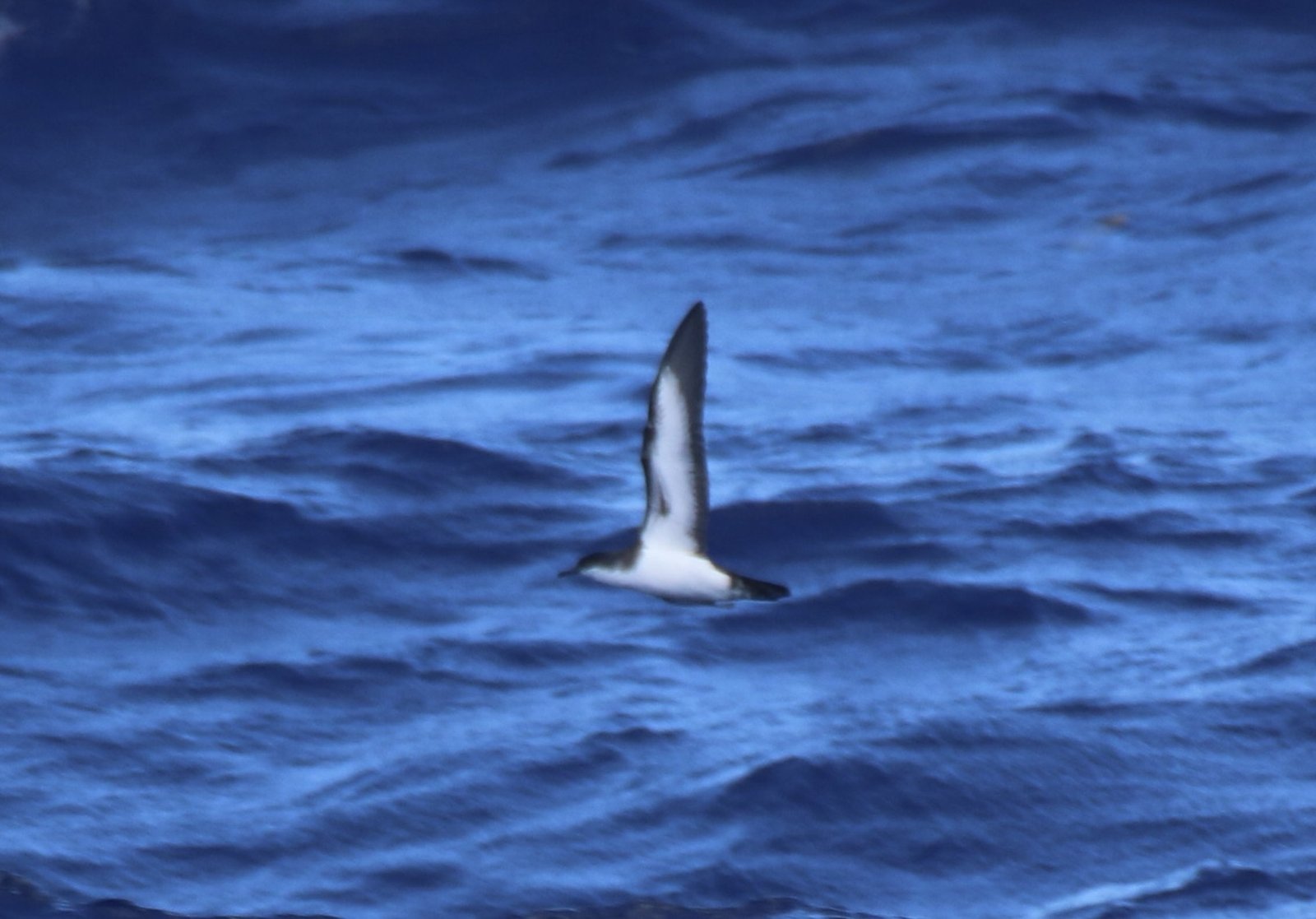
About 30 cm, a small, compact shearwater with short, broad wings and a fairly long tail. The upperparts are uniformly dark blackish brown, the underparts white. The dark cap extends below the eye, giving a dark-faced look. The underwing is white with a broad dark border, especially along the trailing edge and the tip. The undertail coverts are dark, an important feature in good views. The bill is slender and dark, the legs pink with a dark outer side. It flies low with bursts of quick, stiff wingbeats interspersed with short glides.
Confusion species
Little Shearwater (Puffinus assimilis) has a white face with the eye in the white, a cleaner white underwing and white undertail coverts; it occurs mainly in cooler water in the south and west. Manx Shearwater (Puffinus puffinus) is larger, with longer wings and a more shearing flight, and also has white undertail coverts. Sargasso Shearwater (Puffinus lherminieri) is an Atlantic species not to be expected in the region.
Habitat
Warm tropical ocean, often far offshore over deep water. It forages in small groups, often with terns and tuna, and dives after small fish and squid. It breeds in burrows and rock crevices on tropical islands.
Where the bird is most at home, classified by the vegetation units of southern Africa.
Range and movements
Within the region known only from a few records far off Mozambique and northern KwaZulu-Natal, in the warm water of the Mozambique Channel; possibly more regular than the sparse data suggest. It breeds on the Mascarenes, the Seychelles, the Comoros and other islands in the tropical Indian Ocean and disperses across the western Indian Ocean; depending on the taxonomy followed, also in the tropical Pacific.
How and when to look
The only realistic chance is a pelagic trip into warm water off southern Mozambique or out of Durban, mainly in the austral summer. Look for a small black-and-white shearwater with a dark face and dark undertail; photographs of the undertail and head are needed to rule out Little Shearwater.
Conservation status
Not threatened. On the breeding islands introduced rats and cats, light pollution that disorients fledglings and loss of nesting sites are the main threats. In southern Africa the species is too rare to assess.
Scientific name
Puffinus bailloni | (Bonaparte, 1857)
Bonaparte described the species in 1857 as Procellaria nugax a. bailloni; because it was later moved to another genus, the author and year stand in brackets. The genus Puffinus was introduced in 1760 by Brisson. Puffinus comes from English puffin and its variants, the name for the cured nestling of the shearwater, once a delicacy. bailloni honours the French naturalist Louis Antoine François Baillon (1778–1855) of Abbeville. The specimen the first description was based on came from Mauritius.