All species › Tubenoses › Petrels and shearwaters › Mediterranean Shearwater
Mediterranean Shearwater | Puffinus yelkouan
Yelkouanpijlstormvogel | Pardela Mediterránea
The Mediterranean Shearwater is a small brownish-black and white shearwater of the Mediterranean and Black Seas. In the broad sense used in this guide it also includes Balearic Shearwater (mauretanicus), which moves out into the Atlantic after breeding. In southern Africa it is an exceptional vagrant.

Voice
Silent at sea. At the colonies a hoarse, rasping croak and groan at night from rock crevices and caves.
Recording: Mathis Baudrin — CC BY-NC-SA 4.0 · shortened to the first 60 s, mono · xeno-canto
Identification
Small, 30 to 38 cm, with straight, pointed wings. The upperparts are dark brownish-black; in Yelkouan in the narrow sense they are fairly sharply separated from the white underparts, the cap merging gradually into the white throat. The undertail coverts and often the flanks are dark, and the underwing is white with broad dark margins and a dark axillary patch. The form mauretanicus is duller brown above and has dusky brownish underparts, some birds being almost wholly dark. The slender bill is dark and the legs pink with a dark outer side. It flies with fast, fluttering beats and short glides, less stiffly than Manx Shearwater.
Confusion species
Manx Shearwater (Puffinus puffinus) is blacker above, more sharply demarcated, and has white undertail coverts and a pure white underwing. Tropical Shearwater (Puffinus bailloni) is smaller, with a shorter bill and faster flight, but is very similar in plumage; in the Indian Ocean it is much more likely. Dark birds of the form mauretanicus can resemble a small Sooty Shearwater (Ardenna grisea) but lack the silvery underwing.
Habitat
Inshore seas, especially over the continental shelf where there are shoals of small fish such as anchovy and sardine. It dives from the surface and sometimes follows fishing boats. It breeds in caves, rock crevices and burrows on steep islands and cliffs.
Where the bird is most at home, classified by the vegetation units of southern Africa.
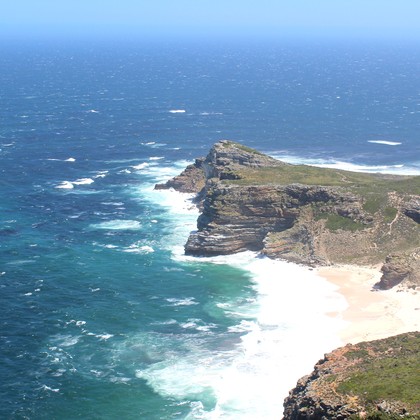
Range and movements
In the region only one or a few records off the South African west coast; any sighting should document the form carefully. Yelkouan in the narrow sense breeds in the central and eastern Mediterranean and forages into the Black Sea; Balearic Shearwater breeds on the Balearic Islands and after breeding moves to the Bay of Biscay, the English Channel and the North Sea, and south along Morocco to Senegal.
How and when to look
A small black-and-white shearwater off the Cape is almost always a Manx Shearwater. A bird with dark undertail coverts, browner upperparts or dusky flanks deserves close attention: photograph the upper- and underside and report the sighting to the rarities committee.
Conservation status
Vulnerable on the Red List. Balearic Shearwater on its own is regarded as Critically Endangered. Major threats are bycatch in longline and net fisheries, predation by rats and cats at the colonies, and disturbance and lighting at the breeding sites.
Scientific name
Puffinus yelkouan | (Acerbi, 1827)
Acerbi described the species in 1827 as Procellaria Yelkouan; because it was later moved to another genus, the author and year stand in brackets. The genus Puffinus was introduced in 1760 by Brisson. Puffinus comes from English puffin and its variants, the name for the cured nestling of the shearwater, once a delicacy. yelkouan is the Turkish name for this shearwater, roughly 'wind chaser'. The specimen the first description was based on came from the Bosphorus, Turkey.