All species › Passerines › Weavers › Vieillot's Black Weaver
Vieillot's Black Weaver | Ploceus nigerrimus
Fluweelwever | Tejedor de Vieillot
Vieillot's Black Weaver is a weaver of West and Central Africa that reaches the southern edge of its range in northern Angola. The male is wholly deep black with a striking yellow eye; the female is olive-green and streaked. It breeds in noisy colonies in trees and palms, often in villages and often together with the Village Weaver.

Voice
A harsh, rapid, grating chatter mixed with sizzling and scratchy notes, a chik-chik-zzzrrr. Males sing with quivering wings beneath the nest. The colony produces a continuous din audible from afar.
Recording: Bernard BOUSQUET — CC BY-NC-SA 4.0 · shortened to the first 60 s, mono · xeno-canto
Identification
15–17 cm; a robust weaver with a heavy, conical bill. The male is wholly black year-round with a slight gloss and no yellow or brown markings; the eye is bright yellow and the bill black. The female is olive-green to olive-brown above with dark streaking, yellowish olive on throat and breast and dull yellow to greyish on the belly, with a horn-coloured bill and a darker eye. Juveniles resemble the female. An all-black male with a yellow eye among the nests of a colony is characteristic.
Confusion species
Black Bishop (Euplectes gierowii) males have an orange-red nape and breast band and a dark eye, and live in tall grass rather than trees. Crested Malimbe (Malimbus malimbicus) and Red-Headed Malimbe (Malimbus rubricollis) are also black but show red on the head. Females resemble female Village Weavers (Ploceus cucullatus), which are yellower below with a paler, less olive breast; in mixed colonies the males help with identification.
Habitat
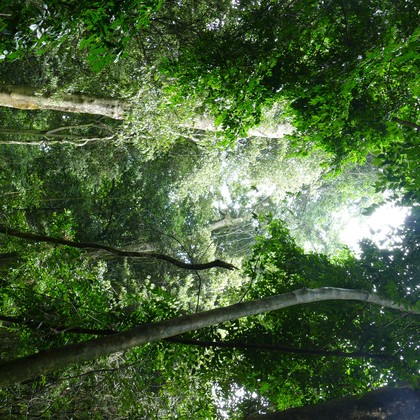
Edges of rainforest and gallery forest, clearings, secondary forest, oil-palm plantations, farmland and villages. It breeds in colonies, often in tall trees or palms near houses or over water, sometimes with hundreds of nests. It eats seeds, fruit and insects.
Where the bird is most at home, classified by the vegetation units of southern Africa.


Range and movements
Within the region only in northern Angola, from Cabinda and the Congo River into the northern interior; reports from the far north-west of Zambia are scarce. Beyond the region from Sierra Leone through the forest belt of West and Central Africa to Uganda and western Kenya.
- Resident
- dark = core range, pale = thinly spread
How and when to look
In villages and near riverine forest in northern Angola, look for tall trees or palms full of nests; Vieillot's Black Weaver often shares colonies with Village Weavers. The yellow eyes of the black males are easy to see when the birds hang singing below the nest.
Conservation status
Not threatened; common across much of its range and benefits from forest edges, palm plantations and settlements. It may locally damage crops.
Scientific name
Ploceus nigerrimus | Vieillot, 1819
Vieillot described the species in 1819 and placed it straight away in the genus where it still stands. The genus Ploceus was introduced in 1816 by Cuvier, GLCFD. Ploceus comes from the Greek plokeus, 'plaiter, weaver', for the tightly woven, ball-shaped nest that gives weavers their name. nigerrimus is Latin for 'jet-black', the superlative of niger, 'black' — for the entirely black male. The specimen the first description was based on came from former Kingdom of Kongo (not specified).